

Hyderabad/New Delhi, Dec 2: The inaugural international conference titled Human and Digital Mutualism: Code, Culture and Communication was hosted recently at Mahindra University’s campus in Hyderabad, and organised by the university’s School of Digital Media and Communication (SDMC) in association with the International Communication Association’s (ICA) India Chapter.
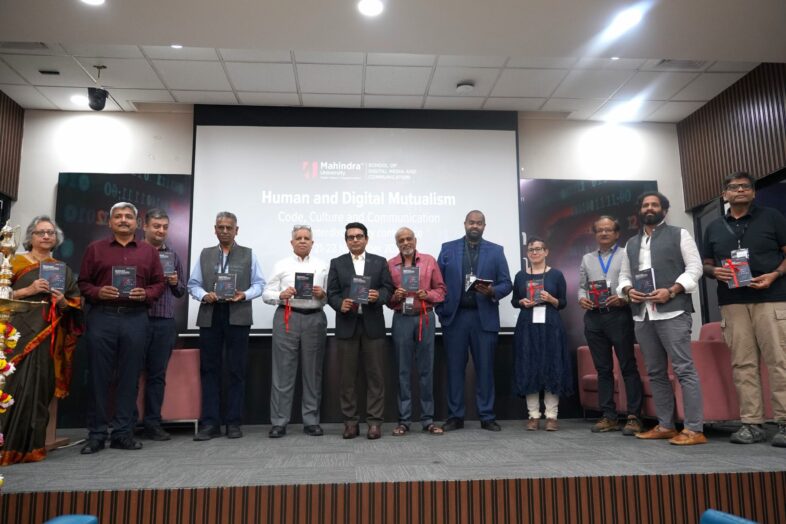
Across sessions, speakers converged on three key arguments: first, that academic and industry leaders must collectively ensure humans remain the key decision-makers in an automation-driven world; second, that understanding the stages of technological acceptance is crucial for responsible adoption; and third, that universities must recognise students as primary stakeholders as AI transforms pedagogy, assessment, and learning environments.
Dr Yajulu Medury, Vice Chancellor, Mahindra University opened the conference by underscoring the university’s commitment to interdisciplinary and future-forward education. He said, “Digital transformation is reshaping every discipline and universities must prepare students not only to understand technology but to question it, shape it, and lead responsibly through it. This conference embodies our belief that human values, ethics, and critical reasoning must anchor all technological progress.”
In his inaugural address, Dr Noshir Contractor, former ICA President and Northwestern University professor, mapped the evolving stages of technological acceptance, emphasising that societies must now move toward “collaborative intelligence” combining AI, AI experts, and domain experts.
Industry leaders from Google, IBM, LTIMindtree, CMU’s Entertainment Technology Center, and Gamitronics emphasised the need for transparency, governance, curiosity, and adaptability as AI increasingly shapes creative and operational workflows. Journalists and media scholars highlighted the need to treat AI not merely as a technological shift but as a profound social, ethical, and pedagogical transformation.
The academic panel of leading scholars from the University of Hyderabad, Symbiosis Institute of Media and Communication, Manipal Institute of Communication, and Mahindra University warned against curriculum obsolescence and call for competency-based, values-driven learning models that integrate AI openly and responsibly.
Explaining the purpose of the conference, conference chair Dr Shashidhar Nanjundaiah, Dean, SDMC, Mahindra University, observed that communication today is co-produced by humans, machines, and algorithmic systems. He said the conference was framed around critical inquiry surrounding our contemporary, tech-enabled societies. He remarked, “Mutualism calls for intentional design, where technology augments human agency rather than override it. This conference reflects SDMC’s mission to cultivate talent that can think critically, act ethically and innovate globally.”
ICA India head Dr Sanjay Bharthur, Senior Professor at Manipal Institute of Communication, added: “The conference positions the theme not as a closed idea but as an open conceptual horizon. It is not cast in any framework but acquires depth when viewed through these multiple frames, making the gathering both timely and intellectually generative.”
The conference also featured six plenary sessions led by experts from Carnegie Mellon University, Michigan State University, the University of Hartford, the Chinese University of Hong Kong, Jamia Millia Islamia, and the University of Illinois Urbana-Champaign, alongside six technical sessions where 21 papers and five documentary films were selected through a rigorous triple-peer review process from over 90 submissions.
A key outcome announced at the conference was the publication of an edited scholarly volume by Springer, co-edited by Dr Nanjundaiah and Dr Sundeep Muppidi, Professor of Digital Media & Communication, University of Hartford, USA. With its strong interdisciplinary focus and high-quality research contributions, the conference marked an important step in shaping equitable, ethical and culturally grounded digital futures.