

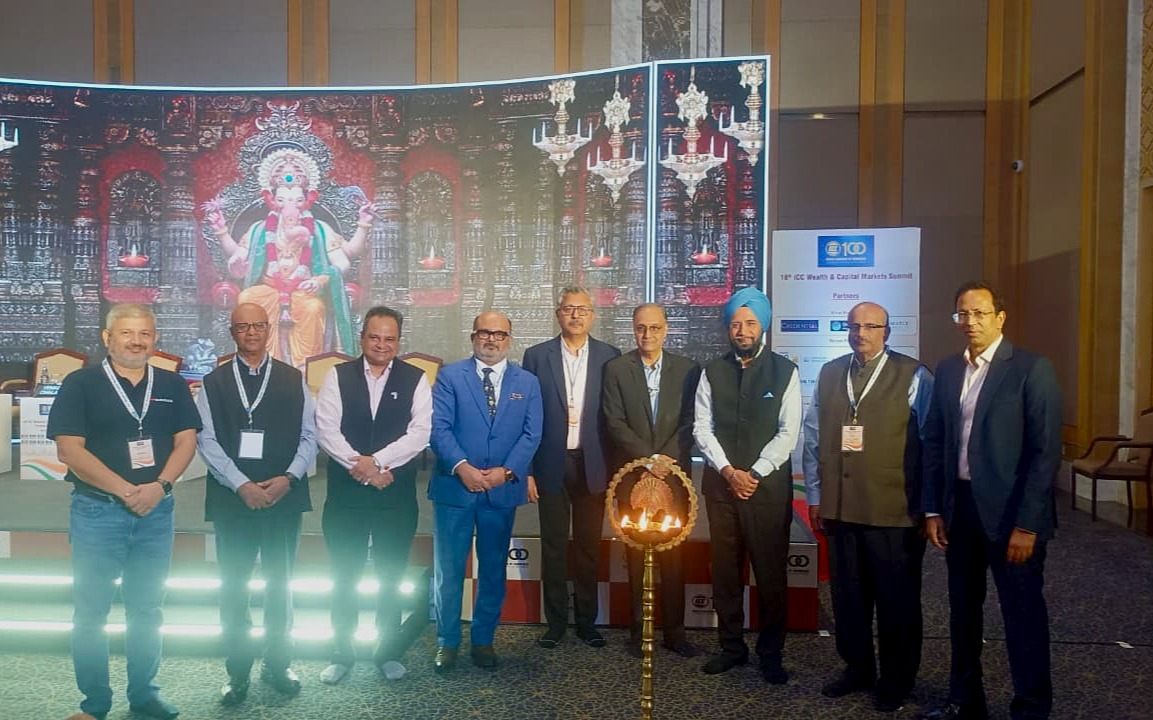
Kolkata 24 May 2026: The Indian Chamber of Commerce hosted the 18th ICC Wealth & Capital Markets Summit in Kolkata, bringing together eminent policymakers, regulators, industry leaders, and financial experts to deliberate on strategies for sustaining India’s economic growth trajectory towards an 8.2% GDP and the vision of a $7 trillion economy. The inaugural session featured addresses by Atanu Sen, Chairman – ICC National Expert Committee, BFSI, In the Boards of Tata & Bandhan Group of Companies, Former MD & CEO – SBI Life Insurance Company Ltd & Former Chairman – NPS Trust, PFRDA; Amarjeet Singh, Whole Time Member, Securities and Exchange Board of India (SEBI); Venkat N Chalasani, CEO, Association of Mutual Funds in India (AMFI); Sashi Krishnan, Director, National Institute of Securities Market (NISM) and Dr Rajeev Singh, Director General, Indian Chamber of Commerce.
Delivering the welcome address, Atanu Sen, Chairman – ICC National Expert Committee, BFSI, In the Boards of Tata & Bandhan Group of Companies, Former MD & CEO – SBI Life Insurance Company Ltd & Former Chairman – NPS Trust, PFRDA, highlighted the growing role of institutional capital, financial innovation, and regulatory alignment in strengthening India’s economic resilience and long-term stability. He said, “India today stands at the intersection of confidence and opportunity. The aspiration of sustaining an approximately 8% GDP growth trajectory is not merely a macroeconomic target; it represents a larger national ambition to build an economy that is investment-led, innovation-driven, financially inclusive, and globally competitive for Viksit Bharat by 2047. The wealth and capital markets ecosystem has emerged as one of the strongest pillars supporting India’s economic transformation. Over the last decade, we have witnessed a remarkable deepening of financial participation across the country — from the rapid expansion of retail investing and the SIP culture to the increasing sophistication of institutional capital and alternative investments. One of the central themes of this summit is the role of mutual funds and institutional capital as the bedrock of macroeconomic stability in a high-growth economy. As India scales, the quality and stability of domestic capital will become increasingly important. Strong domestic participation can cushion external shocks, improve market depth, and support long-term infrastructure and enterprise creation. Mutual funds and institutional investors together form a stabilizing force that strengthens investor confidence and economic continuity. Equally significant is India’s growing potential as an offshore financial and investment hub, capable of delivering global standards for both Indian and international investors. The establishment and maturity of GIFT City, fully integrated with best-in-class infrastructure, connectivity, technology, and legal framework, can become very significant as a global financial centre and help integrate India with the global financial community. As India charts its path towards becoming a multi-trillion-dollar economy, the role of wealth and capital markets will be central to sustaining momentum, building economic resilience, and shaping the future of India’s financial ecosystem in an era of accelerated growth,”
Shri Amarjeet Singh, Whole Time Member, Securities and Exchange Board of India (SEBI) added, “Capital market should not just be Western India-centric or Mumbai-centric. It should percolate down, and more people should be able to take benefit from the capital markets. The way capital markets have evolved, they present a tremendous opportunity for wealth creation. A larger and faster-growing economy will need long-term and patient capital for financing infrastructure, financing growth, financing innovation, financing urban transformation, and that is where efficient capital markets are key to the ambition of a seven-trillion-dollar economy going forward. Mutual funds, portfolio managers, and alternative investment funds are very important constituents of this ecosystem, and their role goes beyond simply managing money to responsible capital allocation and widening participation in market-linked wealth creation. Over the past decade, India has witnessed significant financialization, with household savings increasingly being channelled into capital markets. The rise of systematic investing is one of the strongest indicators of changing household behaviour. These numbers reflect financial discipline, long-term thinking, and the growing integration of capital market participation into everyday financial planning. Despite recent geopolitical headwinds, SIP flows have remained resilient, which reflects the growing trust in mutual funds as a reliable investment vehicle. To realize the ambition of becoming a seven-trillion-dollar economy, the fund management industry will have to grow further, both in scale and depth. The opportunity is to manage a larger pool of capital while making market participation more broad-based and accessible across geographies. Deep, efficient, and trusted capital markets, together with responsible financial intermediation, will be key to meeting India’s economic aspirations. The ultimate objective is not merely more products, more clients, or more transactions; it is better outcomes for investors, enterprises, and the economy,”
Speaking on this occasion, Shri Venkat N Chalasani, CEO, Association of Mutual Funds in India (AMFI) said, “India is expected to grow at a pace of around 7.6% despite all the headwinds that we are looking at, be it energy prices or global geopolitical tensions. But an aspiration to grow at 8.2% is the scale at which India would like to grow, and it is a national imperative. For this growth to happen, there is a need for us to look at household savings, which is extremely important. While physical assets continue to dominate household savings, within financial savings we are finding that people are moving from banking deposits and cash holdings towards growth assets like mutual funds, insurance, pension funds and provident funds. Since the launch of the ‘Mutual Fund Sahi Hai’ campaign in 2017, people’s perception has changed. Earlier, mutual funds were perceived as products only for HNIs or corporates, but today they have become a household product. Many people may not fully understand what mutual funds are, but they certainly understand what SIPs are. That is the way in which the product has become extremely popular. The industry’s assets under management have grown from around ₹14 lakh crore in 2017-18 to nearly ₹82 lakh crore today. However, we have only scratched the surface. Today, only around 18% of India’s GDP is in the form of assets under management, whereas in the developed world it is more than 100%, and the global average itself is around 65%. There is also a huge gap between awareness and action. While more than 65% of the population knows about mutual fund products, only around 7% are investing in them. Therefore, financial literacy and investor awareness remain extremely important. Trust and ethics are non-negotiable for the industry. We want to ensure that the person sitting in the corner of the country who is investing in mutual funds continues to trust the system. Transparency, investor awareness, financial literacy and responsible distribution will be critical as the industry grows further. The 8.2% GDP growth trajectory is not just going to be a dream; it is quite achievable. It represents jobs for our youth, infrastructure for our future, innovation for our industries, and a decisive step towards Viksit Bharat. The mutual fund industry is no longer at the periphery of this journey; it is a part of the core engine that is powering it,”
While concluding the session with a vote of thanks, Dr Rajeev Singh, Director General, Indian Chamber of Commerce said, “We had a very engaging conversation on what the government is doing and how it is steering the entire capital market while keeping it transparent, reliable, trust-based, and also keeping pace with the changing times. India has huge aspirations. The Prime Minister has set a very ambitious target of becoming a five-trillion-dollar economy and a developed country, and the money available in the country has to be channelled towards productive uses and the markets. At the same time, we have to keep investors’ interests in mind because if investors do not have trust and confidence, this entire exercise will only go up to a point. Trust is a very complex term, and there are a lot of issues which have to be addressed continuously because markets are constantly changing and geopolitical situations are evolving every day. Going ahead, things are going to become much more complex. Kolkata continues to keep pace with the capital markets. Investors here are quite well-informed, and discussions like these are important in taking the message to a larger audience. We are grateful to all our distinguished speakers and experts for bringing diverse perspectives on the future of wealth and capital markets in India,” said Dr Rajeev Singh.
The summit’s anchor session, “Steering India to a $7 Trillion Economy,” featured distinguished speakers including Anand Radhakrishnan, MD & CEO, Sundaram Mutual Fund; Avinash Satwalekar, President, Franklin Templeton Asset Management (India) Pvt. Ltd.; Aashish Somaiyaa, MD & CEO, White Oak AMC; Raghav Iyengar, CEO, 360 ONE AMC; and Varun Gupta, CEO, Groww Mutual Fund. The session was moderated by Anindya Paul Chaudhuri, Founder-WealthApp Family Office & Group CEO, WealthApp Group of Companies, and focused on the role of mutual funds and institutional capital in ensuring macroeconomic stability amidst global volatility and evolving trade dynamics.
The session on “The Global Gateway – GIFT City, International Diversification & AIFs” featured insights from Saurabh Bhatia, Investment Specialist and Head-Products, SBI Mutual Fund; Kulbhushan Singh, Head, Partner Relations (IFAs); Anindya Sengupta, Executive Vice President & Zonal Head-East, UTI Mutual Fund; Ankit Agarwal, Fund Manager for Equity Component, Motilal Oswal Asset Management Co. Ltd.; and Vijay Darak, Director, Credential Asset Management Pvt Ltd. Moderated by Atanu Sen, Chairman – ICC National Expert Committee, BFSI, In the Boards of Tata & Bandhan Group of Companies, Former MD & CEO – SBI Life Insurance Company Ltd & Former Chairman – NPS Trust, PFRDA, the discussion explored the emergence of GIFT City as India’s offshore financial hub and the increasing significance of alternative investments and global diversification strategies.
A key attraction of the summit was the fireside chat featuring Nilesh Shah, Managing Director, Kotak Mahindra Asset Management Co. Ltd., in conversation with Anindya Paul Chaudhuri, Founder-WealthApp Family Office & Group CEO, WealthApp Group of Companies, where they shared perspectives on market opportunities, investor confidence, and the future of wealth creation in India.
The session titled “The Alpha Edge – Wealth Management, Tech Innovation & Private Markets” featured panelists Rajesh Nambiar, Co Business Head, 360 One Wealth; Partha Sengupta, Joint Managing Director & CEO, Systematix Private Wealth; and Saibal Ghosh, Head- Investments & Wealth Solutions, HSBC Bank, India. Moderated by Soumyajit Ghosh, Founder, WealthApp Distributors Pvt Ltd, the session focused on AI-driven wealth solutions, cyber resilience, operational continuity, and emerging risks in the financial ecosystem.
Speaking on this occasion, Mr Nilesh Shah, Managing Director, Kotak Mahindra Asset Management Co. Ltd. said, “Every human being is emotional as well as rational, and unless there is an institutional check, people are likely to be driven more by emotions than rationality. At Kotak Mutual Fund, we have created boundaries within which fund managers have to operate, and if they operate within those boundaries, they are not blamed for factors outside their control. There is no substitute to financial education or literacy. Investors today are smart and well connected; our job is to keep the mirror in front of them. Whatever we did in mutual funds in terms of good regulation, good handling of customers, and good performance, we have to repeat on the asset allocation side. The credibility of the mutual fund industry has been built brick by brick. The first credit should go to the regulator for ensuring that we remain within boundaries, and the second credit should go to distributors who carried our message to investors and handled them especially during difficult times. Trust, discipline, culture, teamwork and keeping the client first are what create a winning combination in the long run. At the end of the day, it is the team which matters, not the captain.”
The summit concluded with an engaging “Gupp Shapp over Jhalmuri” session featuring Gayathri Parthasarathy, Advisor to Chairman, PwC India, and Vineet Malhotra, Co-Founder & CEO, Compoundexpress Private Limited, cultivating insightful conversations on the future of India’s wealth and capital markets landscape.