
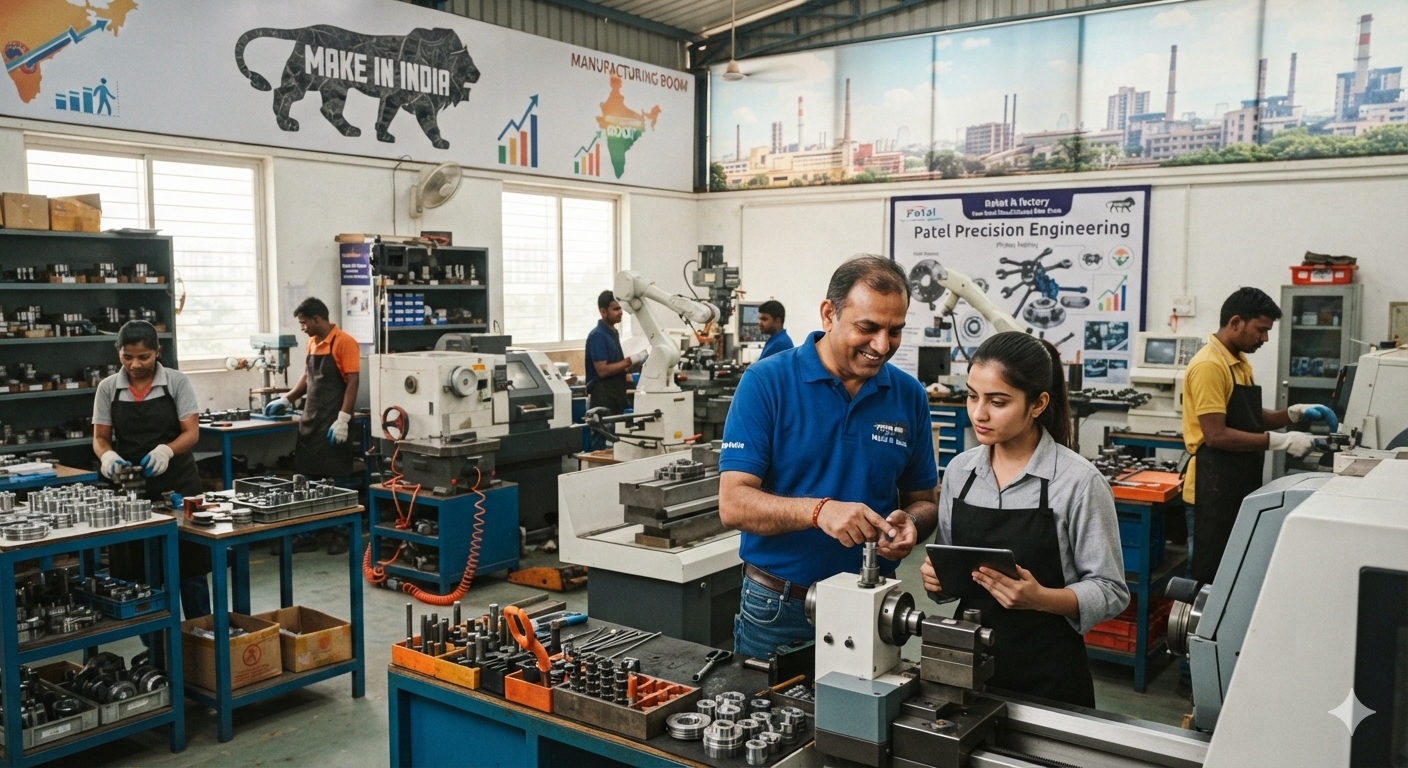
Oct 17: India’s manufacturing story is creating opportunities for businesses of all sizes. From electronics and automobiles to textiles, food processing and engineering, the country’s growing industrial capabilities are opening doors for companies that want to manufacture locally, develop new products and reach wider markets.
For small manufacturers, this presents an opportunity to become part of a much larger economic transformation. A local engineering unit can become a supplier to an established manufacturer. A food-processing business can expand its distribution network, while a packaging company can invest in better machinery to serve more customers.
The Make in India initiative has helped place domestic manufacturing, investment and job creation at the centre of India’s economic ambitions. Alongside this broader push, support for micro, small and medium enterprises (MSMEs) is helping businesses explore ways to improve production, access finance and strengthen their market presence.
The opportunity ahead is not simply to manufacture more products. It is to help small businesses become more productive, develop specialised capabilities and build sustainable operations that can compete in an increasingly demanding marketplace.
Small Manufacturers Are Powering India’s Industrial Growth
India’s manufacturing ecosystem depends on a wide network of enterprises. While large factories produce goods at scale, smaller businesses supply components, process materials, manufacture finished products and provide essential services to industrial customers.
According to the Economic Survey 2025–26, MSMEs account for approximately 35.4% of India’s manufacturing output, 48.58% of exports and 31.1% of GDP. The sector includes more than 7.47 crore enterprises employing over 32.82 crore people, according to figures reported by the Ministry of Finance.
These numbers highlight the importance of small businesses in India’s economic development. Their contribution extends beyond factory production to employment, regional entrepreneurship and the development of local supply chains.
As domestic manufacturing expands, MSMEs can explore opportunities in automotive components, electronics, industrial machinery, textiles, packaging, renewable energy equipment and other sectors.
For example, a small engineering business with the right technical capabilities could supply precision components to a larger manufacturer. A textile unit could explore specialised fabrics, while a food-processing enterprise could develop packaged products for retail and institutional buyers.
Such opportunities can help small manufacturers build a more diverse customer base and reduce their dependence on a single market.
Access to Finance Can Turn Business Potential into Expansion
For a small manufacturer, a new order can create an opportunity to grow. However, fulfilling that order may require additional raw materials, machinery, skilled employees and working capital.
Access to suitable finance can help businesses bridge this gap.
India has several financing and investment mechanisms intended to support eligible MSMEs. These include credit guarantee arrangements, bank lending and equity-oriented support for businesses with growth potential.
The Economic Survey 2025–26 reported that MSME credit was a key driver of industrial credit growth during the first half of FY2025–26. It also reported that the Self-Reliant India Fund had supported 682 MSMEs through investments worth ₹15,442 crore as of November 30, 2025.
For manufacturers looking to expand, these developments underline the growing importance of financing options beyond traditional business savings.
Business owners can prepare for expansion by maintaining clear financial records, estimating the working capital required for new orders and exploring suitable funding options through banks and relevant government programmes.
The objective is to make investment decisions that strengthen the business over time, whether that means upgrading a machine, increasing production capacity or entering a new market.
A Real-World Example: How Financial Support Helped a Manufacturer Expand
The experience of Rainbow Packaging Pvt. Ltd., a plastic packaging manufacturer based in Sarkhej, Ahmedabad, illustrates how access to growth capital can support industrial expansion.
In an August 2026 update, the Press Information Bureau reported that the company received ₹4.46 crore in financial assistance through the Venture Capital Fund for Scheduled Castes in 2015. The funding helped the business strengthen its production capabilities, improve product quality, recruit skilled professionals and fulfil larger orders. The expansion also generated direct and indirect employment opportunities.
The example demonstrates how financing can help a manufacturing business move from an existing customer base towards greater production capacity and stronger market reach.
It also highlights an important point for small manufacturers: growth often requires more than demand alone. Businesses need the resources and operational capabilities to convert new orders into lasting commercial opportunities.
Although every enterprise has different financing needs and eligibility requirements, this example shows how targeted support can contribute to business expansion and employment.
Technology Is Helping Small Manufacturers Improve Productivity
Technology adoption is becoming an important part of manufacturing competitiveness. Digital inventory systems, improved machinery, quality-control equipment and energy-efficient processes can help businesses manage operations more effectively.
For a small factory, the benefits can begin with relatively focused improvements. Better inventory tracking can reduce material shortages, while improved quality checks can help minimise rejected products. Upgrading a key machine may also improve production consistency and delivery schedules.
The Ministry of MSME’s Zero Defect Zero Effect (ZED) Certification Scheme encourages businesses to improve product quality and adopt more environmentally responsible manufacturing practices. The ministry’s 2025–26 annual report records more than 7.23 lakh MSME registrations under the scheme since its inception, as of December 31, 2025.
The MSME Competitive (LEAN) Scheme also supports enterprises seeking to improve efficiency and reduce waste through structured production practices.
For small manufacturers, these initiatives provide avenues to assess existing operations and identify improvements that can strengthen competitiveness.
The most effective approach is to prioritise upgrades that solve real business problems. Rather than investing in technology simply because it is new, manufacturers can focus on improvements that deliver measurable gains in productivity, quality, energy use or delivery performance.
Domestic Supply Chains Are Creating New Opportunities
One of the most promising aspects of India’s manufacturing ambitions is the opportunity to build stronger domestic supply chains.
Large manufacturers need a dependable network of suppliers for components, packaging, tools, fabricated products and specialised services. Smaller businesses that meet the required quality standards and delivery schedules can work towards becoming long-term suppliers.
Industries such as automobiles, electronics, renewable energy and industrial equipment offer potential opportunities for enterprises with suitable capabilities.
For a small manufacturer, entering these supply chains can create access to larger customers and more consistent demand. Working with established buyers may also help businesses understand technical specifications, improve production processes and strengthen quality management.
Manufacturers can explore supplier-registration programmes, procurement platforms, industry associations and industrial clusters to identify relevant opportunities.
The next step is to build a reputation for reliability. Consistent product quality, clear communication and timely delivery can help smaller suppliers strengthen customer relationships and compete for repeat business.
Over time, some enterprises may also develop specialised products or capabilities that allow them to serve additional industries.
Digital Platforms Can Help Small Businesses Reach New Markets
Manufacturing growth is not limited to traditional factory-to-factory sales. Digital platforms are creating additional ways for businesses to present their products, connect with buyers and explore markets beyond their immediate locations.
For manufacturers selling standardised products or suitable industrial supplies, online catalogues and business-to-business platforms can make product discovery easier. Businesses may also use digital tools to manage enquiries, track orders and communicate with customers.
The Ministry of MSME’s TEAM initiative is designed to help micro and small enterprises onboard e-commerce platforms, including through assistance with cataloguing, account management, logistics and packaging. The programme aims to support five lakh MSMEs, including 2.5 lakh women-owned enterprises, according to the ministry’s 2024–25 annual report.
For manufacturers, digital visibility can complement traditional sales channels. A well-presented product catalogue, clear technical specifications and responsive customer service can help potential buyers evaluate a supplier more easily.
Businesses should select platforms suited to their products and target customers, while accounting for listing requirements, logistics costs and the effort needed to manage online orders.
Skills and Infrastructure Can Support the Next Stage of Growth
Better machinery and production systems are most effective when employees have the skills to use them.
Training in machine operation, quality assurance, maintenance, digital tools and workplace safety can help manufacturers improve productivity and prepare for more demanding orders.
Infrastructure matters as well. Reliable electricity, efficient transport, warehousing and access to testing facilities can help businesses manage costs and maintain production schedules.
Industrial clusters and shared facilities can be especially useful for smaller enterprises that cannot independently invest in every piece of specialised equipment.
Collaboration between manufacturers, technical institutions, industry associations and training providers can help businesses identify the skills they need and prepare employees for changing production requirements.
For small manufacturers, these improvements can support more consistent operations, stronger customer relationships and greater readiness to enter new markets.
Practical Steps Small Manufacturers Can Take to Grow
The opportunities associated with Make in India become more useful when businesses connect them with clear growth plans.
-
Identify suitable markets: Explore industries and buyers whose requirements match existing production capabilities.
-
Strengthen product quality: Standardise processes, maintain quality records and invest in appropriate testing.
-
Review funding options: Compare eligible loans, credit guarantee facilities and other suitable sources of finance before committing to expansion.
-
Upgrade strategically: Prioritise machinery and digital tools that can improve productivity or reduce operating costs.
-
Explore supplier networks: Contact prospective buyers, investigate vendor-registration processes and participate in relevant industry events.
-
Use digital channels: Develop clear product catalogues and explore appropriate online marketplaces.
-
Invest in employees: Provide training that supports better production, quality and maintenance.
-
Plan for sustainable growth: Review cash flow, customer demand and production capacity before accepting significantly larger orders.
These steps can help manufacturers make informed decisions and build on opportunities emerging across India’s industrial landscape.
Make in India: A Growing Opportunity for Small Manufacturers
India’s manufacturing ambitions offer a promising pathway for smaller businesses to expand their capabilities, connect with new customers and contribute to the country’s industrial development.
The contribution of MSMEs to manufacturing output, exports and GDP demonstrates their importance to the wider economy. Financing support, quality-improvement programmes, digital market access and stronger supply chains can provide additional opportunities for businesses that are ready to invest in their next stage of growth.
For manufacturers, the focus should be on understanding market demand, improving operational efficiency and developing products that meet customer expectations.
The benefits of manufacturing growth can extend well beyond individual factories. When small businesses expand successfully, they can create employment, support local suppliers, develop workforce skills and contribute to economic activity in their regions.
The next chapter of Make in India will be shaped not only by the scale of the country’s largest factories, but also by the ability of smaller manufacturers to innovate, grow and compete. By combining business initiative with suitable finance, technology and market access, India can build a stronger manufacturing ecosystem in which enterprises of different sizes have more opportunities to succeed.
