

Amethyst presents an exhibition of Silver and Fashion Jewellery by Tribe Amrapali, Fleur Spring Summer 2026 collection by Sunira, Saritorial and Joining the Dots collection by Abraham and Thakore from 11am to 7.30pm from June 11th to 14th, 2026 at Amethyst, Whites Road, Royapettah, Chennai.
Please find the collection notes, images and price range for each collection below.
Tribe Amrapali
Tribe Amrapali is an enigma of traditional folklore in a young and vibrant embodiment. Budding out from the essence of the mother brand ‘Amrapali’, Tribe Amrapali creates contemporary and affordable designs cultivated out of experimental design philosophy, primarily focusing on silver, gold-plated silver and fashion jewellery.
Tribe is infused with vibrant and dramatic energies, enriched with the allure of rich tribal life and folklore. Acting as an authentic extension of India’s artistic and cultural roots, Tribe emits Indian modernity.
Interwoven with symbolic and diverse identities, Tribe comes from a rich, rustic world. The brand reveals a story like of a local myth, which is dynamic and diverse.
Tribal life is richly embellished in art and by jewellery alike. Acting as an intrinsic part of tribal culture – both expressions are heavily interlocked with celebrating powerful and deep symbols. The notion of Anima or the “the cosmic vital force” of life is honoured in Tribal art through rich, layered animal symbolism.
The identity for Tribe Amrapali speaks to a youthful and modern customer; someone who has an instant connection to cultivating tribal culture in new ways. Tribe Amrapali is composed of jewellery which is eclectic yet heritage.
Sunira Fleur – Spring Summer 2026
In this collection, we explore the relationship between structure and flow—where something begins to take form.
Creation doesn’t happen in isolation. At times it is instinctive, at others more considered—but it is almost always guided, consciously or subconsciously, by an underlying structure. At SUNIRA, this structure comes from our process and ethos. We begin with traditional crafts and techniques. These act as frameworks—holding knowledge, skill, and a way of making. Alongside this, our design philosophies shape direction. Yet within these frameworks, there is always room for movement. As we create, the process begins to flow—allowing ideas to evolve naturally. It is this flow that allows tradition to move forward. Craft, for us, is not fixed or static. It continues to shift and grow, while still holding on to its essence. Each collection emerges from this dialogue between framework and flow. For this season, we began with familiar structures—hand block printing and the light, effortless language of SUNIRA summers. What emerges feels softer, freer, and more fluid. Silhouettes remain rooted in ease: phirans, kurtas, dresses, and versatile separates that move seamlessly from morning into evening—comfortable, familiar, and fluid. Within these forms, detail becomes the narrative. Delicate contrasting picot and beaded scallop edges trace the garments, while hems carry embroidered roses in contrasting resham with fine leaf work. Recycled organza florals add soft dimension, finished with precise scalloped picot edging—an etching that brings quiet richness to fluid forms.
Beyond the garment, this dialogue continues. A loom holds threads in place yet creates movement; scaffolding defines space yet allows form to emerge. The campaign reflects this—set within a construction site where structure is at its most raw. Against it, the garments introduce softness through colour and movement, revealing how each gives meaning to the other. At its core, FLEUR is a study in balance—where structure and flow come together to create something alive.
Abraham and Thakore
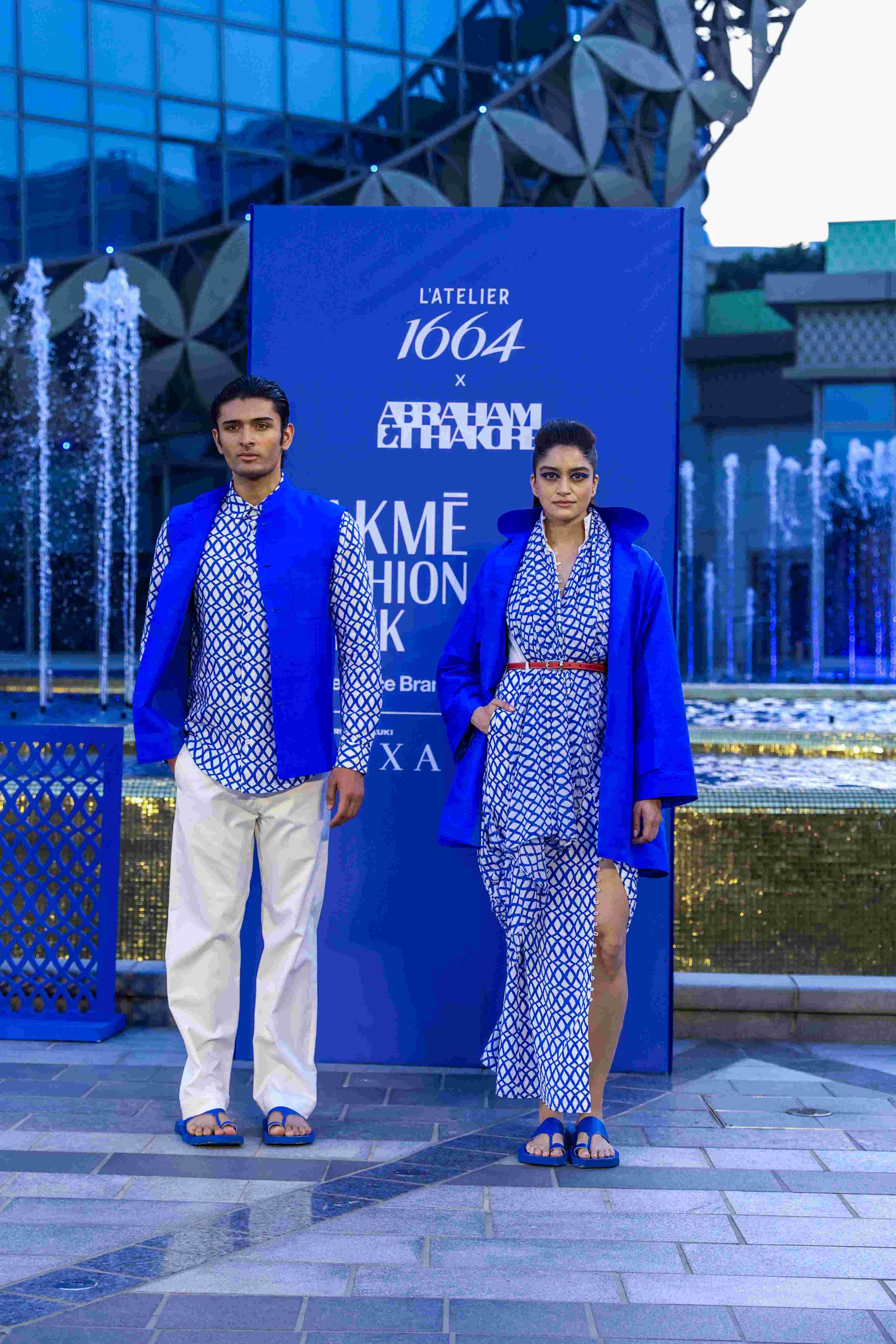
L’Atelier 1664 x Abraham & Thakore presents The ‘Sari’torial
The collaboration between L’Atelier 1664 & A&T is a synergy between the two brands. L’Atelier 1664’s design philosophy of being inspired by history & tradition, yet modern and elegant, echoes with A&T’s belief in using Indian craft and silhouettes in a new vocabulary.
Contemporary French culture meets Indian heritage in this collaboration where juxtapositions are rife, where West meets the East, the old and the new, the daring with the understated, the laidback with the refined and the elegant with the witty surprise – to create clothes that elevate an occasion.
A&T’s byline of clothes that are for “all the days you’re not getting married” reflects in a collection where stitched and unstitched, male and female, structure and drape combine for a collection of stylish everyday wear but with a twist.
Titled “Sari-to-rial”—a play on Sartorial—the collection combines French flair with Indian sensibility: tailored dressing that is also easy to wear.
Patterns take a cue from the L’Atelier 1664 Cocarde design inspired from the Eiffel Tower—a leitmotif that is interpreted in wood block print, hand embroidery, and tie-dye. The color palette of white & black is offset with L’Atelier signature blue and a hint of gold. Crafted in handwoven fabrics, luxe silk and handspun cotton, ‘Sari’torial proposes elevated dressing reinterpreted through a modern lens.
Joining the Dots explores the act of seeing patterns where none were apparent before. It begins with the dot, which becomes a dash, the dash becomes a line, and the line gradually resolves into motifs and florals.
This transformation unfolds across surfaces and structures. The dot appears and recedes, shifts in scale and density, and moves between suggestion and clarity. Technique becomes the language of this evolution. The dot is interpreted through embroidery, translated into ikat, reimagined in cutwork, and expressed across varied techniques and sizes.
The collection reflects relationships central to A&T. Design and commerce, art and practicality, masculine and feminine, control and fluidity exist in balance, echoing the principles of yin and yang.
Textiles and techniques from across India are brought into dialogue. Ikat from Telangana meets tie and dye from Jaipur. Silk cotton cutwork from Varanasi sits alongside dhoti borders from Kerala, while woven stripes from Andhra introduces geometric element. Jaali techniques from Pune and Ottoman inspired motifs reference historic trade routes, tracing the movement of materials, skills, and ideas across regions.
The colour palette centres around ivory, blue, black, and beige, allowing texture and surface detail to take precedence and creating continuity across the collection.
New dress forms, fluid tops, bottoms, and coordinated sets are developed for both women and men. Jackets, shirts, pants, shackets, and linen jackets explore proportion and layering, balancing softness with structure and versatility with clarity.
Joining the Dots is ultimately about connection. Between techniques and geographies, form and function, the individual mark and the larger pattern. A collection that finds coherence in continuity, and meaning in the coming together of many parts.
We look forward to receiving a confirmation of your presence and coordinating any requests you may have in this respect.