

The new luxury traveller isn’t necessarily looking for a bigger suite. Increasingly, they are looking for fewer people around them.
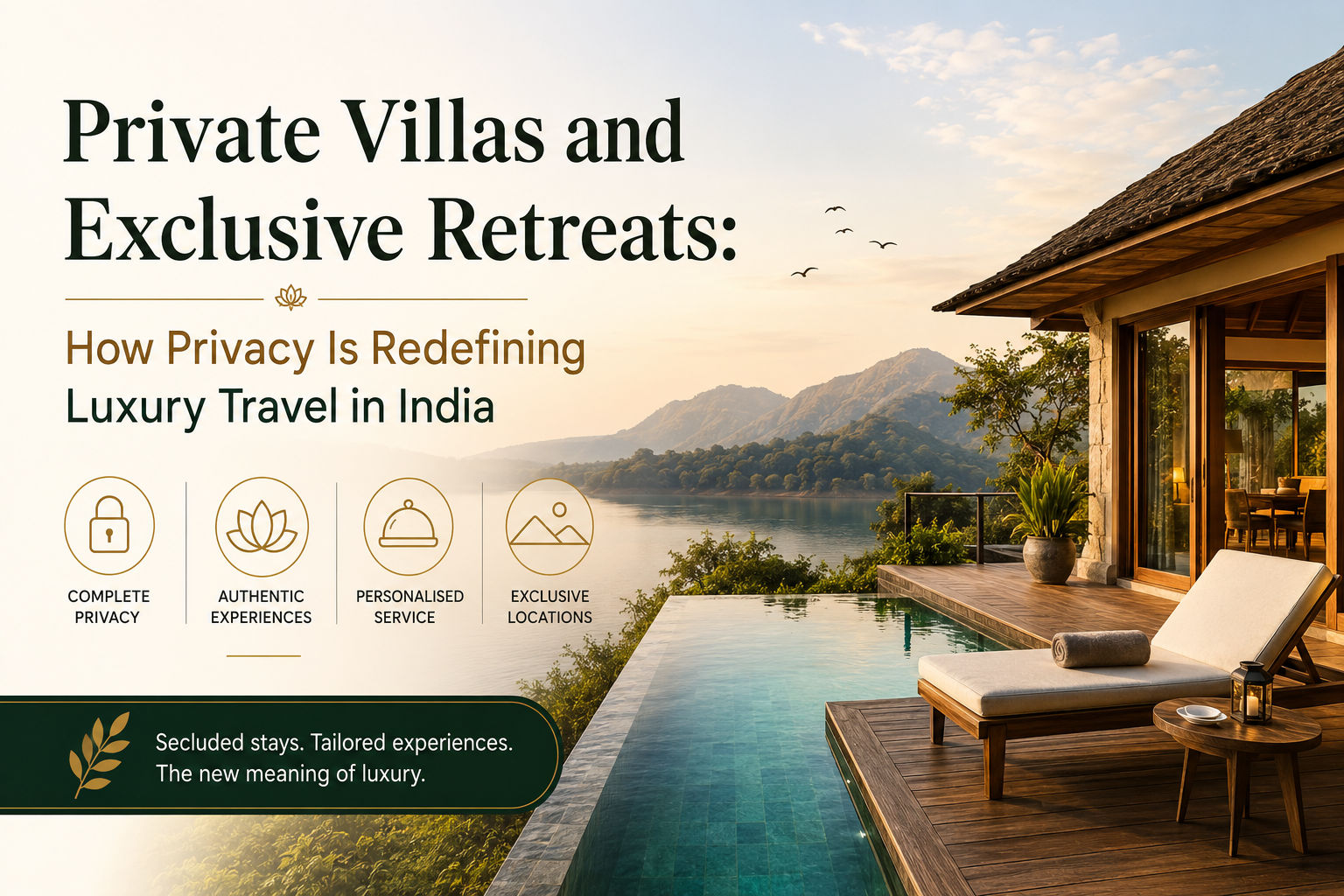
Sept 05: Across India’s evolving travel landscape, privacy is becoming one of the most sought-after forms of luxury. Private villas, secluded estates and exclusive retreats are offering travellers something conventional hotels cannot always provide: the freedom to experience a destination without crowds, fixed schedules or shared spaces.
From a private villa overlooking the Goan coast to a heritage retreat in Rajasthan or a secluded mountain property in Himachal Pradesh, the idea of luxury is moving towards space, personalisation and experiences that feel uniquely one’s own.
India’s Travel Economy Is Creating Room for Premium Experiences
The shift is taking place against the backdrop of a rapidly expanding tourism economy.
According to the World Travel & Tourism Council’s (WTTC) latest Economic Impact Research, Travel & Tourism contributed US$263.6 billion to India’s economy in 2025 and supported 46.2 million jobs. The sector grew by 7.3% during the year, considerably faster than global Travel & Tourism growth of 4.1%. WTTC expects India’s tourism sector to grow another 8.5% in 2026, taking its economic contribution to an estimated US$286.1 billion.
The strength of domestic travel is particularly significant. Domestic visitor spending reached US$203 billion in 2025, accounting for 86% of India’s total Travel & Tourism spending, according to WTTC.
For India’s hospitality industry, this creates an opportunity beyond traditional hotel stays. As more Indians travel and spend on premium experiences, demand is expanding for accommodation that offers something beyond a standard room.
Why Privacy Is Becoming the New Luxury
Luxury has traditionally been associated with grand architecture, elaborate service and expensive amenities. But today’s affluent traveller is increasingly placing value on something much harder to quantify: privacy.
A private villa can offer an entire holiday environment rather than simply a room.
A family can have breakfast beside its own pool. A couple can enjoy a private dinner without a crowded restaurant around them. A group of friends can spend several days together in a property designed around shared living spaces while retaining individual rooms and personal space.
There is also greater flexibility.
Guests can decide when to eat, when to explore and when to simply stay in. The holiday follows their rhythm rather than a property’s schedule.
That sense of control is becoming an important part of premium travel.
The Private Villa Is Becoming Part of the Destination
The accommodation itself is increasingly becoming a reason to travel.
A beautifully designed villa overlooking the sea, a restored haveli surrounded by history or a mountain retreat with uninterrupted views can become as important as the destination itself.
This represents a wider shift from room-based hospitality to experience-led hospitality.
Travellers may choose a property because of its architecture, setting, food, wellness offering or access to experiences that cannot easily be replicated elsewhere.
The result is a holiday where the stay is not simply where the traveller sleeps—it becomes part of the story.
India’s Diverse Destinations Offer a Natural Advantage
India has an unusual advantage in this market because of its geographical and cultural diversity.
Goa: Private Coastal Living
Goa has long attracted luxury travellers, but the private villa has created an alternative to conventional resort stays. Spacious properties with pools, gardens and private services allow guests to remain close to the beach while enjoying greater seclusion.
Kerala: Slow Luxury
Kerala offers a different proposition. Backwaters, plantations, forests and beaches provide natural settings for secluded retreats. Wellness, local cuisine, Ayurveda-inspired experiences and slow travel can all become part of the stay.
Rajasthan: Heritage With Exclusivity
In Rajasthan, luxury can be rooted in history. Heritage homes, havelis and restored estates offer travellers an opportunity to experience architecture, culture and hospitality in a more intimate environment.
The Himalayas: Luxury Through Isolation
In Himachal Pradesh and Uttarakhand, the appeal is often the landscape itself. Mountain villas and boutique retreats allow travellers to exchange city noise for forests, valleys, fireplaces and expansive views.
The settings may be different, but the demand is similar: a distinctive place with fewer distractions.
Wellness Gives Exclusive Retreats Another Edge
The rise of wellness travel is closely connected with the demand for secluded accommodation.
Travellers increasingly want holidays that help them slow down rather than return home needing another holiday.
Private retreats can provide space for yoga, meditation, spa treatments, nature walks, healthy dining and digital detoxes. India’s existing reputation for yoga, Ayurveda and holistic wellness gives domestic hospitality operators an opportunity to create experiences with a distinctly Indian identity.
For some travellers, luxury may now mean waking up without an alarm, spending an afternoon in nature and going to bed without checking a phone.
The Experience Is More Important Than the Room
Premium travellers are increasingly interested in what they can do rather than simply where they can stay.
A private villa can become the starting point for a personalised itinerary: a chef-led dinner using local ingredients, a private heritage tour, a guided wildlife experience, a sunrise trek, a boat journey or a wellness programme designed around the guest.
This is particularly relevant for families and small groups, where the ability to customise the experience can add significant value.
The luxury proposition is therefore moving from:
“What does the property have?”
to:
“What can the property make possible?”
Sustainability Is Becoming Part of Premium Hospitality
Exclusivity does not necessarily have to mean excess.
Increasingly, travellers are paying attention to how luxury properties interact with their surroundings. Local architecture, regional food, renewable energy, water conservation and responsible tourism practices can become part of the appeal.
For properties located near forests, wildlife habitats, coastlines or fragile mountain ecosystems, responsible development is especially important.
The opportunity for India’s hospitality industry is to create properties that feel exclusive without being environmentally disconnected from the destinations they occupy.
Why Investors Are Watching the Luxury Hospitality Segment
The growth of premium travel is also creating a compelling business opportunity.
An industry report based on HVS ANAROCK and CoStar data estimates that demand in India’s luxury hospitality segment could grow at a 10.6% CAGR between FY2024 and FY2028, compared with 5.9% CAGR growth in supply. The report points to rising demand for premium experiences and growing interest in niche segments such as heritage, wildlife, wellness and spiritual tourism.
The supply-demand gap is important because luxury accommodation is relatively difficult to scale quickly. Land availability, regulations, construction costs and long development timelines can restrict new supply.
That creates opportunities for boutique hospitality concepts, luxury villas, heritage conversions and specialised retreats in emerging leisure destinations.
The investment opportunity, however, is not simply about adding more rooms. It is about creating properties with a clear identity.
A villa surrounded by nature, a heritage estate built around local culture or a wellness retreat designed around a specific philosophy can potentially command a premium because the experience itself becomes difficult to replicate.
The New Luxury Traveller Wants Something Personal
Perhaps the biggest change is that luxury travel is becoming less about status and more about individuality.
Travellers want beautiful places, but they also want stories. They want good service, but they do not necessarily want crowds. They want comfort, but they increasingly want authenticity alongside it.
For one traveller, that could mean a private villa overlooking the Arabian Sea.
For another, it could be a restored palace in Rajasthan, a forest retreat in Kerala or a quiet mountain home in the Himalayas.
The definition of luxury is becoming increasingly personal.
The Future of Luxury Travel May Be Smaller, Quieter and More Exclusive
Private villas and exclusive retreats are unlikely to replace luxury hotels. Instead, they are creating a new layer within India’s premium hospitality market.
As tourism expands and travellers become more selective about how they spend their time, properties that offer privacy, personalisation, wellness and a strong sense of place could become increasingly attractive.
The biggest luxury may no longer be a room with more features.
It may be the ability to close the door, look out at an extraordinary landscape and feel that, for a little while, the entire place is yours.
