

By Rania Gule, Senior Market Analyst at XS.com– MENA
In recent days, the USD/JPY pair has witnessed notable movements, rising by 0.3% to approach the 148.00 level in its latest trading sessions, supported by the strength of the U.S. dollar against most major currencies ahead of the release of August inflation data. This move is not merely a routine fluctuation in the currency market, but rather reflects a deep divergence between U.S. and Japanese monetary policy orientations—providing fertile ground for analysis and forward-looking perspectives.
It is evident that the U.S. Dollar Index (DXY), which tracks the dollar’s performance against a basket of six major currencies, is hovering near a three-day high around 98.00. This signals a notable level of investor confidence in the dollar’s short-term strength. That confidence was reinforced by U.S. Consumer Price Index (CPI) data, which aligned with annual expectations and came in slightly above forecasts every month. This suggests that inflationary pressures remain in play, although not at levels severe enough to fully unsettle the Federal Reserve.
On the other hand, U.S. jobless claims came in much higher than expected, highlighting a clear weakening in the labor market compared to previous months. In my view, this contrast—between relatively stable inflation and a softening job market—brings the Fed back to its classic dilemma: how to balance its dual mandate of controlling prices on the one hand, and sustaining employment and growth on the other. This dilemma makes monetary policy decisions over the coming period far more delicate and complex.
Markets are still pricing in a 92% probability of a modest 25-basis-point rate cut at the upcoming meeting, versus just 8% for a more aggressive 50-basis-point move. In my opinion, while inflation data were not particularly surprising, labor market weakness could give the Fed more room to lean toward bolder action if negative signals persist in the weeks ahead. Nevertheless, the Fed’s current stance appears highly cautious, making a limited step more likely—while leaving the door open for additional easing in subsequent meetings.
For the Japanese yen, the picture is clearer but less dynamic. The Bank of Japan appears committed to keeping interest rates low at 0.5% without major adjustments for now. This steadfast position reflects the Bank’s assessment that the Japanese economy still requires broad monetary support, particularly given weak domestic inflation and sluggish growth. As a result, the yen remains fundamentally weak against the dollar, offering investors few incentives to hold it in the face of higher returns available in U.S. assets.
From a technical perspective, the 148.00 level represents an important psychological barrier for USD/JPY. If the pair manages to break through it decisively, we could see a fresh rally toward 149.00 or even 150.00 in the short term—driven by the policy gap between the Fed and the Bank of Japan. However, I believe that the sustainability of such an upward move depends on the U.S. economy showing further resilience, particularly in labor market and industrial output data. Should those indicators deteriorate further, the dollar could face temporary corrective pressure even against a structurally weak yen.
More broadly, current USD/JPY price action is not solely a reflection of monetary policy divergence; it also signals global portfolio repositioning amid heightened uncertainty over growth prospects worldwide. U.S. inflation remains the central focus, but increasing signs of economic slowdown are making investment decisions more cautious, often tilting preferences toward safe-haven assets. In this context, it cannot be ruled out that the yen may regain some strength in the medium term if geopolitical risks escalate or recession fears deepen across major economies.
In my opinion, the most likely trajectory is for the dollar to maintain its short-term advantage over the yen, benefiting from higher yields and expectations of a gradual, orderly easing cycle by the Fed. Yet, this advantage is far from guaranteed over the longer term. Mounting evidence of U.S. labor market weakness could quickly shift investor sentiment and trigger a collective reassessment of expectations. In such a scenario, the yen could transform from a weak currency into a haven if global risks intensify.
Ultimately, I see the USD/JPY rally toward the 148 level as a pivotal moment in global markets, where inflation dynamics, monetary policy, labor market signals, and geopolitical considerations all converge. The Fed’s upcoming decision will be a turning point, but what matters more is its forward guidance on the path of interest rates. If the Bank of Japan holds steady, the dollar will remain supported—but any unexpected shift in Tokyo’s tone could add a surprise element that reshuffles the deck. Therefore, I believe flexibility in navigating this pair and maintaining a dynamic outlook remains the most prudent strategy for investors at this stage.
Technical Analysis of ( USDJPY ) Prices:
Based on the USD/JPY chart on the four-hour timeframe, the pair appears to be moving within a sideways range with a slight upward bias between roughly 146.30 and 148.20. The 148.22 level remains a key resistance that has repeatedly capped bullish momentum, making it the main obstacle to sustaining an upward trend. From a pattern perspective, the pair is close to completing a harmonic (ABCD) formation, which increases the likelihood of a price pullback unless the major resistance is decisively broken. Meanwhile, technical indicators—particularly the stochastic oscillator—point to clear oversold conditions, which could provide short-term bullish momentum for the price to retest higher levels.
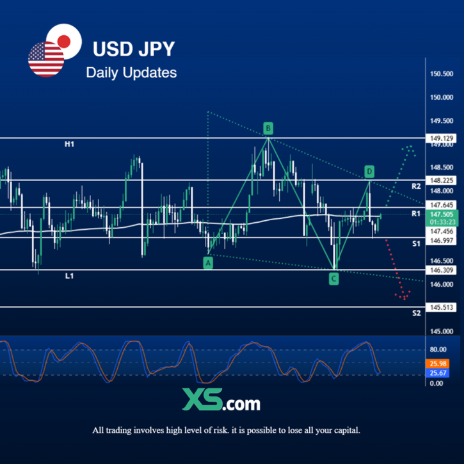
On the other hand, holding above the 147.00 level reinforces the view that buyers are still defending their positions. However, any clear break below this support could restore bearish momentum and drive the price to test 146.30. If buyers fail to protect this level, a deeper decline toward 145.50 could follow, in line with the downward extension illustrated on the chart. Conversely, a successful breakout above 148.22 would pave the way toward 149.10 as a new bullish target, potentially triggering a strong wave of buying.
From my technical perspective, the most likely scenario is continued range-bound movement with a limited bullish bias, awaiting a fresh catalyst such as Fed commentary or additional U.S. economic data. Therefore, monitoring price reactions around 148.22 as a key resistance and 147.00 as a pivotal support will remain critical in determining the next direction in the coming sessions.
Support levels: 147.00 – 146.30 – 145.50
Resistance levels: 148.22 – 149.10 – 150.00