

By Aishwarya Sharma & Prof. P. B. Sharma
Humanity, from time immemorial, has been in search of common ground on which to build a society aligned with the collective mindset of working together to attain the noble objectives of human existence, while also exalting the innate and infinite potential of human beings. In this pursuit, humanity made significant progress through philosophy, spiritual awakening, and the development of enlightened communities through higher education and research.
These efforts laid the foundation for humanity’s advancement to new altars of work and business, ensuring a rising quality of life. This progress continued remarkably with modern scientific and technological innovations, culminating in the current age of hyper-connectivity and artificial intelligence–powered systems and services. These forces have emerged as dominant drivers bringing global humanity together, opening new and exciting horizons of human existence—aspiring to reach unprecedented levels of capability and calibre, and even attempting to master creation and its sustenance.
However, with the advancement of science and technology came increased urbanisation and a gradual alienation from the beauty and bliss of Mother Nature. Moreover, humanity’s expanding scientific capabilities prompted efforts to overpower nature and exploit its resources, resulting in an enormous burden of disease and severe air, water, and soil pollution—posing unprecedented global challenges.
In the relentless pursuit of efficiency and speed in work and business, innovation and creativity began causing large-scale disruptions. A society increasingly tuned to consumerism has emerged, accumulating excessive and often wasteful possessions, generating mountains of waste and environmental stress.
Hyper-Connectivity and the Power of Big Data Redefining Human Endeavours
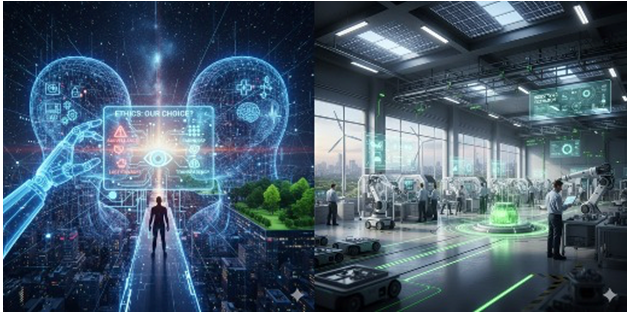
Source: AI-generated image
The hyper-connected world, powered by AI- and ML-integrated systems, is reshaping human activity at a pace that often feels overwhelming. These technologies are disrupting traditional workplaces, displacing human labour on a large scale while creating niche advantages for a select few. Combined with widening economic disparities and social inequalities, this transformation presents daunting challenges in keeping humanity united as one family—rooted in goodness and a shared future.
Compounding this concern is the fear of destruction arising from the unprecedented and all-pervasive power of AI and autonomous systems falling into unscrupulous hands, creating a near-existential crisis for humanity.
Yet, the opportunities in the age of AI and ML are equally profound. These technologies possess immense potential to augment human capabilities and enable leaps into domains once considered impossible to scale. Today’s era is powered by ideas and innovation, no longer bound by age or economic hierarchy.
The advent of artificial intelligence and machine learning is not merely an incremental upgrade to existing tools; it represents a fundamental shift in how we interact with information, make decisions, and even understand ourselves. AI systems now permeate every facet of life—from recommending entertainment to managing complex global logistics and healthcare systems. This moment presents a powerful opportunity to harness AI’s positive potential to address current challenges while building resilience for the future.
However, realising this potential requires focused attention and thoughtful policy initiatives to realign humanity with its core objectives—peace, harmony, and a profound recognition of humanity as one.
The Digital Nexus: AI Reshaping Our Minds and Societies
One of the most profound transformations underway is in human cognition. AI increasingly functions as an extension of human intellect, capable of processing vast volumes of data at speeds unimaginable for the human brain. By offloading tasks such as analysis, prediction, and pattern recognition to machines, humans gain the freedom to focus on creativity, ethical reasoning, and higher-order problem-solving.
Yet, if this opportunity remains underutilised, the human mind risks drifting towards digital passivity—excessive social media consumption and mental dependency on automated systems, with potentially irreversible consequences.
On the positive side, AI is revolutionising healthcare by analysing medical images with exceptional accuracy, detecting diseases early, and recommending personalised treatment plans. In education, machine learning–driven adaptive platforms tailor learning experiences to individual needs, transforming not just efficiency but the very nature of knowledge acquisition and problem-solving.
Nonetheless, this cognitive retooling introduces serious challenges. Bias in data, ethical decision-making, and over-reliance on automated systems demand urgent attention. AI must be consciously designed as an aid—not a replacement—for human judgment, empathy, and moral reasoning, ensuring humanity does not become subordinate to intelligent autonomous systems.
The Automated Economy: Redefining Work and Values
The workplace is where AI-driven transformation is most visible. Automation is rapidly reshaping industries, making production systems increasingly autonomous and service sectors more intelligent through advanced cognitive understanding of human behaviour.
Repetitive and routine tasks are steadily being absorbed by intelligent machines, raising urgent questions about the future of work, employment, and human purpose. This moment demands a fundamental rewiring of humanity—to collaborate with intelligent machines as co-workers rather than competitors.
Equally important is training machines to integrate emotional intelligence, ethical reasoning, and empathy. Such “machines of conscience” could support the development of a caring and compassionate society—protecting both people and the planet—while ensuring the highest standards of integrity, sustainability, and responsibility.
Ethical Crossroads: Navigating the Future of Humanity
As AI systems gain greater autonomy and influence, humanity confronts profound ethical dilemmas. How can fairness and transparency be ensured in algorithmic decision-making? What does privacy mean in a world of pervasive data collection and surveillance? How can society prevent AI from reinforcing or amplifying existing social biases?
These are not merely technical issues; they are deeply human concerns. Rewiring humanity in the age of AI requires preserving timeless universal values while consciously choosing which principles to embed in intelligent systems. This process calls for inclusive public discourse, robust regulatory frameworks, and a shared commitment among developers, policymakers, and industry leaders to prioritise human well-being—while still enabling innovation, markets, and economic growth.
Man–Machine Synthesis: A New Human Epoch
The age of AI and ML represents far more than technological advancement—it is a grand societal experiment. Humanity stands at a pivotal juncture, possessing the power to shape a future where intelligent systems amplify human potential, solve complex global challenges, and create unprecedented opportunities for growth and collective well-being.
Rewiring humanity requires embracing change, nurturing lifelong learning, and engaging critically with the ethical implications of our technological creations. Technology, ultimately, is a reflection of human intent. As we design algorithms and build intelligent machines, we are shaping our own future.
The challenge—and the promise—of this era is to ensure that this transformation leads toward a more intelligent, equitable, and profoundly human world. Amid the relentless rush of the digital revolution, humanity must not lose sight of its destined goal:
“Sarve Bhavantu Sukhina,
Sarve Santu Niramaya,
Sarve Bhadrani Pashyantu,
Ma Kashchit Duhkha Bhagbhavet”
(May all be happy, healthy, and enlightened; may no one suffer, now or in the future.)
About the Authors
Aishwarya Sharma is a software professional and a postgraduate in Computer Engineering from Purdue University.
Prof. P. B. Sharma is a visionary educationist and renowned thought leader, Founder Vice-Chancellor of DTU, former President of the Association of Indian Universities, and currently Vice-Chancellor of Amity University Gurugram.
The views expressed are personal to the authors.