

Hyderabad / Visakhapatnam, Dec 27: The Andhra Pradesh government has allotted five acres of land at Nagarjunakonda for the establishment of a National Academy for Rural Buddhist Heritage Conservation and Development, positioning the State at the forefront of India’s efforts to revive and protect its vast yet underrepresented rural Buddhist legacy.
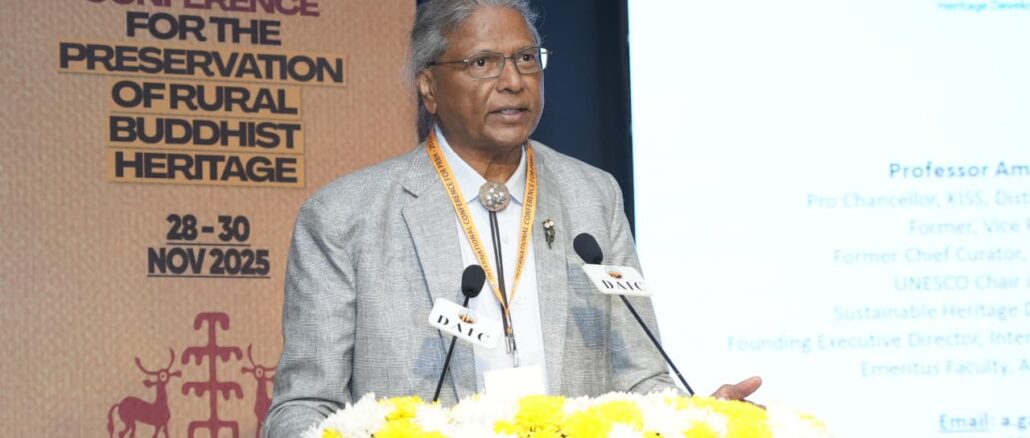
The announcement was made at the conclusion of the three-day International Conference on the Preservation of Rural Buddhist Heritage held in New Delhi, where the Delhi Declaration was adopted as a national framework for conservation. The conference brought together eminent scholars, Buddhist monks, conservation professionals, and policymakers from India and overseas.
Situated in the Krishna River valley, Nagarjunakonda is among India’s most significant archaeological landscapes linked to early Buddhism. Once a thriving centre of monastic education, philosophy, and Buddhist art, the region continues to hold immense historical and cultural value. The proposed academy is expected to build upon this legacy, emerging as India’s first institution dedicated exclusively to research, training, and community-led conservation of rural Buddhist heritage.
The academy will focus on the documentation of lesser-known rural Buddhist sites, development of professional skills in heritage conservation, and the active involvement of local communities. The Andhra Pradesh government’s decision to allot land is being viewed as a decisive step towards translating national policy commitments into actionable, state-level initiatives.
During the conference, speakers drew attention to the growing threats faced by rural Buddhist heritage sites, including climate change, environmental degradation, and regulatory challenges. His Eminence Kyabje Serkong Tsenshap Rinpoche highlighted the example of the Tabo Monastery, a 1,000-year-old institution in Himachal Pradesh, which has suffered extensive damage due to unseasonal rainfall and moisture seepage.
Former NITI Aayog CEO Amitabh Kant called for treating Buddhist heritage conservation as a national mission and underscored the importance of sustainable, community-centric Buddhist tourism models. Heritage experts including Professor Amareswar Galla and Dr. Prajapati Trivedi of Harvard University emphasised the need for systematic documentation, academic capacity-building, and deeper international collaboration.
The conference concluded with the adoption of the Delhi Declaration, an eight-point commitment recognising rural Buddhist heritage as a living cultural tradition. The declaration calls for enhanced community participation, technology-enabled documentation, regional cooperation through a proposed Asian Consortium, and strong institutional support for the Nagarjunakonda academy.
With land now officially allotted, the proposed academy at Nagarjunakonda is expected to evolve into a national hub for Buddhist heritage conservation. For Andhra Pradesh, the initiative marks a renewed engagement with its rich Buddhist past while opening new avenues for heritage-led research, education, and sustainable rural development.