
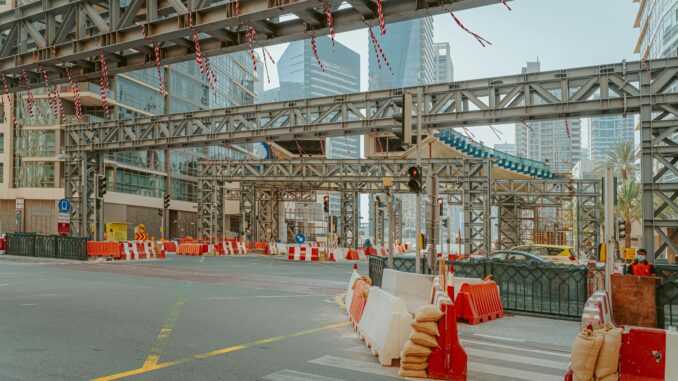

Unprecedented urban population growth results in ever-growing demands on urban infrastructure requirements including: transportation systems, utilities & public hubs, but also digital connection methods. While streetscapes, utilities, public spaces & digital connectivity are essential components of any developed community, substantial obstacles can hinder an urban infrastructure project’s successful completion; such obstacles may delay project timelines, increase construction costs and create strain on surrounding communities. Gaining insight into the obstacles faced when constructing an urban infrastructure and understanding how technology is revolutionizing the way urban planners, engineers and policymakers deliver urban development projects will greatly increase the likelihood of obtaining satisfactory results for residents and businesses alike.
1.The Challenge of Planning and Constructing Urban Infrastructure in Dense Areas.
The primary challenge that urban authorities face when creating city infrastructure construction
projects are working with multiple large scale complex projects at the same time needing to rely on established infrastructure (i.e. electrical, underground lines, etc.) to be able to build new structures to modern standards. In order to build structures without interrupting existing infrastructure requires the need to have very detailed planning criteria (in space) in which to build.
To help cities address the above issues there are now many methods of developing new urban structures using digital modeling tools that allow for virtual representation of what is going to be built prior to construction starting. Tools such as Building Information Modeling (BIM) and geospatial analytic modeling help decrease the occurrence of errors or discrepancies between infrastructure systems, increasing accuracy of projects and reducing prediction time regarding completion of projects. These types of tools allow for architects, engineers, and other stakeholders to work together in a shared workspace to greatly speed the rate at which infrastructure projects can be completed.Similarly, customizable digital elements, like a Sale Badge in e-commerce platforms, demonstrate how visualization tools can enhance clarity and stakeholder engagement.
Another area of support for engineers and planners in developing and building new urban infrastructure is through the use of more advanced decision support technology. For example, when urban planners and engineers can use computerized master planning software for city engineers as part of their ongoing decision making process they have access to predictive models regarding urban development projects including data interpretation and scenario analysis; both of which are critical components to large-scale infrastructure project development and completion within a given timeframe.
2. Constraints on Funding and Budgeting
Building infrastructure is expensive in terms of capital costs, and the initial investment for such projects (mass transit systems; sewer systems; expanding broadband) is often significant. As a result, many municipalities experience challenges in acquiring stable funding sources. Additionally, when they do have access to funds, it is often difficult for cities to justify making investments when benefits will be realized over a longer period of time.
Public-private partnerships (PPPs) provide cities with a way to fill in the funding gap due to the fact that both the government and a private investor share the financial burden and risks associated with the project’s development. As a result of this collaborative approach to financing projects, the speed at which projects are delivered is often increased without compromising the quality of either the finished project or the delivery process itself. Financial modeling tools that project a return on investment, an estimate of costs throughout the project’s lifecycle, or the cash flow scenarios associated with infrastructure projects are becoming increasingly important when cities are trying to obtain public or private funding for their complex infrastructure initiatives.
Furthermore, many policymakers are also recognizing that technology plays an important role in creating infrastructure. For instance, a number of recent industry forums have indicated that the adoption of technologies including advanced project management software and smart building systems can help reduce risks during the execution process and significantly increase the amount of transparency associated with each phase of the project, thereby leading to increased productivity when completing construction projects. These two items have been regarded as high priorities during recent discussions regarding the budgets associated with infrastructure.
3. Legacy Systems and Technological Integration
Using existing infrastructure to introduce new technologies may resemble attempting to insert square pegs into round holes. Many old urban systems use out-of-date hardware and therefore cannot be easily updated digitally. The difficulty in converting legacy systems into new digital technologies due to their lack of interoperability may delay construction time and increase project costs where portions of the infrastructure must remain in use while being upgraded.
Cities have begun to replace old infrastructure with modular technology. At the same time, they have begun using interoperable technology that allows for incremental improvements rather than requiring an entire system replacement. Municipalities also utilize smart sensor networks, automated monitoring systems, and edge computing solutions to ensure that new innovations can be integrated into existing legacy structures and provide data collection, storage, and analysis capabilities. In addition, cities are relying on new construction processes for data centres to help establish the digital infrastructure of modern construction projects and cities of the future.
4. Data Management and Security
As more and more urban systems are connected, the amount of data generated by sensors, cameras, and connected devices continues to increase dramatically. While this data has the potential to yield a wide variety of valuable insights that can be used to plan and operate, it also creates a number of significant issues related to privacy, cybersecurity, and ethical use. Therefore, any smart city or smart infrastructure platform must have strong cybersecurity platforms in place to protect sensitive data and reduce service disruptions as much as possible. Building public trust within the community is critical, as citizens need to be confident that any data collected from them is being used appropriately and securely. Cities are investing heavily to implement strong encryption, near real-time monitoring, and integrated cybersecurity systems to protect the data that powers current infrastructure operations.
5. Standards and Interoperability
While there is great potential for digital transformation, the absence of shared standards can hinder seamless integration between different systems and technology platforms. Cities frequently use numerous vendor-provided systems that operate using their own individual data formats and protocols. Without standards for interoperability, capital improvement projects or infrastructure upgrades could create a collection of disparate systems that are costly to operate and scale. Adopting interoperable technologies and establishing open standards will help cities break free from vendor lock-in and allow them to support a more competitive technology provider environment. Establishing communications protocols and data exchange standards on a citywide basis will enable various components of infrastructure to operate together seamlessly — from traffic systems to electricity grids.
6. Workforce Skills and Adoption Barriers
The use of state-of-the-art digital tools requires skilled workers to successfully install and use the systems to support municipal infrastructure. Many cities throughout the United States have found that they have a shortage of skilled workers, particularly in knowledge areas such as data science, digital construction management, and cybersecurity. Therefore, cities must invest in training their current workforce to use digital tools and properly interpret the large amounts of complex data generated by today’s systems to ensure their success in adopting new infrastructure technology.
The workforce development of cities is progressively emphasizing the provision of training and certification programs together with on-the-job training to enable workers to gain skill and expertise in their employment through the use of digital technology. With the provision of developing the technical skills of workers to successfully deploy new digital technology solutions, cities can expect to see significant improvement in their infrastructure as a result of the effective implementation of new technologies.
7. Environmental and Social Considerations
Construction of urban infrastructure cannot be seen in isolation to its environmental and social impact. Urban infrastructure projects can disrupt communities, cause pollution, and put stress on natural resources. In order to address these matters, it is vital to have a sustainable planning process, and also an accountability process that creates a balance between construction project needs and environmental/protective stewardship.
Green construction is becoming commonplace in the construction of urban infrastructure. Recyclable materials are used, renewable energy sources are implemented, and lesser impacts are designed into the infrastructure. Smart infrastructure also allows for real-time environmental monitoring to limit noise and emissions during the construction phase as well as to maximize resources throughout the construction life cycle.
8. Enhancing Urban Mobility and Citizen Experience
Mobility — the way in which people and goods move through urban areas — is critical to urban infrastructure today. Urban infrastructure projects that cause traffic congestion, limited access to parking, and inefficient transit systems hinder productivity in urban areas. To mitigate those issues, many cities are using technology-based solutions to improve urban mobility. Examples of that include smart parking applications and Internet of Things (IoT)-enabled urban mobility platforms to help reduce daily frustration associated with locating parking and reduce traffic congestion in highly populated areas such as the large metropolitan areas found in India.
9. Towards Resilient, Future-Ready Cities
Cities can find both advantages and disadvantages in their efforts to create a future where urban infrastructure is both resilient and ready for the future. Although cities are experiencing barriers due to funding limitations, systems that have not been modernized, and workforce issues; there are solutions offered by technology that will help cities increase their planning accuracy, operate more efficiently, and improve the public’s engagement with government activities.
Developing infrastructure effectively requires an overall approach by cities to guarantee safe and equitable provision of services to their residents today and in future generations. As cities continue to grow and evolve, so too must the infrastructure used by those cities to accommodate both current demands of infrastructure users as well as forecasted future barriers to providing services. This ultimately creates a combination of resilient, sustainable, and economically viable infrastructures for many years into the future.
Photo by Denys Gromov: