

The Union Budget 2026–27 has emerged as one of the most keenly debated fiscal blueprints in recent years, evoking strong and contrasting responses from political leaders, state governments, industry bodies, and social stakeholders. While the ruling establishment has projected the budget as a decisive step towards achieving Viksit Bharat (Developed India), the opposition has criticised it as underwhelming and disconnected from the everyday concerns of ordinary citizens.
PM Modi: Budget as a Catalyst for Reform and Self-Reliance
Prime Minister Narendra Modi described the Union Budget as an ambitious and forward-looking roadmap that gives fresh momentum to the Make in India and Aatmanirbhar Bharat initiatives. In a video message, he said the budget would energise India’s “reform express,” strengthen domestic manufacturing, and build long-term economic resilience.
Highlighting India’s transformation “from the fragile five to a global front-runner,” the Prime Minister said the budget reflects confidence in India’s growth trajectory despite global economic uncertainties. BJP leaders, including the Tamil Nadu BJP, hailed it as a model budget that charts India’s ascent as a competitive global economy.
President Murmu Sets the Tone for the Budget Session
President Droupadi Murmu, in her address to the joint sitting of Parliament on January 28, 2026, marked the beginning of the Budget Session by underlining the government’s achievements in social justice, inclusive development, and economic expansion. Emphasising the vision of Viksit Bharat, she highlighted efforts to uplift marginalised communities, empower women and youth, and strengthen India’s global standing.
Finance Minister’s Big Push on Capital Expenditure and Innovation
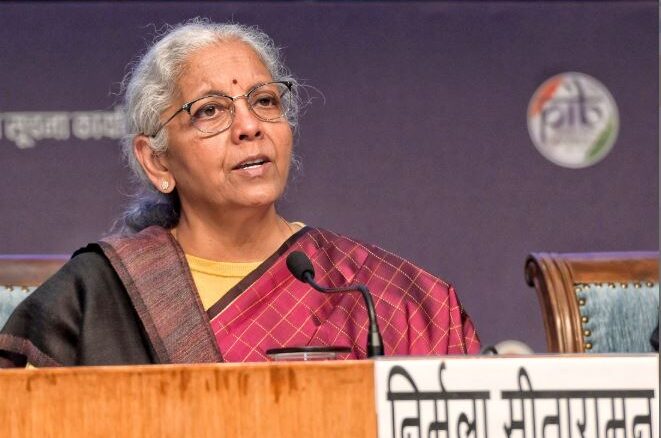
Finance Minister Nirmala Sitharaman reinforced the government’s growth-first approach by proposing a sharp increase in capital expenditure to ₹12.2 lakh crore for FY 2026–27. The budget places a strong bet on public investment to crowd in private capital, boost job creation, and modernise infrastructure across transport, logistics, manufacturing, health, and education.
Industry leaders welcomed the budget’s fiscal discipline amid global volatility. The SBI Chairman said the proposals would help position India as a global hub for innovation and advanced manufacturing, while bodies such as Assocham praised the balance between growth and fiscal prudence.
Focus on Skilling, AI and Future Entrepreneurs
A key highlight of Budget 2026 is its emphasis on AI-enabled skilling and innovation-driven entrepreneurship. Industry representatives said this focus would help nurture India’s next generation of entrepreneurs and prepare the workforce for emerging technologies. The integration of artificial intelligence into skilling programmes is being seen as a critical step towards future-ready employment and productivity growth.
Sectoral Boost: Health, AYUSH, Women and MSMEs
The budget also announced notable increases in social sector spending:
- Healthcare allocation rose by 9 per cent, reflecting the government’s commitment to making healthcare more accessible and affordable, according to BJP President J.P. Nadda.
- The AYUSH Ministry’s budget was increased by over 10 per cent to ₹4,500 crore, with Minister Prataprao Jadhav calling it a boost for traditional and holistic healthcare systems.
- Industry body FLO welcomed the budget’s women-centric and MSME-led growth agenda, noting enhanced support for women entrepreneurs and small businesses.
BJP and NDA Leaders Hail a Development-Oriented Budget
Chief Ministers and ministers from BJP-ruled and NDA-ruled states broadly endorsed the budget, calling it people-centric, inclusive, and forward-looking.
- Uttar Pradesh CM Yogi Adityanath described it as having a “clear vision for developed India.”
- Maharashtra CM Devendra Fadnavis said the budget would empower Mumbai and Maharashtra while accelerating the growth of Tier-2 and Tier-3 cities, noting that the state would receive nearly ₹1 lakh crore from central taxes.
- Bihar CM Nitish Kumar and Deputy CM Samrat Choudhary said the budget would significantly benefit Bihar.
- Andhra Pradesh Minister Nara Lokesh said the state stands to gain substantially.
- Tripura leaders highlighted the focus on tourism, jobs, health, education, and development of the Northeast.
- Odisha CM Mohan Charan Majhi said the budget would strengthen the state’s logistics and industrial ecosystem, opening new opportunities for youth, farmers, entrepreneurs, the middle class, and workers.
Union Ministers Nitin Gadkari, Kiren Rijiju, and Shivraj Singh Chouhan hailed the infrastructure and reform push, while Pralhad Joshi termed the budget a “blueprint for a developed India.”
Sectoral and Regional Expectations
Several leaders pointed to sector-specific gains:
- Increased allocation for MSMEs was seen as a boost for small businesses and employment.
- Higher education experts, including the Gauhati University Vice-Chancellor, said the budget has the potential to reshape India’s higher education ecosystem.
- Tourism received special attention, with renewed focus on Jammu & Kashmir, the Northeast, Himachal Pradesh, and other regions.
- Rail and connectivity projects drew mixed reactions, with support for new corridors but questions over high-speed rail feasibility in some states.
Opposition Slams Budget as Disappointing and Directionless
In sharp contrast, opposition parties mounted a strong attack on the budget. Congress leaders Sachin Pilot, P. Chidambaram, and Rahul Gandhi criticised it for ignoring concerns raised in the Economic Survey, including unemployment, inflation, and slowing demand. Rahul Gandhi described the budget as “blind to India’s real crises.”
Regional parties echoed similar concerns:
- Shiv Sena (UBT) said the Finance Minister failed to address economic instability.
- Samajwadi Party claimed the budget ignored the poor, farmers, and middle class.
- Kerala’s LDF and UDF criticised the absence of AIIMS and high-speed rail projects.
- Karnataka CM Siddaramaiah termed it the most disappointing budget of his career.
- Former Odisha CM Naveen Patnaik said the state received no noteworthy benefits.
Opposition leaders accused the government of presenting “big numbers and empty promises” without immediate relief for common citizens.
A Budget That Divides Opinion
The Union Budget 2026–27 reflects the government’s confidence in investment-led growth, innovation, and long-term structural reforms. Supporters see it as a credible balance between growth, reform, and fiscal discipline, while critics argue it falls short on immediate job creation and cost-of-living concerns.
As Parliament continues to debate the proposals, the budget remains at the heart of national political discourse—symbolising both the ruling party’s vision for a developed India and the opposition’s concerns over inclusivity and ground-level impact.