

By Ahmad Assiri, Research Strategist at Pepperstone
Global markets delivered notable cross asset shifts last week. Oil prices retraced as geopolitical tensions eased, Japan’s snap election promoted expectations of additional fiscal expansion and equity markets continued to exhibit rotation rather than broad-based risk aversion. This week, focus turns to US inflation and labour market data, the payrolls report delayed by the brief government shutdown, releases that shape near-term risk sentiment across asset classes.
Last week’s market narrative revolved around three interconnected themes seem in volatility in energy markets, Japan’s weekend snap election and an increasingly visible rotation within global equities. The broader price action suggests a repricing of risk premia rather than a deterioration in growth expectations.
Oil: Geopolitical Premium Compresses
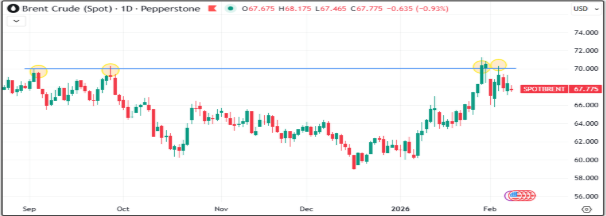
Crude price fell following indications of diplomatic de-escalation between the United States and Iran. The move effectively compressed the geopolitical risk premium embedded in crude, an element that had contributed to roughly a 16% repricing since the start of the year and had propelled Brent above the $70 per barrel threshold, its highest level in four months.
Brent crude declined before stabilising, underscoring just how sensitive the market remains to shifts in perceived supply disruption probabilities. The adjustment was not demand driven as there was no material downgrade to consumption forecasts nor a deterioration in macro fundamentals. Rather, the move reflected repositioning and unwind of a geopolitical premium that had become extended.
Elsewhere, in Japan, the snap election materially strengthened Prime Minister Sanae Takaichi’s political standing, reinforcing expectations of a more expansionary fiscal stance. Japanese equities responded positively to this renewed policy momentum while long-dated government bonds are highly sensitive to deficit-widening risks. The combination of fiscal stimulus alongside a gradual path toward monetary normalisation has reignited debate around inflation risks and the durability of Japan’s price dynamics.
In parallel, global equities exhibited a sector rotation as flows rotated out of mega-cap technology into Europe, Japan and more cyclical segments such as industrials and materials. This reflects a broadening of market leadership rather than a retreat from risk.
The week ahead
At the start of this week, attention turns squarely to Japan following the strong post-election price action in its markets. The Nikkei 225 surged toward the 58,000 level marking a fresh record high after the Liberal Democratic Party, led by Takaichi, secured a historic two-thirds majority in the Lower House.
The ruling coalition captured 352 of 465 seats, with the LDP alone winning 316 seats, exceeding the 310-seat threshold required to override the Upper House. This outcome significantly reduces legislative friction and grants the government greater capacity to advance its fiscal expansion agenda with reduced political uncertainty.
However, the most contentious element of that agenda is the proposed reduction in food taxes. At present, there is no clearly articulated funding mechanism to offset the revenue shortfall. The absence of balancing measures raises legitimate concerns regarding fiscal sustainability particularly against the backdrop of public debt hovering near 230% of GDP.
Ultra-long Japanese government bond yields have already become increasingly sensitive to incremental supply risks, especially as typical buyers appear more cautious. Despite these fiscal dynamics, USD/JPY continues to trade marginally below the 157 level, displaying a somewhat surprising degree of stability.
Beyond Japan, the macro lens now shifts toward the United States. This week’s data carries material implications for rate and cross-asset positioning, beginning with retail sales as a gauge of consumer resilience, followed by the delayed payrolls report, and culminating in the CPI figures.
The labour market data, postponed from last week, will play an important role in shaping trading sentiment. Wage growth trends, participation unemployment rates and revisions may prove just as consequential as the headline payroll figure, expected around 70,000 added jobs. Yet the CPI release remains the primary catalyst, with markets currently anchored around inflation near 2.5%. A materially stronger print would likely push the front end of the yield curve higher, compress rate cut expectations and weigh on equity valuations.