


By Anil Pharande, Chairman – Pharande Spaces
The recent news stories about the Real Estate Regulation Act (RERA) have been nothing short of extraordinary. People understandably get anxious when the Supreme Court says that a regulator has turned into a ‘rehabilitation center’ for retiring officials – or that we may as well get rid of it. But as a developer who has worked in this field for decades, both before and after 2016, I see this uproar not as a sign of failure but as a crucial turning point.
Let’s be clear – we can’t go back to the ‘dark ages.’ To those who want RERA to be thrown out, I ask: Have we really forgotten the time when deposits disappeared, projects were put on hold for twenty years, and no one was held accountable? RERA is not a problem for serious, professional developers; it is the infrastructure that finally gave our industry respectability.
The ‘Last Mile’ – The Real Issue
The judges’ remarks are all about one thing, and that is enforcement. When a homebuyer obtains a refund order, the ‘last mile’ – getting the money back – often gets trapped in the slow gears of local revenue departments. This is a fair criticism of how this legislation is carried out, not the law itself.
The ‘paper tiger’ story makes for excellent headlines, but it ignores the structural shield that works every day. The 70% escrow rule, which says that most of a buyer’s money must stay in a project-specific account, has put an end to the risky practice of robbing Peter to pay Paul, so to speak. The financial safety net for homebuyers became stronger than ever in 2025 when required quarterly audits by third parties were put in place.
This means that the money you pay for your house is going toward building it. And that is purely thanks to RERA
How RERA Transformed Pune and PCMC
The Pune and Pimpri-Chinchwad Municipal Corporation (PCMC) corridor is one where RERA has been most successful. In 2025, Pune had the most active real estate market in Maharashtra, with 1,144 new projects – more than Thane and suburban Mumbai combined.
Frankly, the change in PCMC has been amazing. Ravet, Moshi, and Punawale have become high-demand hubs instead of outlying zones, thanks to the fact that RERA encourages strong developers with full execution capabilities and weeds out fly-by-night builders who leave their projects incomplete or only on paper. Serious homebuyers, like Pune’s IT professionals and various industrial professionals, expect transparency and reliability.
In PCMC, property values went up by 10% in early 2025, which was faster than even central Pune. This is because investors and end-users are zeroing in on integrated townships and other gated communities by reputed developers in the PCMC corridor. But this did not just happen by chance. MahaRERA has been a true godsend in these markets.
When you buy a home in a high-demand area like Hinjewadi, Punawale or Moshi today, you are buying on the basis of a legally binding guarantee that you can see on a public dashboard which shows you how projects are progressing in real time. Thanks to MahaRERA.
Taking Out the Gamblers
One of RERA’s best accomplishments has been to do a thorough house-cleaning on who can and cannot build, what they can build, and by when they have to complete it. Yes, some builders play with the loopholes in RERA, but strong, branded players actually abide by its rules and regulations.
So much so that the two main pieces of advice given to a homebuyer today are – buy from a strong developer with a proven track record (which can be checked on the RERA portal) and make sure that the project is RERA-registered. The real estate market used to be a landscape where fly-by-night operators could play at will. Anyone with a piece of land and a brochure but no money or commitment power could launch a project. RERA has done an exemplary job of sweeping these ‘gamblers’ out of the market.
The cost of compliance, which includes five-year structural warranties and comprehensive quarterly reports, has favoured strong hands – developers with enough cash and proven records. Thanks to RERA, we are seeing a huge consolidation, and the end result is that homebuyers can now deal with thoroughbred professional builders who have a lot to lose if they do not do a good job.
Quality is Now the Default Option
Before 2016, builders could say and advertise whatever they wanted about the scope and quality of their projects. RERA’s five-year defect liability clause has forced developers to stop using cheap promotional practices to entice buyers. They invest in better building technologies because they know that if a project develops faults and flaws even four years after you move in, they have to pay to fix it.
Today, every real estate advertisement must have a QR code on it. A simple scan gives a buyer the land titles for the project, the permissions, and even images of construction progress on the ground. Ten years ago, this level of openness would have been unthinkable. RERA has changed the balance of power from the developer to the customer.
Yes, We DO Need RERA with Teeth
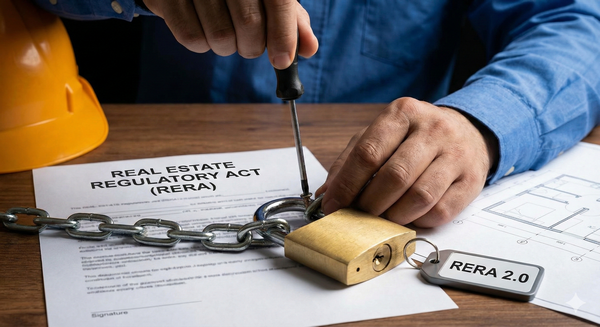
So, are there issues? Absolutely, but the answer is not to get rid of RERA – it is to give it more power. We need to work on RERA 2.0 – a version that has its own separate enforcement wings instead of depending on overworked district collectors to carry out recovery warrants. We need a system where the regulator can do more than simply make a decision.
My message to homebuyers in Pune and PCMC is simple – you are safer now than you have ever been. The current uproar shows that people are looking closely at the system, which is a good thing. It suggests that the courts want even higher standards, and that is totally justified.
RERA has made project finances more organised, raised the requirements for construction, and gotten rid of the rogue actors that gave this business a poor name. RERA empowers developers who intend to stay in the industry for the long-term, and fully intend to run their business in a responsible, regulated, and serious manner.
No doubt, the house needs further cleaning – but we don’t need to set it on fire just because we need to fix the front door locks. We need to enforce the rules more, not less. That’s the only way to make ‘Viksit Bharat’ happen.
About the author:
Anil Pharande is Chairman of Pharande Spaces, a leading real estate construction and development firm famous for its township projects in Greater Pune and beyond. Pharande Promoters & Builders, the flagship company of Pharande Spaces and an ISO 9001-2000 certified company, is a pioneer of townships in the region.