

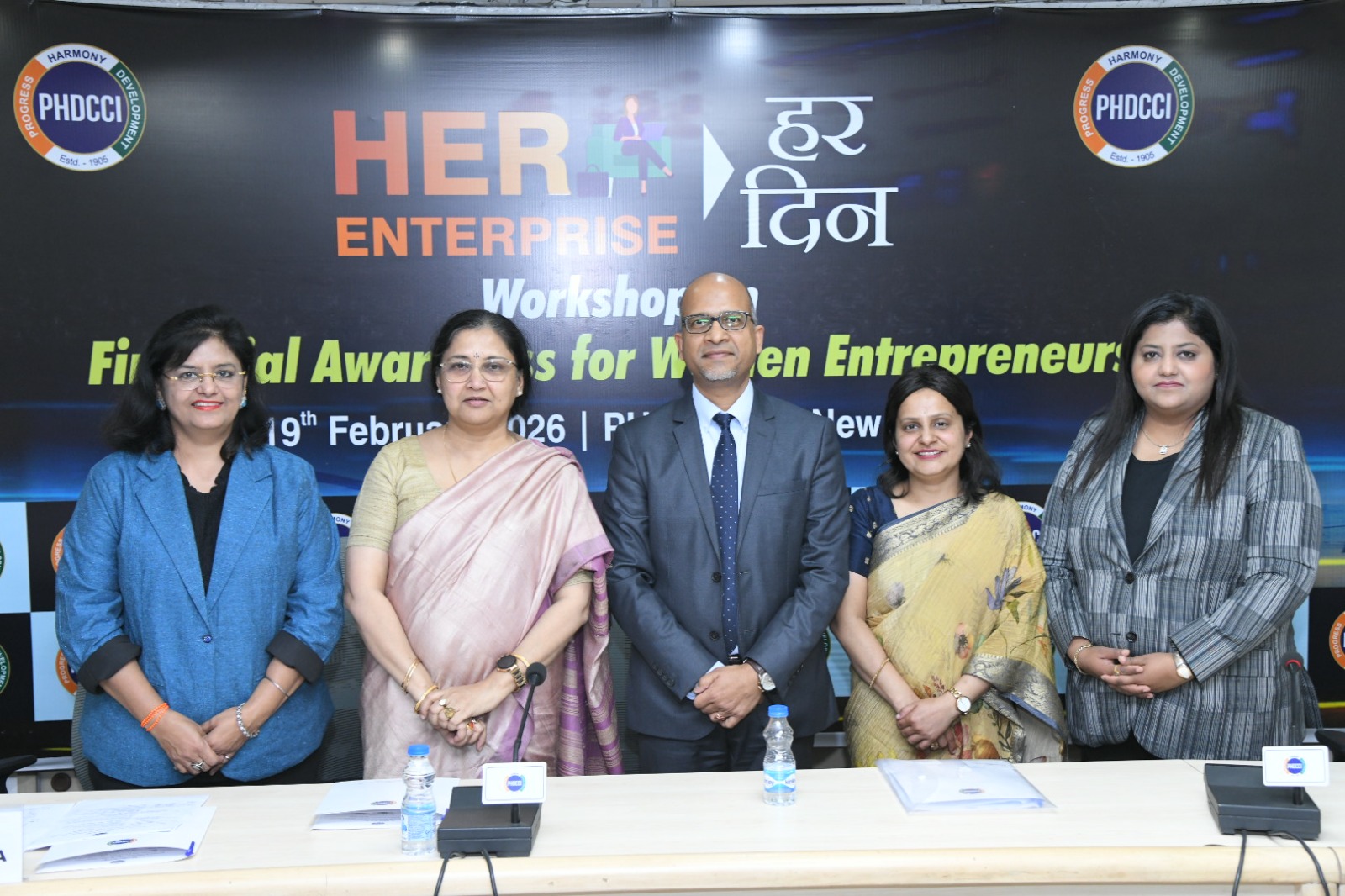
The PHD Chamber of Commerce and Industry organised Her Enterprise Har Din’ – Workshop on Financial Awareness for Women Entrepreneurs on Thursday, 19 February 2026 at PHD House, New Delhi. The workshop aimed at strengthening financial literacy, enhancing awareness on tax planning and improving structured access to finance for women-led enterprises.
Setting the context of the programme, Ms. Shalini S Sharma, Assistant Secretary General, PHDCCI, highlighted the Chamber’s 121-year legacy as a leading industry association and elaborated on the initiatives of the Women Child Development and Entrepreneurship Committee. She emphasised that financial discipline, regulatory compliance and informed decision-making are essential pillars for building sustainable women-led businesses.
The first panel discussion on “Access to Finance & Banking Solutions for Women-Led Enterprises”, moderated by Ms. Shalini S Sharma, featured Mr. Sharad Goyal, Partner, GSAP & Associates LLP; Ms. Tanvi Jain, Founder, Hallmark Investment Services Pvt. Ltd.; and Prof. Vandana Bhama, Associate Professor – Finance & Accounting, FORE School of Management, New Delhi.
Mr. Sharad Goyal, Partner, GSAP & Associates LLP, highlighted that financial institutions primarily assess compliance track record, profitability trends and tax flows before extending credit. He emphasised the importance of planning tax structures from the inception stage and explained how the choice between a Private Limited Company and an LLP can significantly influence investor interest and scalability. Early-stage structuring, he noted, strengthens credibility and long-term sustainability.
Ms. Tanvi Jain, Founder, Hallmark Investment Services Pvt. Ltd., addressed the common hesitation among women entrepreneurs to start or scale their ventures. She encouraged participants to define business survival through steady cash flows rather than turnover alone and stressed the importance of disciplined monthly withdrawals, proper documentation and building digital transaction footprints. She pointed out that several NBFCs now assess lending eligibility based on digital financial records, making transparency and technology adoption critical for credit access.
Prof. Vandana Bhama, Associate Professor – Finance & Accounting, FORE School of Management, New Delhi, underscored the central role of bookkeeping and financial documentation in strengthening bank confidence. She noted that structured accounting practices not only ease compliance and legal processes but also enhance access to institutional finance. She further highlighted the need for mentorship, incubation support and strong professional networks to convert entrepreneurial ideas into viable enterprises.
The second panel discussion on “Tax Planning, Compliance & Financial Discipline”, also moderated by Ms. Shalini S Sharma, featured Mr. Raman Aggarwal, Co-Chair, BFSI Committee, PHDCCI & Chief Executive Officer, Finance Industry Development Council (FIDC); CA Ashish Dua, Founder, Ashish Dua Corporation; CA (Adv.) Prakash Sinha, Partner, Finjuris LLP; and CA Shweta Walecha, Executive Partner, Lakshmikumaran and Sridharan Attorneys.
Mr. Raman Aggarwal, Co-Chair, BFSI Committee, PHDCCI & Chief Executive Officer, Finance Industry Development Council (FIDC), emphasised the importance of registering as an MSME on the Udyam platform to avail collateral-free credit support. He highlighted that timely GST filings, maintaining credit scores and disciplined repayment behaviour are critical to avoid accounts turning into NPAs. He also elaborated on alternative financing models such as leasing through NBFCs, explaining how lease payments can offer tax advantages while preserving working capital.
CA Ashish Dua, Founder, Ashish Dua Corporation, discussed the expanding reach of microfinance institutions in Tier II and Tier III cities, noting that women entrepreneurs are often preferred borrowers due to
stronger repayment behaviour. He also reflected on the role of GST reforms in formalising businesses and improving financial transparency, particularly for small enterprises entering the organised ecosystem.
CA (Adv.) Prakash Sinha, Partner, Finjuris LLP, stressed the importance of disciplined financial planning by advising entrepreneurs to systematically allocate income towards household maintenance, investments and future growth. He highlighted the benefits of schemes such as MUDRA loans for collateral-free funding and encouraged participants to maintain active banking records to build long-term credit credibility. He also advised entrepreneurs to use formal grievance redressal mechanisms where necessary to safeguard their financial rights.
CA Shweta Walecha, Executive Partner, Lakshmikumaran and Sridharan Attorneys, advised first- generation entrepreneurs to carefully evaluate loan documentation, including rate of interest, pre-payment clauses and default triggers. She emphasised the importance of reviewing Key Fact Statements (KFS), maintaining a compliance calendar and ensuring written communication in financial dealings to avoid future disputes.
The workshop concluded with an engaging interactive session, where participants sought practical guidance on accessing credit, leveraging government schemes, managing tax structures and maintaining financial discipline. The event ended with a Networking High Tea, fostering meaningful exchange between experts and aspiring women entrepreneurs.
Ms. Babeeta Sharma, Director, PHDCCI, delivered the Vote of Thanks and expressed appreciation to the distinguished speakers and participants for their valuable contributions.
PHDCCI expressed its deep gratitude to its valued partners — Aruna Abhey Oswal Group, Blossom Kochhar Beauty Products Pvt Ltd, and Gems N Jewels — for their generous support in making the event a success.
Through initiatives like Her Enterprise हर दिन, PHDCCI continues to promote financial empowerment and sustainable enterprise development for women entrepreneurs across the country.