

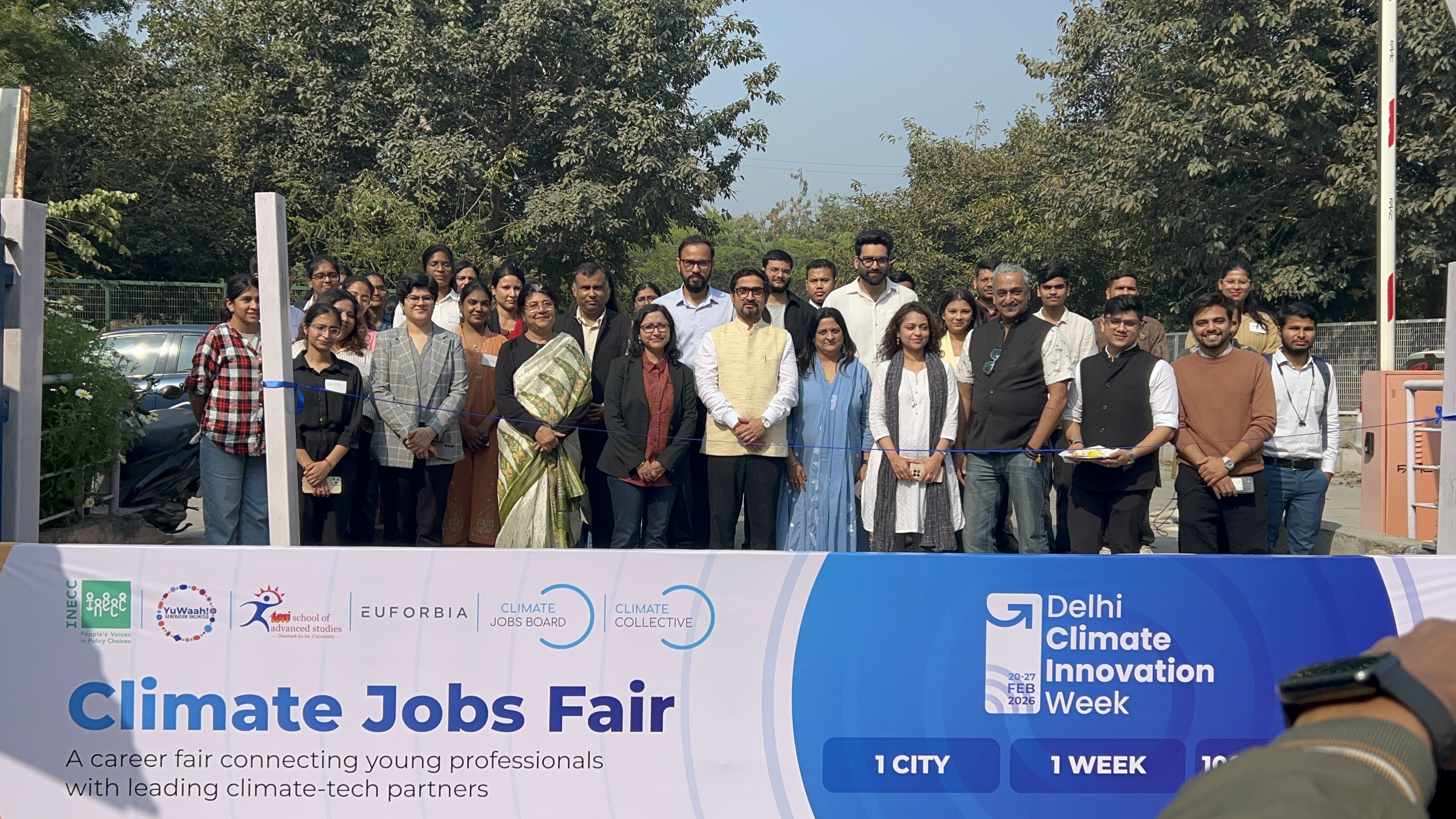
New Delhi, Feb 23: Day Two of Delhi Climate Innovation Week (DCIW) 2026 witnessed 19 events across Delhi NCR, as part of the week-long platform featuring 110+ climate-focused events over seven days.
A major highlight of the day was the Climate Jobs Fair 2026, hosted at TERI School of Advanced Studies (TERI SAS) in collaboration with Climate Collective Foundation (CCF). The fair brought together climate technology-focused startups, students, researchers, and young professionals for a day dedicated to green careers and workforce readiness.
Participating startups represented sectors including clean energy, energy efficiency, mobility, AI, grid intelligence, circular economy, and waste management. Startups engaging with talent at the fair included KHEONI, Valency Energy, TRILLECTRIC, and 3R Zerowaste Pvt Ltd, among others. About 100+ job seekers engaged with the startups and spot interviews were conducted across the day.
Beyond recruitment interactions, the Climate Jobs Fair featured sustainability games, a climate quiz, resume-building sessions, and direct founder–student networking. The event positioned itself not merely as a hiring drive but as a structured career exploration platform, connecting young people to the expanding climate innovation ecosystem.
India’s climate innovation landscape has expanded significantly in recent years, with nearly 4,000 clean tech startups now active across the country — a sharp rise from just a few dozen a decade ago. Yet, a gap persists between emerging opportunities and awareness among youth. The Climate Jobs Fair aimed to address this mismatch by creating direct pathways between climate enterprises and aspiring professionals.
Prof. Suman Kumar Dhar, Vice Chancellor, TERI School of Advanced Studies, said: “At TERI School of Advanced Studies (TERI SAS), we are committed to nurturing the next generation of ‘sustainability natives.’ The Climate Jobs Fair 2026 is a vital bridge between academic excellence and real-world impact. The future of work is undeniably green. As a pioneer in sustainability education and research, TERI SAS recognizes that solving the climate challenge requires a highly specialized and dedicated workforce. This jobs fair serves as a catalyst for innovation, connecting talented minds with organizations that are at the forefront of climate action. TERI SAS in collaboration with Climate Collective Foundation (CCF) is proud to provide a platform where education meets opportunity, driving the systemic change needed for a sustainable and equitable planet.”
Jui Joshi, Partner, Climate Collective Foundation, added: “Less than a decade ago, climate careers were seen as niche. Today, they are central to India’s growth story. With India’s green economy booming and projected to create 48 million full time jobs by 2047, a large portion of this will be led by fast-growing startups transforming climate goals into a massive employment reality. The climate transition is creating real businesses and real jobs across sectors. The Climate Jobs Fair aims to support startups in building the right talent pipeline during their crucial phase of growth. It makes these opportunities visible and accessible — showing young people that climate is not just impact work, it is a serious and rewarding career path.”
The event also saw participation from school students exploring future academic streams, as well as Masters and PhD scholars seeking internships and placements. Faculty leaders from TERI SAS emphasised the importance of building early exposure at school level while strengthening forward linkages into industry — reinforcing academia–industry collaboration.
Also on Day Two of DCIW, an event titled “Building Climate-Ready Talent: Data and AI Pathways for Climate Action” was hosted by data.org, spotlighting the growing importance of data science and artificial intelligence in climate action. The session explored how data-driven tools are strengthening heat risk and vulnerability mapping, supporting climate finance and Loss & Damage evidence, and enabling informed local climate planning. Through an interactive engagement format, participants explored learning pathways in data-driven climate careers, further reinforcing the central theme emerging from the day: India’s climate transition requires not only technology and capital, but skilled, interdisciplinary talent.