

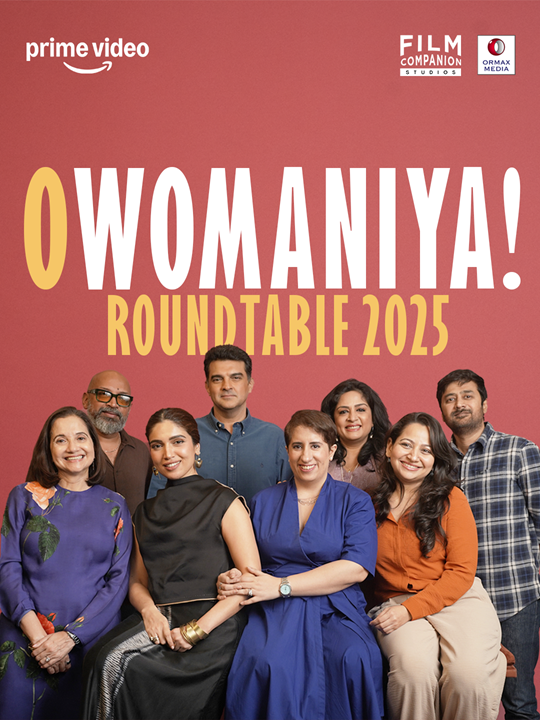
MUMBAI, Feb 25: Prime Video, India’s most loved entertainment destination, today released the latest edition of O Womaniya! report, the most definitive study on female representation in Indian entertainment. Researched and curated by media consulting firm, Ormax Media, produced by Film Companion Studios, and championed by Prime Video, the O Womaniya! 2025 study continues to examine the industry-wide trends and white spaces in female representation across key areas of production, corporate leadership, and marketing in entertainment. This year, the report analyzed 122 films and series released in 2024 in nine Indian languages (Hindi, Tamil, Telugu, Malayalam, Kannada, Marathi, Punjabi, Bengali, and Gujarati), across streaming and theatrical.
Key findings of the report include:
● Content – O Womaniya! Toolkit1, a test institutionalized last year, measures female representation in content, and also enables filmmakers to apply the test and eliminate biases early on in the content creation cycle. This test checks whether women in a film or series have agency and are drivers of their own stories. This year 32% of the titles analyzed passed the test. While theatrical films lagged behind like last year, streaming films displayed a significant jump of 16 percentage points over the 2024 report, with 47% of the titles passing the test. At the same time, Telugu titles—that have historically underperformed when it comes to on-screen female representation—displayed a remarkable improvement over last year, surging by 21 percentage points to have 31% of the films and series clear the test. Although more titles passed the test if they were commissioned by women, the increase in the number of titles commissioned by men meeting the bar came as a pleasant surprise, and also proved that in order to achieve true equity, the entertainment industry needs more male allies.
● Creative Talent – The drop in female representation behind the camera came as a setback with only 13% of the HOD positions analyzed across key departments of direction, cinematography, editing, writing, and production design held by women as compared to 15% in the previous report. Editing and cinematography presented the biggest drops of 4 and 5 percentage points respectively. While the number for direction has remained unchanged since the last report, with 8% of analyzed titles featuring a female director, there is clear opportunity for progress in this area. Hindi titles had the highest contribution to off-camera creative talent, with almost a quarter of the analyzed films and series having at least one female HOD; other languages remained at the lower end with most recording less than 5% HOD roles held by women.
● Marketing – Women still have only 29% talk time2 in trailers, though it has increased marginally from 2022 when it was 27%. Streaming films and series continue to exhibit the highest propensity to allocate more talk time to women in promotional trailers, at 36% each. Of the titles analyzed, Follow Kar Lo Yaar (Hindi), Big Girls Don’t Cry (Hindi), Do Patti (Hindi), Crew (Hindi), Heart Beat (Tamil), The Tribe (Hindi), Naach Ga Ghuma (Marathi), Call Me Bae (Hindi), and Heeramandi (Hindi) were some of the films and series to feature high in the list.
● Corporate Talent – Among the 110 Director/CXO positions analyzed across 25 leading M&E firms in India, female representation in senior leadership roles showed a significant rise – from 12% in the previous report to 18% in the current one. While this number continues to be on the lower side, the six-percentage-point increase in just a year signals steady progress toward gender-balanced leadership.
“At Prime Video, we have always believed that for stories to truly resonate, they must reflect a balanced perspective. That’s why strong female representation – on-screen, behind the camera, and at the decision-making table – is more than just an organizational priority; it is a critical driver for the creative industry to thrive,” said Stuti Ramachandra, director & head of production and post, International Originals, Prime Video India. “Over the years, we’ve remained focused on building a more inclusive and equitable creative ecosystem – one that can only be achieved through collaboration. Together with our partners and the wider industry, we have been working to create spaces where women not only have a seat at the table, but also the opportunity to lead, create, and shine. The O Womaniya! 2025 report by Ormax Media and Film Companion Studios is more than an industry study – it is a reminder that real change cannot happen overnight or in isolation. Every step forward, no matter how small, signals a real shift in mindsets. And when we move forward together, those small steps add up to lasting change that can truly reshape the industry for the better.”
Shailesh Kapoor, Founder & CEO, Ormax Media added,
“Each year, O Womaniya! gives us the opportunity to go deeper and uncover more actionable insights about female representation in Indian entertainment. The 2025 report reflects not only the existing challenges and the gaps that persist in building a more inclusive ecosystem, but also the progress – however small or slow – that can be seen in driving gender equality across the industry. Our aim is to enable stakeholders across the media and entertainment industry to make informed choices that drive gender inclusivity meaningfully, and to move from intent to real, measurable impact.”
Anupama Chopra, Film Critic and Producer shared,
“Year after year, O Womaniya! reminds us that change in the entertainment industry must be both intentional and continuous. The 2025 edition of the report serves as a powerful call to action for all stakeholders to examine their choices and create space for authentic, diverse female voices. I am grateful to Prime Video and Ormax Media for their continued support towards driving this industry-defining initiative forward and helping build a more equitable and inclusive ecosystem.”
Five years in, OWomaniya! continues to ignite conversations around gender equity in Indian entertainment. Discussing the findings of the report, Anupama Chopra hosted a powerful roundtable brings together Bhumi Pednekkar, Siddharth Roy Kapur, Guneet Monga Kapoor, Rahul Ravindran, Shazia Iqbal, Suresh Triveni and Stuti Ramachandra to unpack some of the most pressing questions facing the industry today. From the gap between women-led stories in theatrical releases versus streaming platforms, to why meaningful roles for women remain scarce, the panel digs into the disconnect between intent and action and what it will take to turn good intentions into non-negotiable must dos.
1 The O Womaniya! Toolkit is a test created exclusively for O Womaniya!
In this test, a film or series is analyzed to check female representation on-screen. A title passes the test if it is positive on all four of the following questions: (1) Is there at least one named female character with at least one line of dialogue, who plays a role that does not have any romantic or familial connection to the male protagonist? (2) Does at least one female character play an active role in taking economic, domestic and/or community decisions that are pivotal to the show’s/film’s story? (3) Is there any point in the story where a female protagonist expresses a conflicting viewpoint to that of a male character, on an issue central to the plot? (4) Does the show/film portray sexualization of women, and/or violence against women, as normal/acceptable? The positive answer to the first three questions is “YES”, while that to the fourth question is “NO”. The test can also be used by filmmakers early in the content creation cycle to check how their film or series fares on female representation on screen.
2 Trailer Talk Time is a test created exclusively for O Womaniya!
In this test, the main trailer of the film or series is analyzed and classified by the speaking time allotted to the male and female characters. The test reports % speaking time that was owned by female characters. The test gives an insight into how producers and platforms are marketing content. At 71% trailer talk time being controlled by the male characters, the results suggest that properties are being pitched from a male POV in their marketing.