

Rising memory prices are becoming a key factor that could change the balance in the global smartphone market as early as 2026. Even in the optimistic scenario, global production will decrease by 10% to 1.135 billion devices, and in the event of an adverse development, the drop may exceed 15%. The main reason is a sharp jump in contract prices. For example, the configuration with 8 GB of RAM and 256 GB of storage almost tripled in price year-on-year in the first quarter. Previously, memory accounted for 10-15% of a smartphone’s cost, but now its share is 30-40%, sharply narrowing the room for maneuver.
An increase in retail prices in these conditions becomes almost inevitable. Brands focused on the mass segment and price-sensitive markets, such as Xiaomi, Transsion, and some Chinese manufacturers, appear particularly vulnerable. With limited margins in entry-level models, it is more difficult to compensate for the cost increase by optimizing the product line. Another pressure factor for Chinese brands is intensifying competition from Huawei in the domestic market, where the company is relying on the development of its HarmonyOS ecosystem and a flexible pricing policy.
At the same time, the structure of the global active smartphone base shows that manufacturers’ resilience to price shocks varies greatly. According to data, by the end of 2025, every fourth active smartphone in the world was an iPhone. Apple and Samsung remain the only members of the club with a billion active devices, jointly controlling 44% of the global base. This concentration reflects not only sales volumes but also the strength of ecosystems, user loyalty, and the ability to retain an audience over the long life cycle of a device. As component costs rise, the scale of the installed base becomes an additional buffer. Brands with a high share of the premium segment and a stable ecosystem are more likely to shift some costs to the end user.
The US market is an illustrative example. In the fourth quarter of 2025, Apple brought its share of sales to a record 69%, while Samsung reduced its presence from 18% to 13%. The growth was driven by the new iPhone 16e and 17 models, active operator support, and by strengthening its position in the mid-range segment of $300 to $600, where annual growth was 27%. At the same time, the segment below $300 has already shown a 7% decline, and it is here that the effect of cost increases due to memory will be most pronounced in 2026. Margins in budget devices are almost exhausted, and further increases in component costs will almost inevitably be passed on to customers.
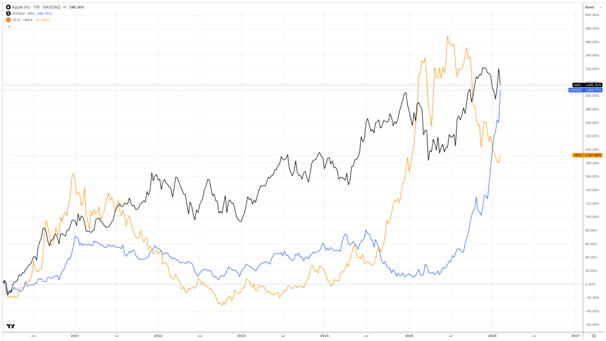
Samsung’s next presentation is scheduled for February 25, coinciding with the release of South Korea’s Business Survey Index, as shown on the economic calendar. The company is expected to unveil new models with a stronger focus on AI features. Apple’s next event, meanwhile, is anticipated a week later, on March 4, when it is expected to introduce new devices, including a more affordable MacBook, along with AI-powered Siri updates. The presentations may reveal how rising costs are being reflected in retail pricing.
It is important that the current recession is not only a consequence of the price shock. A deeper structural shift is also noticeable. Modern smartphones already meet the basic needs of most users, which lengthens replacement cycles and reduces the motivation to upgrade. Even if memory prices stabilize, a return to previous production growth rates is unlikely.
The memory shortage itself, however, is anticipated to persist, putting further pressure on consumer electronics while benefiting memory-chip manufacturers and paving the way for their stocks to appear among market movers and premarket gainers. Thus, 2026 may become a point of adaptation for the industry to a new reality with higher costs, more cautious demand, and strengthened positions for players whose ecosystems and installed bases allow them to absorb price fluctuations with fewer losses.