

A syllable is a unit of pronunciation in a word. It usually contains one vowel sound and may include surrounding consonants. In simple terms, a syllable represents a single beat or sound chunk when a word is spoken aloud.
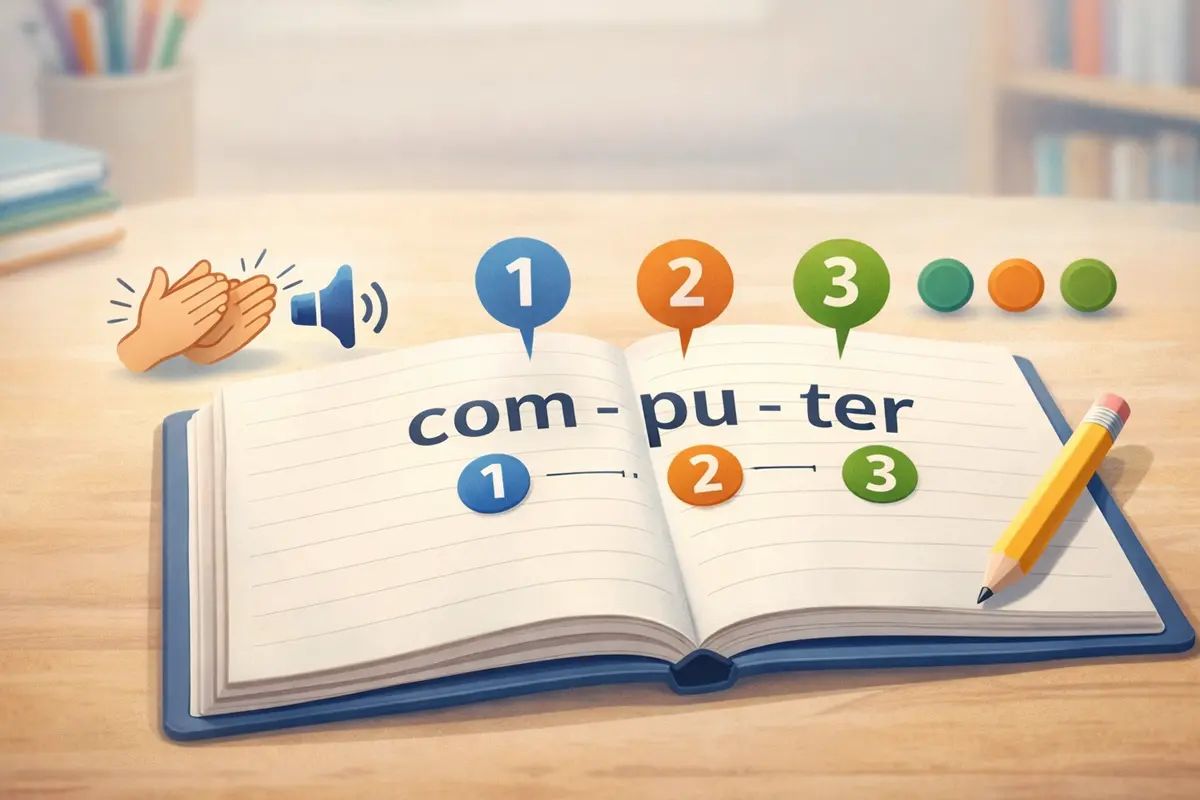
For example, the word cat has one syllable because it contains one vowel sound. The word table has two syllables: ta-ble. The word computer has three syllables: com-pu-ter. In English, syllables are built around vowel sounds rather than letters. A single vowel can form a syllable on its own, but in many cases vowels combine with consonants to create the syllable structure of a word.
Understanding syllables helps learners break words into smaller pronunciation units. This makes it easier to read unfamiliar words, pronounce them correctly, and understand how English rhythm works.
Examples of syllables in common words
- 1 syllable: book, dog, train
- 2 syllables: teacher, apple, window
- 3 syllables: family, computer, beautiful
- 4 syllables: information, education
Why Syllables Matter in English Learning and Writing
Syllables play an important role in how English is spoken, read, and written. They shape the rhythm of speech and help learners understand how words are structured. For language learners, recognizing syllables makes pronunciation easier. Breaking a long word into syllables allows speakers to pronounce it step by step instead of struggling with the entire word at once.
Syllables are also important in reading and vocabulary development. When learners identify syllable patterns, they can decode unfamiliar words more quickly and understand how English words are formed. In writing, syllables are useful for maintaining rhythm and clarity. This is especially important in poetry, songwriting, and other forms of creative writing where the flow of language matters.
Why understanding syllables is useful
- Improves pronunciation and speaking rhythm
- Makes it easier to read unfamiliar words
- Helps break long words into manageable parts
- Supports writing, poetry, and creative language use
Basic Rules for Counting Syllables in English Words
Counting syllables in English is not always perfectly predictable, but several common rules can help estimate the number of syllables in most words. These rules are especially useful for learners who want to understand pronunciation patterns and word structure.
1. Each vowel sound usually forms one syllable
In most cases, every vowel sound represents one syllable. The key point is that syllables are based on sounds rather than the number of vowel letters.
- cat – 1 syllable
- paper – pa-per (2 syllables)
- banana – ba-na-na (3 syllables)
2. Silent “e” at the end of a word usually does not form a syllable
Many English words end with a silent “e”. This letter changes the pronunciation of the vowel before it but normally does not create a separate syllable.
- make – 1 syllable
- time – 1 syllable
- cake – 1 syllable
3. Two vowels together can form one syllable
When two vowels appear together, they sometimes produce a single vowel sound. In such cases, they count as one syllable.
- boat – 1 syllable
- team – 1 syllable
- rain – 1 syllable
4. Some consonants can act as syllable sounds
In certain words, consonants such as l or n can form part of a syllable without a clear vowel sound, especially in endings like “-le”.
- table – ta-ble (2 syllables)
- little – lit-tle (2 syllables)
- bottle – bot-tle (2 syllables)
Simple Methods to Count Syllables in a Word
Even when you know the rules, counting syllables can sometimes be confusing. Fortunately, there are several simple techniques that help identify syllables in most English words.
1. The clap method
This method is commonly used by teachers. Say the word out loud and clap once for each syllable you hear.
- apple – ap-ple (2 claps)
- computer – com-pu-ter (3 claps)
- information – in-for-ma-tion (4 claps)
2. Slow pronunciation method
Pronounce the word slowly and listen for natural breaks in the sound. Each break usually marks a syllable.
- teacher – tea-cher (2 syllables)
- family – fam-i-ly (3 syllables)
- education – ed-u-ca-tion (4 syllables)
3. Checking a dictionary
Many dictionaries show syllable divisions directly in the word entry. This helps learners verify the correct pronunciation and syllable count.
For example, a dictionary may display a word like this:
- com-pu-ter
- in-for-ma-tion
- ed-u-ca-tion
Using these simple techniques together with the basic rules makes it much easier to identify syllables correctly in everyday English words.
Examples: Counting Syllables in Common English Words
Looking at real examples is one of the easiest ways to understand how syllables work in English. Words can contain one or several syllables depending on the number of vowel sounds they include.
Words with 1 syllable
These words contain a single vowel sound and are pronounced in one beat.
- cat
- dog
- book
- train
- light
Words with 2 syllables
Two-syllable words contain two separate vowel sounds that create two pronunciation beats.
- ap-ple
- teach-er
- win-dow
- ta-ble
- mar-ket
Words with 3 syllables
Three-syllable words are very common in everyday English vocabulary.
- com-pu-ter
- fam-i-ly
- an-i-mal
- po-ta-to
- el-e-phant
Words with 4 syllables
Longer words often contain four syllables or more and usually appear in academic or formal language.
- in-for-ma-tion
- ed-u-ca-tion
- com-mu-ni-ty
- ex-am-i-na-tion
- re-al-i-ty
How to Count Syllables in Longer Words and Complex Terms
Longer English words can look intimidating, but they usually follow the same basic syllable patterns. The key is to break the word into smaller sound units and pronounce each part clearly.
Many long words are built from prefixes, roots, and suffixes. Each part often forms its own syllable or group of syllables.
Step-by-step approach
- Read the word slowly.
- Listen for natural sound breaks.
- Separate the word into pronunciation units.
- Count each unit as one syllable.
Examples with longer words
- communication – com-mu-ni-ca-tion (5 syllables)
- opportunity – op-por-tu-ni-ty (5 syllables)
- university – u-ni-ver-si-ty (5 syllables)
- responsibility – re-spon-si-bil-i-ty (6 syllables)
Practicing with longer words helps learners recognize syllable patterns more easily. Over time, it becomes natural to hear the syllable structure of unfamiliar English vocabulary.
How to Count Syllables in Sentences and Full Text
Counting syllables in a single word is relatively simple, but the task becomes more challenging when dealing with full sentences or longer passages of text. In these cases, you need to identify the syllables in every individual word and then combine the total.
One practical approach is to read the sentence slowly and focus on the natural rhythm of the words. Each word can be divided into syllables using the same methods described earlier, such as slow pronunciation or listening for sound breaks.
Example sentence
Consider the sentence:
The student is reading an interesting article.
Now break each word into syllables:
- The – 1 syllable
- stu-dent – 2 syllables
- is – 1 syllable
- read-ing – 2 syllables
- an – 1 syllable
- in-ter-est-ing – 4 syllables
- ar-ti-cle – 3 syllables
When combined, this sentence contains a total of 14 syllables.
While this process works well for short examples, it quickly becomes time-consuming when analyzing longer paragraphs, essays, or articles.
Using an Online Tool to Count Syllables Quickly
When working with longer texts, manually counting syllables can be slow and prone to mistakes. This is especially true for writers, students, teachers, and language learners who need to analyze large amounts of text.
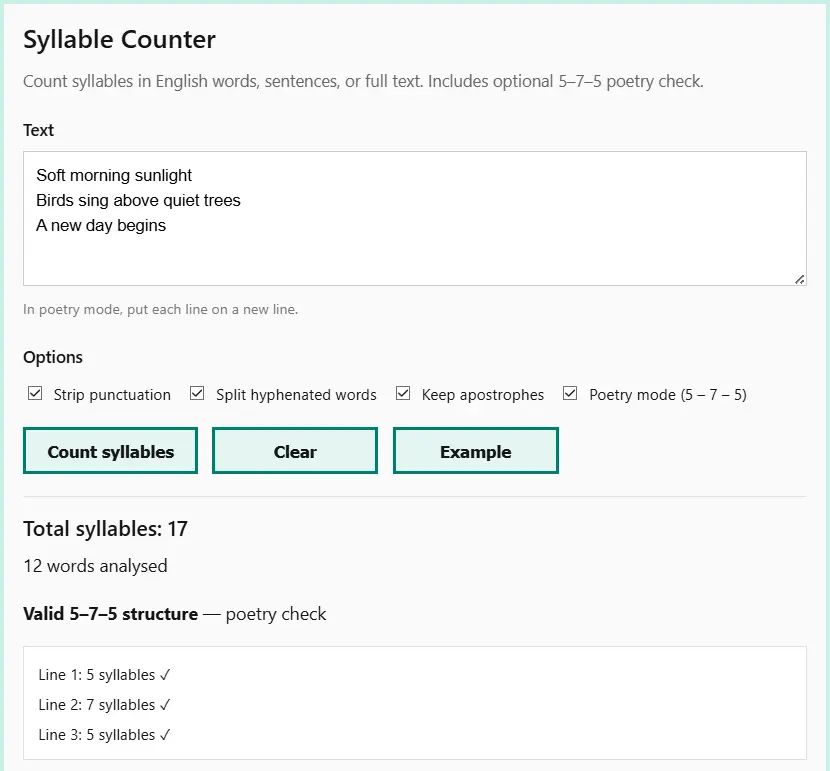
In such cases, an online syllable counter can save significant time by automatically analyzing words and sentences. For example, you can paste your text into a tool like https://lingoharvest.com/calculators/800-english-syllable-counter.html and instantly see how many syllables appear in each word or across the entire text.
Tools like this are useful for several common tasks:
- Analyzing syllable structure in essays or articles
- Checking rhythm in poetry and song lyrics
- Improving pronunciation practice
- Studying English word patterns more efficiently
Using a syllable counter does not replace learning the rules, but it provides a fast and reliable way to verify syllable counts and work with longer pieces of text.