

Most QA teams are running faster release cycles than their testing infrastructure can actually support. Finding top software testing platforms that keep up with modern tech stacks, handle flaky tests, and slot into DevOps workflows without friction is genuinely hard. After reviewing dozens of platforms across enterprise case studies, review platforms, and community adoption signals, the gap between good tools and great ones becomes very clear. This guide covers five standout options worth knowing.
Behind the ranking
Each option was assessed by pulling publicly available data from official product pages, user review platforms, and verified case studies. Only platforms with a documented track record in QA testing made the cut. Options without real-world evidence of performance were dropped early.
→ See the full research breakdown
- Functionize – Best for enterprise QA and automated testing
- Playwright – Best for enterprise web automation and end-to-end testing
- Selenium Testing – Best for cross-browser automation testing and QA
- ACCELQ – Best for enterprise continuous testing automation
- BrowserStack – Best for cross-browser and mobile application testing at enterprise scale
The Difference the Right Top Software Testing Platforms Make
Picking the wrong testing tool doesn’t just slow your team down. It quietly raises your escaped defect rate, inflates maintenance costs, and puts real pressure on release confidence.
Tech stacks evolve fast. Testing frameworks that can’t keep up generate flaky tests that nobody trusts, and that instability eats engineer time while pushing bugs further down the pipeline where they cost more to fix.
The right platform changes that approach. Tools built for modern QA environments handle UI changes without breaking, support meaningful test coverage across browsers and devices, and give teams real data on defect detection rates and mean time to detect (MTTD) bugs.
That kind of reliability is rare. And it’s exactly what separates fast, confident releases from slow, anxious ones.
The 5 Best Top Software Testing Tools: Quick Comparison
Note: All data in this table is sourced from review platforms and the official websites of the listed companies.
| Company Name | Years Operating | Headquartered In |
| Functionize | Est. 2014 | San Francisco, CA |
| Playwright | Est. 2020 | Open Source (Microsoft) |
| Selenium Testing | Est. 2004 | Chicago |
| ACCELQ | Est. 2014 | Dallas, Texas |
| BrowserStack | Est. 2011 | Mumbai |
-
Functionize – Best for Enterprise QA and Automated Testing
What Is Functionize’s Main Business?
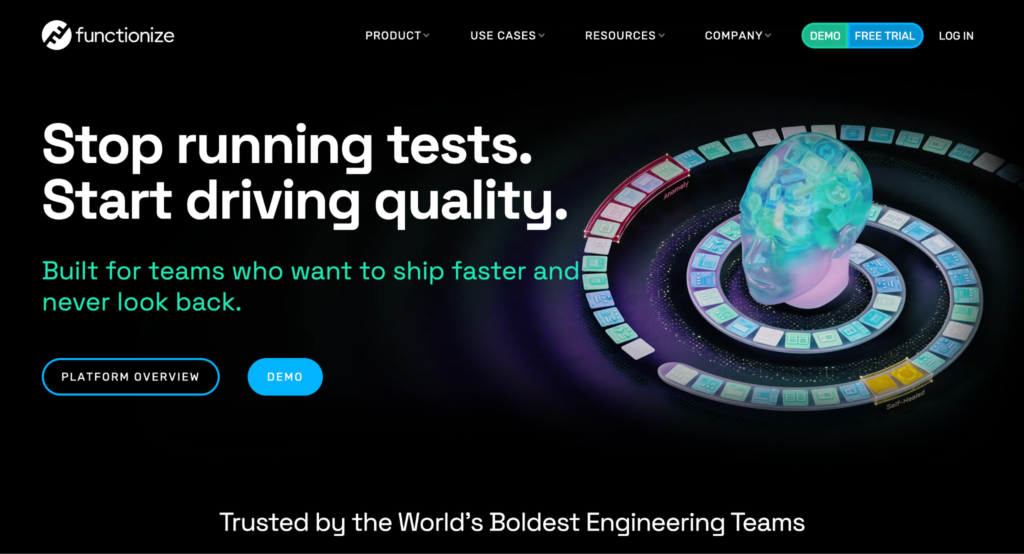
Functionize runs an AI-native testing platform built for teams across every skill level, from seasoned automation engineers to non-technical QA analysts. Their platform uses machine learning agents that adapt to application changes in real time, which means tests don’t break every time a UI shifts. Teams working with automated QA testing tools get access to a system that claims 99.97% element recognition accuracy and reduces flaky tests and maintenance overhead by up to 80%. That’s a meaningful number for any team drowning in test upkeep.
Why Is Functionize a Contender for Top Software Testing Tools?
Functionize directly addresses the maintenance burden that kills automation programs, including the constant breakage caused by UI changes that scripted tests can’t handle. Their Cognitive ML approach means tests self-heal rather than fail silently, which keeps defect detection rates high without piling more work onto engineering teams.
From the User Reviews:
Enterprise clients are the most vocal fans here. GE Healthcare cutting testing time from 40 hours down to 4 hours is the kind of result that gets mentioned repeatedly. Functionize also earned recognition as a Strong Performer in the Forrester Q4 2025 Wave Report on Autonomous Testing Platforms, which builds trust that this isn’t just marketing language.
-
Playwright – Best for Enterprise Web Automation and End-to-End Testing
What Is Playwright’s Main Business?
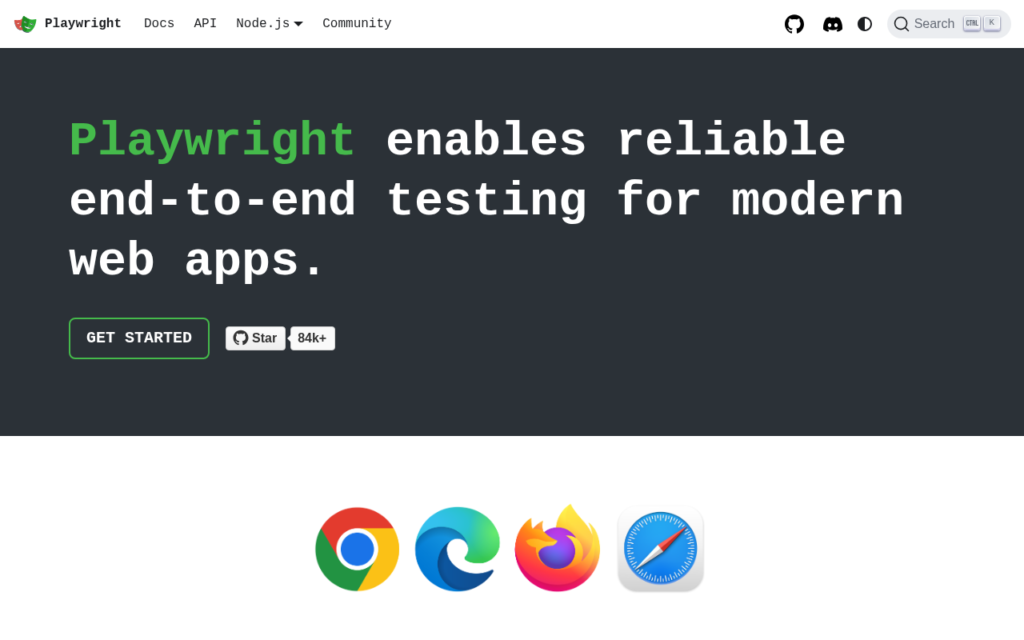
Playwright is an open-source browser automation library backed by Microsoft, built for reliable end-to-end testing across modern web applications. It supports multiple programming languages, including TypeScript, JavaScript, Python, .NET, and Java, which makes it approachable for most engineering teams. Auto-waiting, resilient locators, and network interception are baked in by default. For teams tired of flaky tests caused by timing issues, that auto-wait behavior alone is a practical win. The Apache-2.0 license means zero vendor lock-in (and zero licensing cost, which matters at scale).
Why Is Playwright a Contender for Top Software Testing Tools?
Playwright solves one of the most persistent problems in web testing, which is cross-browser inconsistency, by running the same test suite reliably across Chromium, Firefox, and WebKit without requiring separate configurations. The speed of community adoption here is impressive, and the backing of a major technology company means the framework isn’t going anywhere.
From the User Reviews:
Honestly, the community momentum around Playwright tells a clear story. Over 75,000 GitHub stars and more than 20 million NPM downloads as of 2025 suggest this isn’t a niche tool anymore. Teams using it point to the test isolation and resilient locators as the features that actually reduce day-to-day maintenance pain.
-
Selenium Testing – Best for Cross-Browser Automation Testing and QA
What Is Selenium Testing’s Main Business?
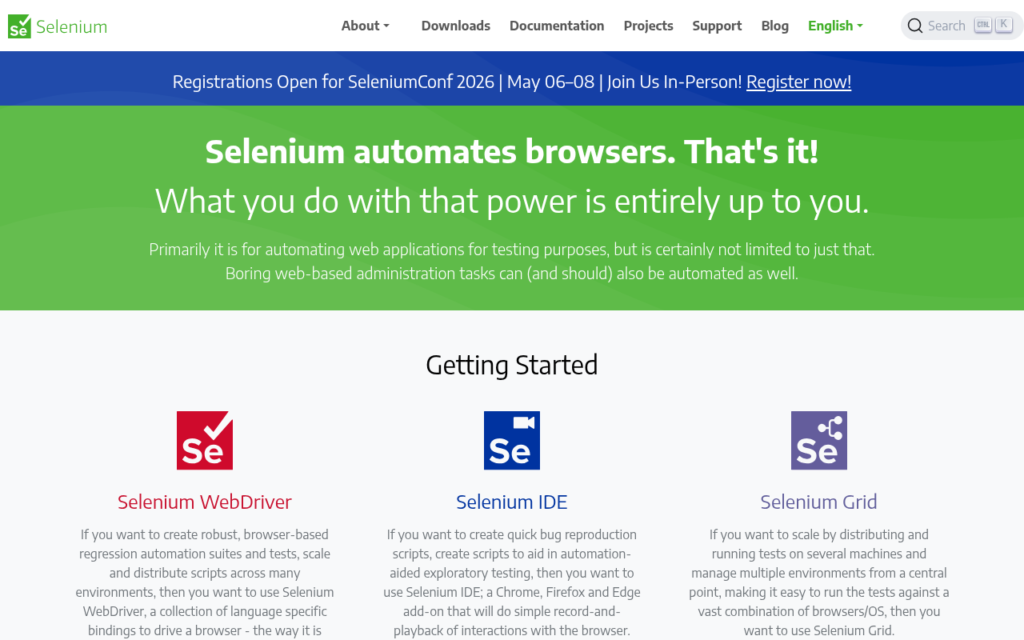
Selenium is the original open-source browser automation framework, and it’s been the industry standard since 2004. The project covers three tools: WebDriver for browser control, IDE for record-and-playback, and Grid for distributed testing across multiple machines. Running under the Software Freedom Conservancy as a 501(c)(3) non-profit, Selenium operates with community governance rather than commercial pressure. For teams that need broad browser coverage at no licensing cost, it remains the foundational choice. The trade-off is that setup and maintenance require solid scripting knowledge (not ideal for smaller teams without dedicated automation engineers).
Why Is Selenium Testing a Contender for Top Software Testing Tools?
Selenium’s longevity and vendor backing from major browser makers give it a stability that newer frameworks are still building toward. When a testing team needs a proven, community-supported framework with no risk of a pricing change or product discontinuation, Selenium is the reliable answer.
From the User Reviews:
Selenium’s reputation is built on trust earned over two decades. QA professionals consistently cite it as the baseline for cross-browser automation, and active community support keeps it relevant. The main criticism that surfaces is the setup complexity and the maintenance cost that comes with more brittle locators compared to newer alternatives like Playwright.
-
ACCELQ – Best for Enterprise Continuous Testing Automation
What Is ACCELQ’s Main Business?
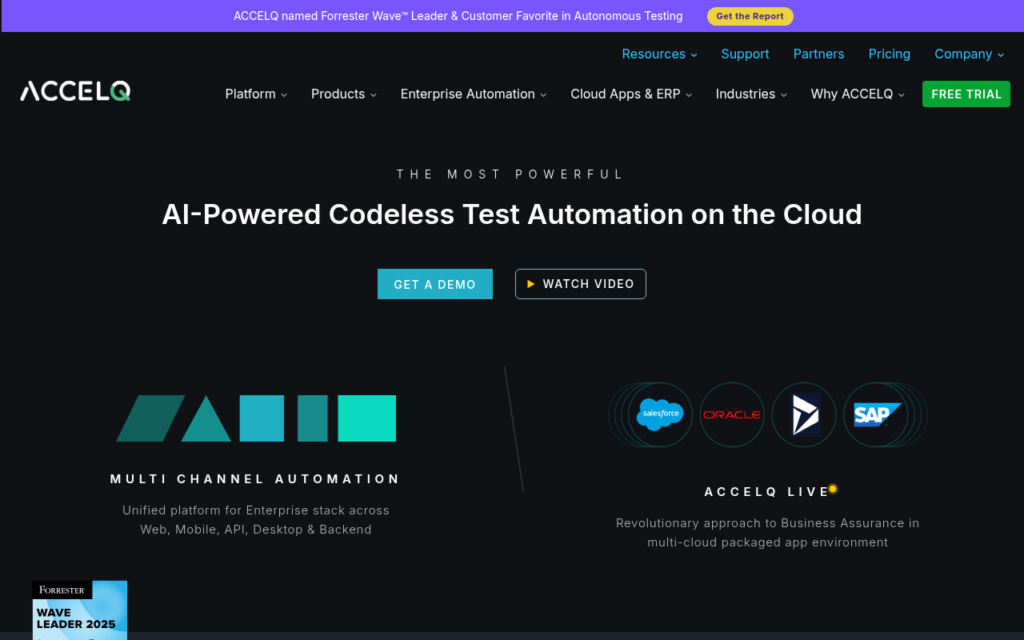
ACCELQ is a continuous testing platform that handles Web UI, API, mobile, and desktop automation without requiring teams to write code. Their browser-based interface lets non-technical testers build and maintain automated tests without an IDE, which removes a real bottleneck in teams where automation skills are unevenly distributed. Serving Fortune 500 clients across healthcare, financial services, retail, and pharmaceutical sectors (think enterprise pricing), ACCELQ focuses on reducing regression cycle time and defect leakage. Their claim of 3X faster test design and over 70% reduction in maintenance costs is backed by verified client results.
Why Is ACCELQ a Contender for Top Software Testing Tools?
ACCELQ addresses the skill gap problem directly, where teams can’t move faster because only a subset of testers can write automation scripts. The codeless approach means business analysts and manual testers can contribute to automation coverage without waiting on engineering resources.
From the User Reviews:
ACCELQ earned a G2 Leader badge with a 4.8 out of 5 rating in Spring 2024, and the “Easiest to Do Business With” badge is the one that stands out most. Users consistently describe the setup experience as notably smoother than comparable platforms. Forrester also named them a leader in continuous functional test automation, which gives the G2 score additional credibility.
-
BrowserStack – Best for Cross-Browser and Mobile Application Testing at Enterprise Scale
What Is BrowserStack’s Main Business?
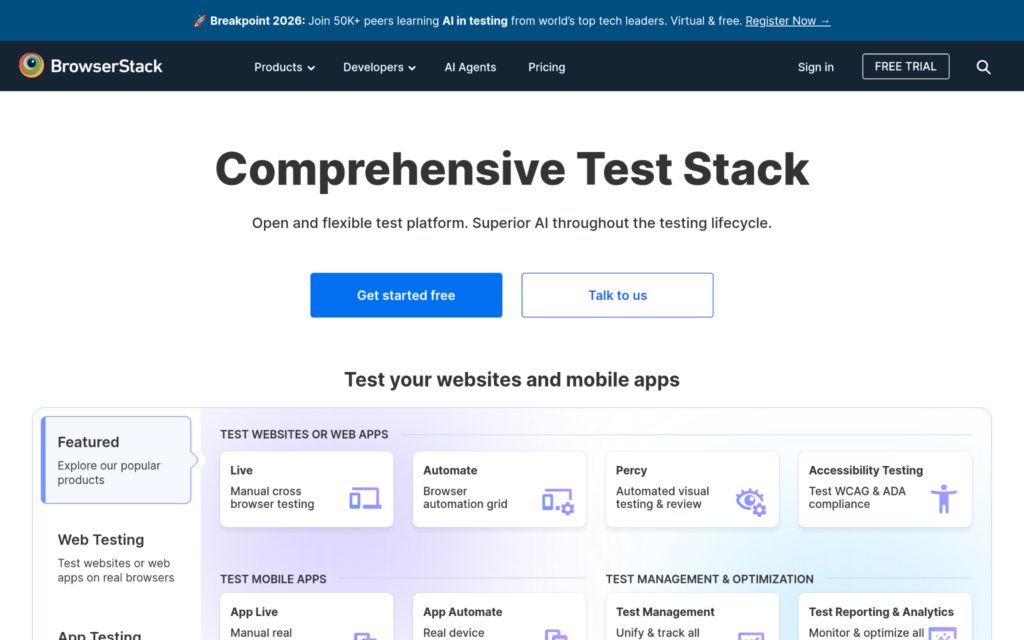
BrowserStack operates one of the largest real device cloud infrastructures in the testing industry, running 21 global data centers and serving over seven million developers and testers across 135 countries. Their product suite covers Live, App Live, Automate, App Automate, and Percy, with integrations built for Selenium, Playwright, and other major automation frameworks. Founded in 2011 and now valued at $4 billion, BrowserStack handles over three million daily tests at the enterprise level. For teams that need reliable cross-device coverage without managing physical device labs, it’s a strong fit. Notable clients include Amazon, Microsoft, and NVIDIA.
Why Is BrowserStack a Contender for Top Software Testing Tools?
BrowserStack removes the infrastructure burden of cross-browser and cross-device testing, letting QA teams focus on test quality rather than environment management. The scale of their real device cloud and their record of strategic acquisitions, including Percy and Nightwatch.js, signal a platform that’s actively expanding to meet where testing is heading.
From the User Reviews:
BrowserStack has earned the TrustRadius Top Rated Award three consecutive years through 2025, which reflects consistent satisfaction rather than a one-year spike. Teams at enterprise scale call out session reliability and the breadth of device coverage. The Forbes Cloud 100 recognition in both 2024 and 2025 adds weight to what the user reviews already say.
How These Were Chosen and Verified
Putting this list together required more than a quick scan of review scores. The goal was to identify platforms with real evidence of performance in QA testing environments, not just strong marketing pages.
Data Sourcing and Preparation
The process started by building a longlist from multiple sources: software review directories, community forums, published case studies, and official product documentation. Platforms that appeared consistently across several of these sources were flagged for deeper review. Any tool with minimal external presence or no documented client results was removed from consideration at this stage, keeping the shortlist focused on options with genuine market presence.
Pre-Verification Phase
Once the shortlist was in place, each platform was checked for review consistency. Patterns in practitioner reviews were analyzed across review platforms to identify recurring themes, both positive and negative. Tools with suspicious review profiles (unusually uniform scores, thin review histories) were deprioritized. The focus stayed on options where real practitioners had shared detailed, experience-based assessments.
The Verification Phase
Site claims were cross-referenced against independent sources wherever possible. If a platform stated a specific performance metric or client outcome, that claim was checked against publicly available case studies, press coverage, or third-party analyst reports. Platforms whose stated capabilities aligned with what external sources described earned more weight in the evaluation. This cross-checking step filtered out platforms that were strong on claims but thin on evidence.
Tracking Authority Markers
Recognition from established analyst firms, inclusion in major industry reports, and mentions in credible technology publications were all tracked during the evaluation. A platform recognized by Forrester, G2, or TrustRadius carries a different level of accountability than one relying solely on its own promotional content. Awards and rankings from these organizations don’t guarantee quality, but they do signal that external reviewers took the platform seriously enough to include it in formal evaluations.
Top Software Testing Tools Proof Points
Each company was checked for dedicated service pages covering their testing capabilities, verified reviews tied to specific use cases, and case studies showing measurable outcomes. Platforms with vague capability descriptions or generic testimonials were scored lower than those with concrete, detailed evidence of results in QA testing contexts. The companies that made the final list all demonstrated documented service depth, not just broad feature lists.
How to Pick Your Best Match
Choosing between these platforms depends on your team’s current setup, your testing maturity, and where your biggest bottlenecks are. Here’s what to think through before committing.
- Industry/Domain Experience: Look for a platform with documented results in your sector. A healthcare company has different testing priorities than a retail startup, and platforms with relevant case studies will get you to value faster.
- Features and Service Options: Match the feature set to your actual workflow. A codeless tool like ACCELQ suits teams with limited scripting resources, while Playwright fits teams with strong engineering depth. Don’t pay for features your team won’t use.
- Pricing Structure: Open-source tools like Selenium and Playwright carry no licensing costs, but the real cost is engineering time. Commercial platforms (think enterprise pricing with ACCELQ or BrowserStack) shift that cost toward subscriptions but reduce internal maintenance load.
- Results Measurement: Choose a platform that surfaces meaningful metrics. Defect detection rates, flaky test rate, and escaped defect rate are the numbers that tell you whether your testing is actually working.
- Industry Knowledge and Compliance: Teams in regulated industries like healthcare or financial services need platforms that support testing against ISO 25010 and IEEE 829 standards. Verify that any platform you’re evaluating has experience with your compliance requirements before signing a contract.
Closing Thoughts
The right testing platform doesn’t just catch bugs faster. It shifts how confidently your team can ship. Functionize leads for enterprise AI-native automation; BrowserStack handles scale and device coverage well, and open-source options like Playwright and Selenium remain strong for engineering-heavy teams. ACCELQ fills the gap for codeless automation at scale. As AI-assisted testing matures, the gap between platforms that adapt automatically and those that require manual upkeep will only grow wider.