

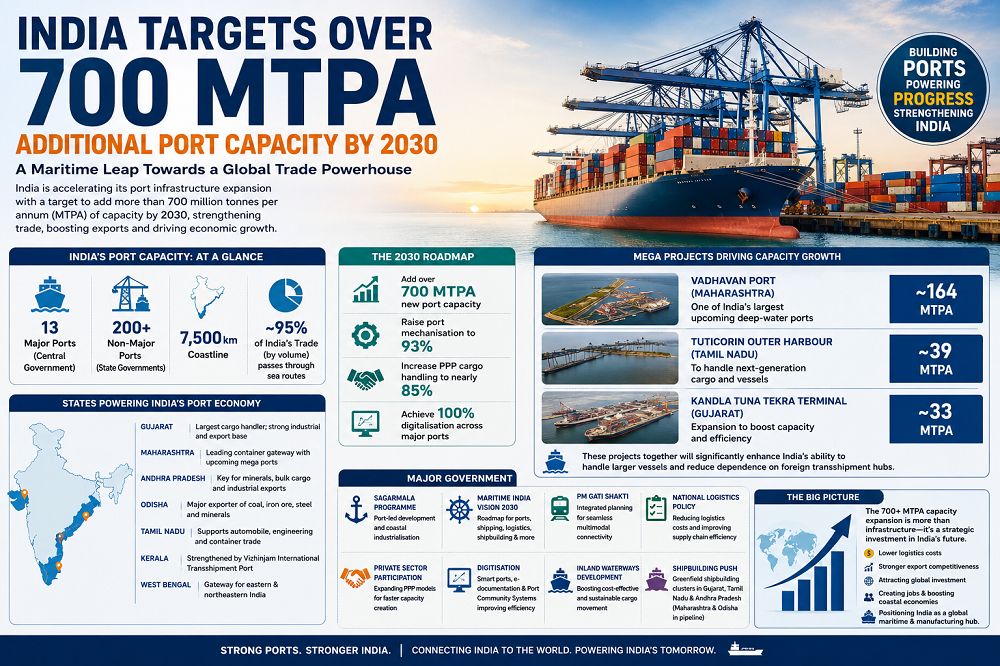
For decades, India’s economic story has largely revolved around highways, railways and airports. Today, another infrastructure revolution is quietly taking shape along the country’s 7,500-kilometre coastline. The government’s ambitious plan to create more than 700 million tonnes per annum (MTPA) of additional port handling capacity by 2030 is more than an infrastructure upgrade—it is a strategic effort to position India as a leading maritime and global trading nation.
As global supply chains continue to diversify and manufacturing shifts towards Asia’s emerging economies, India’s ports are becoming critical assets in determining the country’s competitiveness. Efficient ports reduce logistics costs, attract industries, accelerate exports and connect domestic manufacturers with international markets. In many ways, the next phase of India’s economic growth could be shaped as much by its ports as by its factories.
India’s Growing Maritime Strength
India’s maritime network consists of 13 major ports and more than 200 non-major ports, serving as gateways for international trade. Nearly 95 percent of India’s merchandise trade by volume is transported through the maritime route, making ports indispensable to the country’s economy.
Over the last decade, cargo handling capacity has expanded significantly through mechanisation, private investments and modernization initiatives. However, rising manufacturing output, increasing exports and growing domestic consumption require a new generation of world-class ports capable of handling larger vessels and higher cargo volumes.
The proposed addition of over 700 MTPA capacity by 2030 reflects the government’s confidence that India’s trade volumes will continue to grow rapidly over the next decade.
Ports Are Becoming Economic Ecosystems
Modern ports are no longer just locations where ships load and unload cargo. Around the world, successful ports function as integrated economic ecosystems that combine logistics, manufacturing, warehousing, customs services, industrial parks and export-oriented industries.
India is increasingly adopting this model through port-led industrialisation. New industrial corridors, logistics parks and multimodal transport systems are being developed alongside major ports, allowing manufacturers to move raw materials and finished products more efficiently.
Lower transportation costs make Indian products more competitive in international markets while encouraging global companies to establish production facilities closer to port infrastructure.
Coastal States Leading the Transformation
Several coastal states have emerged as key contributors to India’s maritime economy.
Gujarat remains the country’s largest maritime state, handling a significant share of India’s cargo through a combination of public and private ports. Its strong industrial base, petrochemical sector and manufacturing clusters make it one of India’s biggest export gateways.
Maharashtra continues to dominate container traffic through Jawaharlal Nehru Port, while the upcoming Vadhavan Port is expected to become one of the country’s largest deep-water ports.
Andhra Pradesh has successfully developed multiple commercial ports that support mineral exports, industrial cargo and container movement.
Odisha has transformed into a major maritime hub for coal, iron ore, steel and aluminium exports. Paradip, Dhamra and Gopalpur ports have strengthened the state’s position as one of India’s fastest-growing industrial regions.
Tamil Nadu plays a crucial role in automobile exports, engineering goods and manufacturing, supported by Chennai, Kamarajar and VOC ports.
Meanwhile, Kerala’s Vizhinjam International Transshipment Port has the potential to reduce India’s dependence on foreign transshipment hubs by attracting large international container vessels directly to Indian shores.
Government Policies Driving the Maritime Revolution
India’s maritime transformation is supported by multiple policy initiatives that complement each other.
The Sagarmala Programme introduced the concept of port-led development by integrating port modernization with industrial growth and improved coastal connectivity.
The Maritime India Vision 2030 provides a comprehensive roadmap covering infrastructure development, shipbuilding, coastal shipping, cruise tourism, logistics and digital transformation.
PM Gati Shakti has improved coordination between ports, highways, railways and airports, helping create seamless multimodal transport networks.
The National Logistics Policy focuses on reducing logistics costs, improving supply chain efficiency and increasing India’s competitiveness in global trade.
The government has also encouraged greater private sector participation through Public-Private Partnership (PPP) projects, resulting in faster capacity creation and improved operational efficiency.
Digital initiatives such as electronic documentation, Port Community Systems and smart port technologies are simplifying cargo movement while reducing turnaround time.
Why Capacity Alone Is Not Enough
While expanding port capacity is essential, long-term success will depend on improving overall logistics efficiency.
India still faces challenges related to last-mile connectivity, customs processes, container availability and multimodal integration. Unless highways, dedicated freight corridors, rail connectivity and inland waterways develop simultaneously, additional port capacity alone may not fully translate into lower logistics costs.
Environmental sustainability is another critical consideration. Future ports must incorporate green technologies, renewable energy, shore power facilities and cleaner cargo handling systems to align with global climate commitments.
Developing skilled manpower for maritime logistics, shipbuilding and port management will also be crucial as India’s maritime sector expands.
A Strategic Opportunity
Global trade patterns are changing rapidly. Rising geopolitical tensions, supply chain diversification and increasing demand for resilient manufacturing destinations are creating new opportunities for India.
Countries looking to reduce dependence on single manufacturing locations are actively exploring India as an alternative production base. Efficient ports can become one of India’s strongest competitive advantages in attracting global investments.
Large-scale port expansion also supports the government’s broader ambitions under Make in India, Atmanirbhar Bharat and Viksit Bharat 2047 by strengthening export infrastructure and enabling higher industrial output.
Looking Ahead
The target of adding more than 700 MTPA of port capacity by 2030 represents much more than an infrastructure milestone. It reflects India’s intention to emerge as a global maritime, manufacturing and logistics powerhouse.
If supported by efficient multimodal connectivity, policy reforms, digital innovation and sustainable infrastructure, India’s ports could become powerful engines of economic growth—creating employment, boosting exports, reducing logistics costs and strengthening the country’s position in international trade.
The next chapter of India’s growth story may not be written only in industrial parks or technology hubs. It may well be written along its coastline, where world-class ports are preparing to connect Indian enterprise with the global economy.