
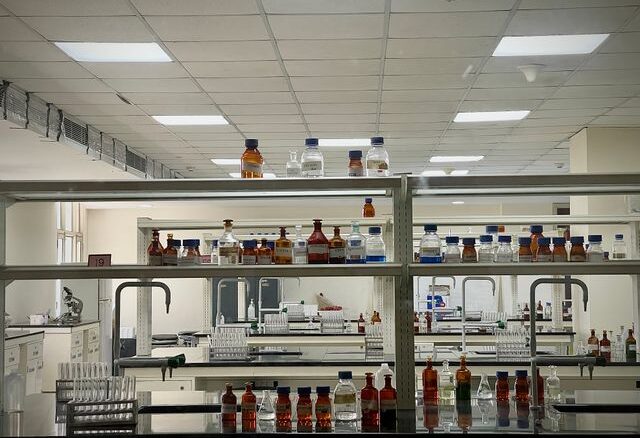
Research institutions and pharmaceutical companies are facing growing pressure to account for a cost center that rarely shows up on balance sheets: the sheer amount of energy, water, and material that a working laboratory consumes compared to standard commercial space.
New data compiled by BestLabTech puts real numbers behind that pressure, and for executives weighing sustainability investments, the figures suggest the return on efficiency measures is larger — and faster — than many assume.
Energy costs that outpace ordinary facilities
The starting point is stark: laboratories consume five to ten times more energy than office space of equivalent size, a gap that widens to 100-fold in facilities with clean rooms. At Harvard, labs occupy about a fifth of total campus floor space but account for nearly 44% of the university’s energy spend — a ratio that should concern any facilities budget owner managing similar infrastructure.
Two categories of equipment dominate that spend. Ultra-low-temperature freezers running at -80°C consume close to 20 kilowatt-hours daily, but a University of Edinburgh study found that raising the set point to -70°C cuts consumption by nearly 30% at zero capital cost — a rare efficiency win with no upfront investment required. Institutions that go further and replace aging units outright see the return scale accordingly: UCSF’s freezer upgrade project saved over 310,000 kilowatt-hours a year across 43 units, paying for itself in eight years, with projected savings exceeding $1.4 million annually if extended across its full 1,119-unit inventory.
Fume hoods present a similar opportunity. An untreated hood can cost more than $3,000 a year to run, and with an estimated 500,000 to 1.5 million hoods operating across the US at a combined annual cost exceeding $6 billion, even modest efficiency gains scale into meaningful savings. Harvard’s sash-management program alone recovered roughly 70% of associated ventilation energy, worth $200,000 to $250,000 a year.
Certification is becoming a competitive signal
Pharmaceutical companies appear to have recognized this math faster than academic institutions. More than 4,500 labs across 54 countries now carry My Green Lab certification, with Biogen certifying its entire lab network two years ahead of schedule and Sanofi targeting 95% completion. AstraZeneca has gone further still, becoming the first organization globally to reach the certification program’s newer 2.0 tier. The average certified lab reports savings of about 29,000 kilowatt-hours a year — a figure that, multiplied across a large corporate lab network, represents a tangible line item on an annual energy budget.
Academic institutions lag well behind this pace, a gap researchers link to program structure rather than available funding, suggesting the opportunity for improvement sits mostly in execution rather than investment.
Materials costs add another layer
Beyond energy, researchers generate an average of 116 kilograms of plastic waste annually, with a handful of consumables — pipettes, tip boxes, multiwell plates — accounting for the majority of it by weight. Reuse programs offer a direct cost lever here too: a single reconditioning cycle cuts a consumable’s plastic footprint in half, with measured savings of up to 4.5 tonnes of CO2 equivalent per tonne of plastic recovered across five cycles.
Zooming out to the industry level, the global pharmaceutical sector’s carbon footprint grew 77% between 1995 and 2019, outpacing overall global emissions growth by a wide margin, with roughly three-quarters of that footprint sitting in supply chains — a signal that procurement strategy, not just facility operations, increasingly belongs on the sustainability agenda.
For decision-makers overseeing lab-intensive operations, the underlying message is straightforward: the efficiency gains are well-documented, largely low-cost, and increasingly used by competitors as a point of differentiation.