

New Delhi, Aug 17: The Women Leaders’ Conclave 2026, held on August 13-14, 2026 at the Kamala Devi Complex, India International Centre, New Delhi, led by Rekha Mody and structured by Dr. Nirja Mattoo, concluded successfully, reaffirming its position as a national platform for dialogue, collaboration, and policy action on women’s leadership.
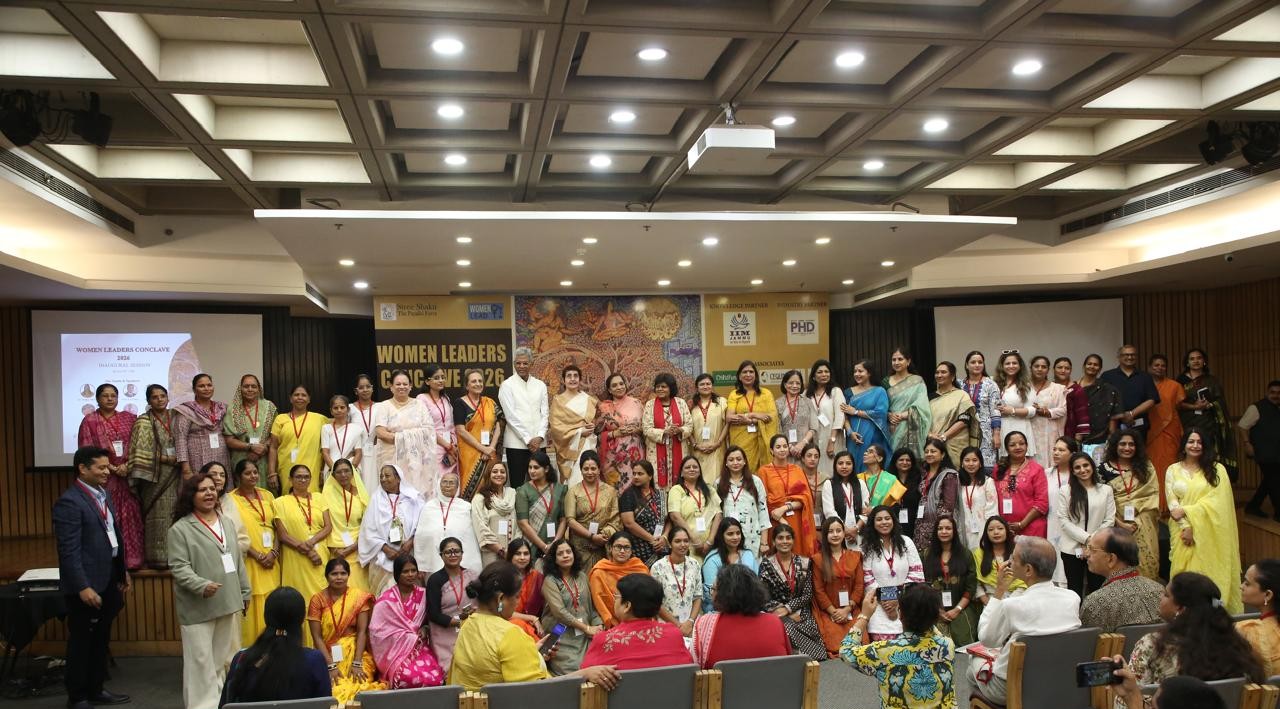
The Conclave brought together 125 women leaders from 13 states across India, continuing WLC’s mission to advance women’s leadership and gender equity in alignment with the vision of a Viksit Bharat
A powerful statement by Dr Karan Singh, statesman, scholar and former Union Minister, made people think: “In Indian culture, women are respected, not in our society.” The thought-provoking observation left the audiences reflecting on the gap between the values we proudly speak of and the lived reality of women today.
Below are the highlights of the event that saw women from all walks of life come together; ladies from the various panchayats broke barriers and attended this powerhouse of a conclave.
A National Gathering of Voices
WLC 2026 featured over 60 speakers, including distinguished leaders from government, academia, law, the arts, and civil society, among them Dr. Rashmi Singh, Prof. B.S. Sahay, Prof. Vinita Sahay, Mathew Cherian, Dr. Meera Khanna, Lora Prabhu, Dr. Nirja Mattoo , Nitya Pathak, Former Judge and Sr. Advocate Anjana Prakash, Dr. Aruna Oswal, Dr. Shalini Sharma, and Gita Shroff
Session Highlights
Day 1, August 13, 2026
– Inaugural Session: Formally opened the Conclave, with welcome and keynote remarks positioning women’s leadership within India’s journey toward a Viksit Bharat, and a vote of thanks by Rekha Mody.
– Plenary 1, Women Lead: Brought together public policy, civil service, and academic leaders to discuss institutional pathways for women’s leadership.
– Breakaway, Climate Change and Mitigation: Examined how women are leading resilient, sustainable responses to climate change, from gender-responsive disaster management and renewable energy to water security, sustainable fashion, and land rights.
– Breakaway, Impact of the Care Economy: Explored the economic weight of paid and unpaid care work, and the case for recognising it in policy and GDP frameworks to strengthen women’s economic visibility.
– Breakaway, When Women Write: Examined the scholarly debate raised by “Revisiting Authorship of Mahakavi Kalidas,” questioning whether classical works long credited to Kalidasa were in fact composed by his wife, Vidyottama.
– Breakaway, Reimagining Livelihood: Discussed pathways for women’s economic empowerment through technology, entrepreneurship, and skilling, including initiatives such as WICET (Women in Construction, Engineering and Technology).
– Plenary 2, When Women Write : Author Dr. Alka Saraogi spoke on her research into Gandhi and Sarla Devi, alongside the release of her novel, Register Me as Kulbhushan, translated by Mr. John Vater.
– Cultural Skit: A performance introduced by Ms. Gita Shroff brought a grassroots, community voice into the day’s programming.
Day 2, August 14, 2026
– Townhall, Panchayat to Parliament: A dedicated session spotlighting India’s grassroots women leaders in direct dialogue with national policymakers (detailed below).
– Innovations for Inclusive Convergence: Highlighted collaborative, state-level models for grassroots governance, including strengthened Anganwadi outreach, the Khelo India, Kashmir sports initiative by CEQUIN, and the SAMARTH capacity-building programme.
– Digital Challenges and Solutions: Addressed the intersections of technology, gender, and safety, including online harassment and emerging AI-related risks, alongside initiatives such as Tech Hinsa by Girl Effect for building safer digital spaces for women and girls.
– Women, Work and Mobility: Examined structural barriers to women’s economic participation, including workplace safety, equal pay, caregiving burdens, and the layered vulnerabilities faced by migrant and homeless women.
– Plenary, Women and Law, Access to Justice: Drew on NCRB 2024 data to examine the gap between women’s constitutional protections and their lived access to justice, and the continuing under-representation of women in legislature and the judiciary.
– Valedictory and Awards: Closed the Conclave with a book release and two national awards presented by Dr. Karan Singh (detailed below).
– Empowering Grassroots Leadership: The Panchayat Leaders
– A defining feature of WLC 2026 was its deliberate spotlight on grassroots governance, with 35 Panchayat leaders from across the country brought into direct dialogue with national policymakers, jurists, and institutional heads, an exchange rarely afforded to elected local leaders at a platform of this scale.
The centrepiece of this effort was the Townhall, “Panchayat to Parliament,” moderated by Prof. Anil Vaidya of the S.P. Jain Institute of Management & Research. The session opened with a skit by Manjusha Bhaskarwar of Pune, setting the tone for a candid, ground-up conversation. Grassroots leaders spoke as group leads representing their regions, including Gita Shroff , Smriti Singh , Dr. Ebha Patel, Lata Devi, Renu Paswan, Vandana , and Anjana Sharma.
By structuring the Townhall as a direct pipeline from panchayat to parliament, WLC 2026 gave these leaders a rare national stage to voice the realities of grassroots governance, reinforcing WLC’s belief that women’s leadership must be built from the panchayat upward, not the parliament downward.
Book Launches
The Conclave marked the release of two significant literary and research works:
– Register Me as Kulbhushan , by Dr. Alka Saraogi, translated by Mr. John Vater
– Revisiting Authorship of Mahakavi Kalidas, a research work by Dr. Kamal Mishra and Dr. Shovana Narayan
National Awards Conferred
Two national awards were presented at the Conclave’s Valedictory Session by Dr. Karan Singh, Statesman, Scholar, and Former Union Minister:
– The Dayawati Modi Stree Shakti Samman to Senior Advocate Dr. Shobha Gupta
– The Vidushi Vidyottama Stree Shakti Samman to Dr. Shashi Bala