
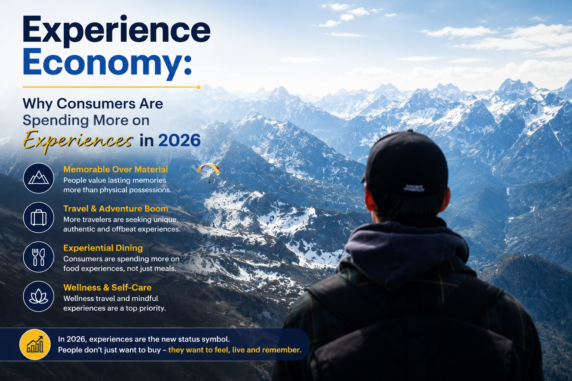

Aug 22: Consumers are increasingly choosing experiences over things, and the shift is becoming visible in spending behaviour. According to the Mastercard Economics Institute, consumers’ share of spending on experiences excluding travel rose to 20.4% in 2025, up from 19.9% in 2024. Mastercard’s 2026 research also found that 59% of Europeans say they value experiences more than ever, while 46% are willing to spend less on technology, gadgets or streaming services to afford more leisure activities.
The trend is also becoming increasingly relevant in India. The Thomas Cook India-SOTC India Holiday Report 2025, based on more than 2,500 respondents, found that 60% of Indian travellers were seeking unique, experiential or bucket-list holidays, while 84% planned to increase their travel spending by 20% to 50%.
From travel and live entertainment to wellness, dining, cultural activities and local experiences, consumers are increasingly spending on things they can feel, participate in and remember. This shift is driving the growth of what is known as the experience economy.
What Is the Experience Economy?
The experience economy describes a shift in consumer behaviour from simply purchasing products and services to seeking memorable, personalised and emotionally engaging experiences.
A product delivers utility. A service solves a need. An experience creates an emotional connection.
For example, a traveller may no longer be satisfied with simply booking a hotel room. They may want a heritage property, a local food experience, a wellness retreat or an activity that allows them to connect with the destination.
This change is influencing sectors ranging from travel and hospitality to retail, entertainment, food, wellness and events.
Why Are Consumers Spending More on Experiences?
Experiences Create Long-Lasting Memories
One of the strongest drivers of the experience economy is the emotional value attached to memories.
A new gadget may eventually become outdated, but a family holiday, concert, sporting event or special celebration can remain meaningful for years.
Mastercard’s European research found that 70% of consumers considered ticking off bucket-list activities a priority in 2025. The motivations included creating lifelong memories, seeing the world differently and sharing experiences with loved ones.
This makes experiences different from conventional purchases. Consumers are not simply buying an activity; they are buying the opportunity to create a story they can remember and share.
Digital Fatigue Is Increasing the Appeal of Offline Experiences
The growth of technology and artificial intelligence is creating an interesting paradox.
As consumers spend more time online, offline experiences can become more attractive.
Mastercard’s 2026 research found that 60% of Europeans are prioritising offline experiences to balance the time they spend online, while 64% are consciously seeking human recommendations instead of relying on algorithms.
This is creating interest in digital-detox holidays, outdoor activities, live entertainment, community events and other experiences that provide a break from screens.
The implication for businesses is significant: technology may help consumers discover an experience, but the experience itself increasingly needs a strong human element.
India’s Experience Economy Is Gaining Momentum
India offers an especially interesting example of this transformation.
The country’s growing travel market is increasingly being shaped by experiential, spiritual, wellness and cultural tourism. Euromonitor identifies experiential and spiritual tourism as an important force shaping India’s travel demand, with travellers seeking wellness retreats, cultural immersion, spiritual festivals and adventure experiences.
The Thomas Cook-SOTC India Holiday Report also found strong interest in experience-led travel, including cruises, concerts, global sporting events, wildlife safaris, gastronomy, stargazing and phenomenon-based travel.
This reflects a broader change in the Indian consumer mindset. Travel is increasingly being viewed not simply as a way to visit a destination but as an opportunity for discovery, personal enrichment and memorable experiences.
Travel Is at the Centre of the Experience Economy
Travel remains one of the clearest examples of experience-driven consumption.
Today’s traveller may want to do more than visit famous landmarks. They may want to learn how local food is prepared, participate in a cultural activity, explore nature, attend a major event or experience a destination through the eyes of local communities.
This creates opportunities for hotels, resorts, tour operators and destinations to move beyond traditional accommodation and sightseeing packages.
The product increasingly becomes the complete experience.
For Indian travellers, this is already visible in growing interest in experiential holidays. The Thomas Cook-SOTC report found that 85% of respondents planned to increase the frequency of their holidays, while 54% planned longer holidays.
Live Events Are Becoming a Major Spending Category
Concerts, sporting events, festivals and cultural programmes have become important parts of the experience economy.
Mastercard Economics Institute data showed that live events represented 32.1% of European consumer spending on experiences excluding travel and restaurants in 2024, compared with 31.5% in 2023 and 30.7% in 2019.
The economic impact extends beyond ticket sales.
A major concert can increase demand for hotels, restaurants, transportation, shopping and other local services. Sporting events and festivals can similarly create economic activity across an entire destination.
This makes experience-led consumption important not only for event companies but also for hospitality, retail and tourism businesses.
Wellness Is Becoming Part of the Experience Economy
Wellness is another area benefiting from experience-driven spending.
Consumers are increasingly interested in retreats, spas, fitness programmes, mindfulness, nature-based activities and personalised wellness experiences.
The appeal is often the complete environment rather than a single service.
A wellness resort, for instance, may combine accommodation, nutrition, exercise, relaxation, nature and social interaction.
For businesses, this creates opportunities to package multiple services into one distinctive experience rather than selling them separately.
Retail Is Moving Beyond Transactions
The experience economy is also changing physical retail.
Consumers can compare products and prices online within seconds. This means physical stores increasingly need to offer something that cannot be replicated easily through an e-commerce page.
Brands are responding through:
- Interactive product demonstrations
- Workshops and events
- Personal consultations
- Product trials
- Immersive store environments
- Community activities
- Exclusive launches and experiences
The objective is to turn the store from simply a place to buy into a place to discover, interact and engage.
Food Is Becoming More Experiential
Dining is also evolving beyond the basic transaction of ordering and eating food.
Consumers are increasingly attracted to chef-led experiences, themed restaurants, food festivals, pop-ups, destination dining and distinctive culinary concepts.
The atmosphere, presentation, storytelling and social experience can be as important as the menu itself.
For restaurants and hospitality brands, creating memorable moments can encourage repeat visits, recommendations and social engagement.
What Does the Experience Economy Mean for Businesses?
The rise of experience-led consumption creates an opportunity for businesses across sectors.
Companies can focus on several areas:
- Personalisation: Make experiences relevant to individual preferences.
- Authenticity: Give customers experiences that feel genuine.
- Community: Create opportunities for people to connect.
- Convenience: Make discovery and booking easy.
- Storytelling: Build an emotional narrative around the experience.
- Technology: Use AI and digital tools to improve discovery and personalisation.
- Local connection: Showcase local culture, food, people and traditions.
The key is not necessarily to make an experience expensive or complicated.
Sometimes a thoughtful personal touch can be more valuable than an elaborate attraction.
The Experience Economy Is Not Just About Luxury
Experience-led spending is not restricted to wealthy consumers.
An international holiday is an experience, but so is a weekend road trip, local food festival, family outing, art workshop, sporting event or cultural programme.
This makes the experience economy relevant to businesses across different price segments.
The common factor is perceived value.
Consumers may be willing to spend more when they believe an experience offers something they cannot easily replace with another purchase.
The Rise of the Experience-First Consumer
Several trends are coming together to create the experience-first consumer:
Digital fatigue: People increasingly want meaningful offline moments.
Personalisation: Consumers expect experiences to reflect their individual interests.
Social connection: Shared activities provide opportunities to connect with family, friends and communities.
Self-expression: Travel, food, entertainment and wellness can reflect personal identity.
Memory creation: Experiences can provide emotional value long after the purchase.
Discovery: Consumers increasingly seek unique and authentic activities.
What Businesses Need to Understand
The experience economy does not mean products are becoming irrelevant.
Instead, the definition of a successful product is changing.
A hotel is no longer simply selling a room. A restaurant is selling more than a meal. A retail store is selling more than merchandise.
The strongest brands increasingly connect their products with emotion, convenience, personalisation and memorable experiences.
That is where customer loyalty can be created.
The Future of the Experience Economy
The experience economy is likely to become even more important as artificial intelligence and digital services become embedded in everyday life.
AI can make discovery and personalisation easier, but it cannot completely replace the emotional value of attending a concert, travelling with family, enjoying a meal with friends or discovering a new place.
This creates an opportunity for businesses to combine digital convenience with human connection.
The companies that understand this balance may have an advantage in attracting consumers who increasingly value how a brand makes them feel.
Conclusion
The rise of the experience economy reflects a fundamental change in consumer behaviour.
People are still buying products, but they are increasingly willing to spend on memories, connection, discovery, wellness and participation.
In India, the shift is particularly visible in travel, where consumers are showing growing interest in experiential and event-led holidays. Globally, Mastercard’s latest research also shows that experiences are taking a larger share of consumer spending, while many consumers are willing to reduce spending on technology and digital entertainment to make room for leisure.
For businesses, the lesson is straightforward: a product can generate a transaction, but a memorable experience can build a relationship.