

Bhubaneswar/New Delhi, Sept. 9 (UDN): Odisha is set to get a major boost to its rail infrastructure with the Centre approving the Kharagpur–Jharsuguda (Bagdehi) fourth railway line as part of a three-project multi-tracking package estimated at Rs 10,783 crore.
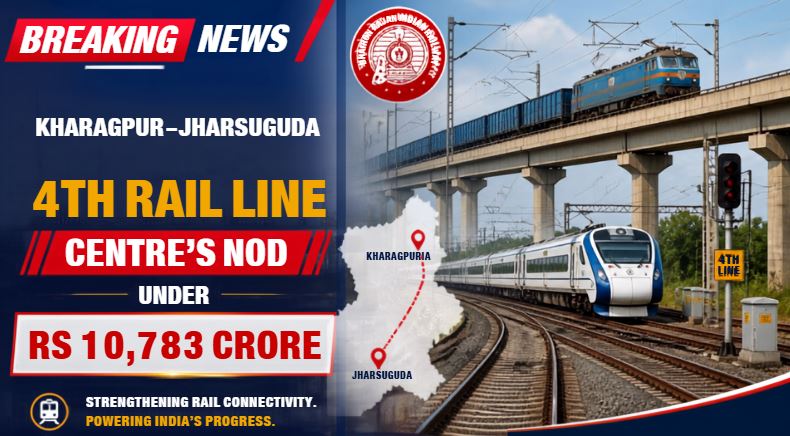
Representational Image
The approval was granted by the Cabinet Committee on Economic Affairs (CCEA), chaired by Prime Minister Narendra Modi, on Wednesday.
Along with the Kharagpur–Jharsuguda project, the package includes the Katni–Pendra Road fourth line and the Bilaspur (Uslapur)–Pendra Road third line.
Fourth Line to Ease Congestion on Key Odisha Route
The Kharagpur–Jharsuguda project is expected to significantly enhance capacity on one of the important rail corridors serving eastern India.
The additional track will help facilitate smoother train movement, reduce congestion and improve the reliability of rail services, particularly along routes carrying large volumes of freight.
The three projects together will add approximately 656 km of new railway lines across 14 districts in Odisha, West Bengal, Jharkhand, Madhya Pradesh and Chhattisgarh.
4,790 Villages to Benefit
According to the government, the expanded rail network will improve connectivity to around 4,790 villages, covering a combined population of nearly 56 lakh people.
The projects are being developed under the PM Gati Shakti National Master Plan, with integrated planning aimed at strengthening multimodal connectivity and improving logistics efficiency.
The upgraded network is also expected to benefit access to several prominent religious and tourist destinations, including Odisha’s Taratarini Temple and the Jagannath Temple region near Jharsuguda, besides destinations in neighbouring states.
Freight Capacity Expected to Rise
The routes covered by the projects are strategically important for the movement of bulk commodities such as coal, cement, iron and steel.
The Railways expects the capacity enhancement to facilitate an additional 27 million tonnes per annum (MTPA) of freight traffic, strengthening rail-based transportation for industries across the region.
A greater shift of freight from road to rail is also projected to reduce logistics costs and lower fuel consumption.
Rail Expansion to Deliver Environmental Gains
The government estimates that the projects could reduce oil imports by around 12 crore litres and cut carbon dioxide emissions by approximately 62 crore kg.
The estimated reduction in emissions is being compared to the environmental benefit of planting around 2.48 crore trees.
Beyond connectivity and freight movement, the projects are expected to generate employment and self-employment opportunities during construction and in related economic activities, while supporting long-term industrial and regional development.
The Centre said the railway expansion is part of its broader infrastructure push aimed at creating a more efficient transport network and supporting the country’s long-term development goals.