

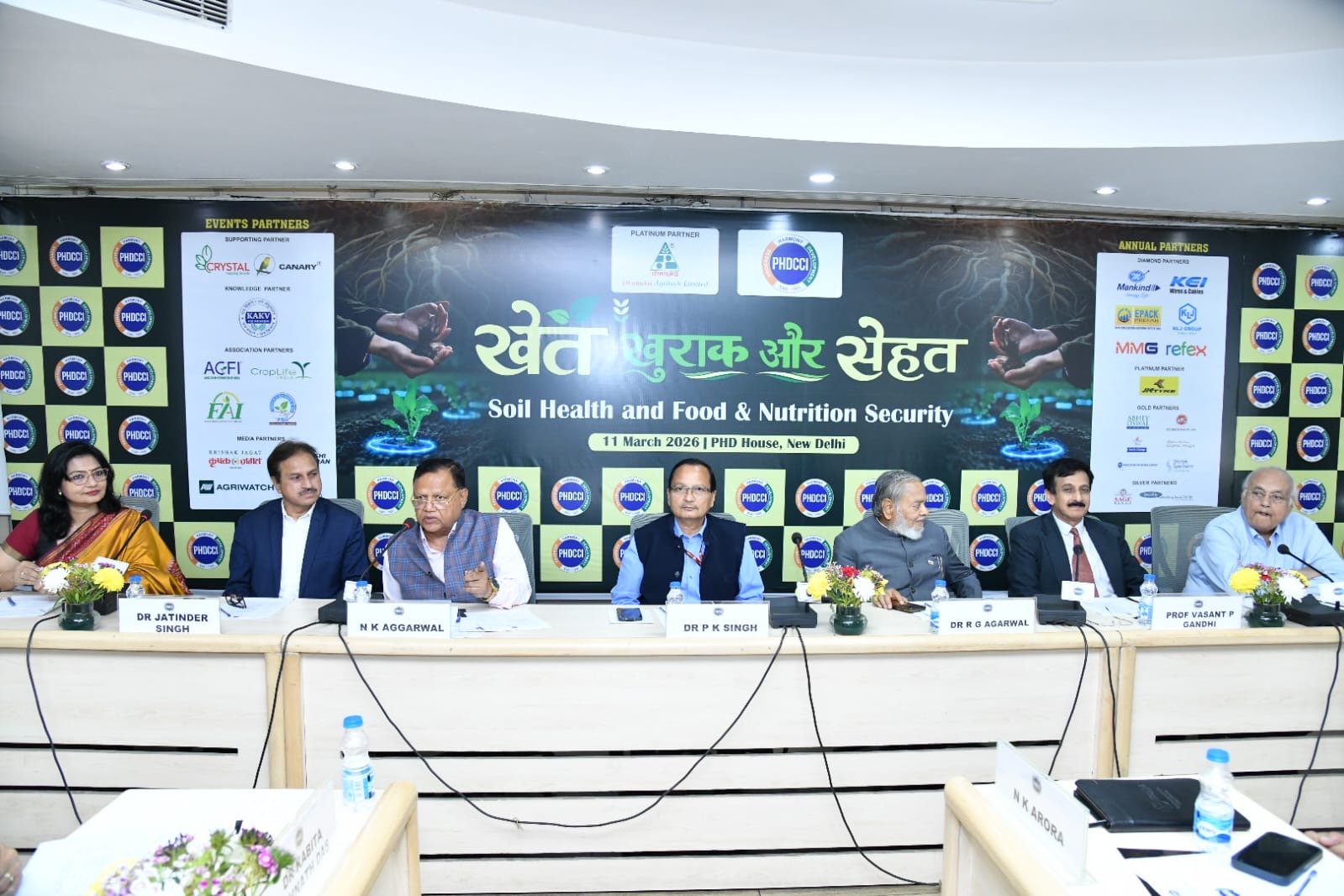
PHD Chamber of Commerce organized a roundtable discussion on Soil Health and Food & Nutrition Security” at PHD House, New Delhi.
Bringing together policymakers, industry leaders, scientists, and agri-experts, the event sparked critical conversations around soil health, crop nutrition, and their broader impact on public health.
The context of the roundtable was set by Dr Jatinder Singh, Dy. Secretary General, PHDCCI along with a welcome address by Mr N.K Aggarwal, Chair, Chemicals & Plastic Committee, PHDCCI and moderation by Ms Gayatri Sharma, Director, PHDCCI.
In attendance of the dignitaries present at the roundtable, Chief Guest Dr P.K. Singh, Agriculture Commissioner, Ministry of Agriculture and Farmers Welfare, Government of India said – “ India’s agricultural transformation must begin with a shift in thinking—from a purely production-oriented approach to one that protects farmers, strengthens soil health, and ensures long-term sustainability. The government is encouraging states to develop clear, measurable roadmaps for sustainable agriculture, including targets such as improving soil organic carbon and overall soil health. Integrated approaches that combine soil conservation, crop diversification, water management, and farmer-centric technologies will be essential to securing long-term food and nutritional security. At the same time, reviving traditional food systems and promoting dietary diversity will play an important role in strengthening both nutritional security and sustainable agriculture in India.“
Mr N.K Aggarwal, Chair, Chemicals & Plastic Committee, PHDCCI welcomed the dignitaries with his address stating – “While agricultural technologies are widely adopted across India, micronutrient management remains critically under- addressed. Deficiencies in zinc and other micronutrients significantly impact both soil fertility and crop quality. Compounding this, overexploitation of soil through multiple cropping cycles demands urgent attention to soil recharging and restoration. As India emerges as a global food security powerhouse with growing export potential, the responsibility to produce nutritious, quality food intensifies. It is hoped that today’s roundtable moves beyond discussion, translating deliberations into actionable policy recommendations that effectively reach and are implemented by the government.
While setting the context of the roundtable, Dr Jatinder Singh, Dy. Secretary General, PHDCCI stated – India produces 351 million tonnes of food grains annually, yet faces a serious nutritional crisis. Severe soil degradation causes deficiencies in nitrogen, zinc, and iron, while overuse of subsidized urea contaminates food and the environment. NFHS data reveals 35.5% of children under five are stunted and 32.1% are underweight — a stark reminder that production alone cannot eliminate “hidden hunger.” Today’s discussion on “Khed, Khurak, and Sehat” aims to collectively address these challenges through sustainable farming, soil restoration, and improved nutritional outcomes.”
Mr. N.K. Arora, Secretary of the Governing Council of KAKV Foundation and Knowledge Partner for the discussion, showcased a presentation to the dignitaries. Separately, the KAKV Foundation also released its report titled “Soil Health, Food Production and Nutritional Security in India – An Integrated Analysis by KAKV.”
The roundtable was wrapped up with a Vote of Thanks from Dr. R.G Agarwal, Chair, Agri Business Committee, PHDCCI.
