

On the opening day of India’s AI Impact Summit, Charles Rivkin, Chairman and CEO of the Motion Picture Association (MPA), joined Shri Ashwini Vaishnaw, Minister for Information & Broadcasting (MIB), Electronics & Information Technology (MeitY), and Railways, Government of India, for a fireside conversation on the future of Artificial Intelligence (AI) and the creative economy.
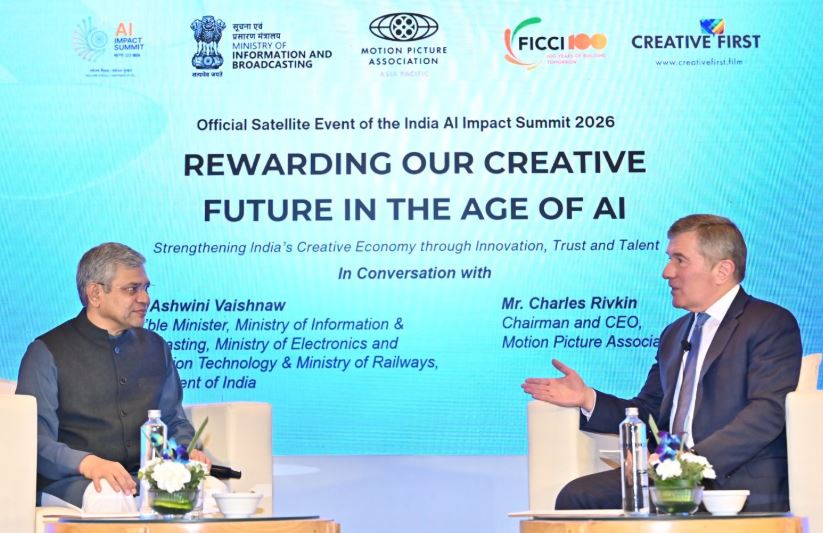
The event, Rewarding Our Creative Future in the Age of AI – Strengthening India Tthrough Innovation, Trust and Talent, was organised by the MPA in partnership with the Federation of Indian Chambers of Commerce and Industry (FICCI), MIB, and Creative First, with support from a broad cross-section of film, television and streaming industry organisations.
Both leaders acknowled that AI represents a new and exciting frontier for the global creative industries, sectors with a long and proven history of embracing transformative technologies in pursuit of creative excellence.
“AI can and must be used to expand creativity in a responsible way,” Rivkin said. “Our member studios are at the forefront of this transformation, recognising the immense potential of AI to enhance storytelling while keeping human creativity at the heart of filmmaking. Strong copyright frameworks are indispensable, they anchor a vibrant creative economy, drive investment in the media & entertainment sector and turn creative ingenuity and storytelling into world-class cultural exports.”
“I commend the Government of India for convening this forum at such a consequential moment,” he added.
Speaking about the intersection between the creative economy and AI, Minister Vaishnaw said, “The challenges between AI and copyright are very, very complex, and we are, in this summit, looking at some sort of consensus on this”.
“If the creators get a chance to deploy their skills, protect their copyrights, protect the roots of their creative energy, then the growth between today and tomorrow will be very high. Then AI can be used as a tool.” Vaishnaw added.
On enforcement mechanisms, Rivkin pressed further, asking what practical steps could translate policy intent into action. Vaishnaw stressed the need for collaborative frameworks. “That would require a lot of technological tools to be created. Our understanding so far is that for such complex problems, we have to have techno-legal solutions.”
When asked by Rivkin on the risks of misinformation and deepfakes, the minister warned of broader societal consequences.
“Foundation of our society is the trust between institutions,” he said. “The rapid spread of defects, misinformation, disinformation is basically striking at the root of these institutions.”
“The social media platforms, the AI models, the creators, all of us will have to take the responsibility for making sure that the new technology is strengthening the trust rather than reducing it.” He added.
On safeguarding children online, when Rivkin asked what principles should guide regulation in this particularly sensitive area, Vaishnaw struck a firm tone. “Protecting kids should be non negotiable for the entire country and the entire society.”
Turning to OTT platforms and global streaming services, the minister urged sensitivity to local norms.
“In the digital world, there are no physical boundaries,” he said, cautioning that platforms must not “forget the cultural context.”
“What is normal in one society may not be normal in another society,” he added. “Global platforms must make sure that the cultural context of the countries in which they are operating is fully taken care of.”
He emphasized that companies should “work by the constitution and the legal framework of that country, rather than the framework of another country.”
As AI accelerates across industries, the summit underscored a central message: innovation must move forward, but with consensus, cultural sensitivity, and safeguards firmly in place.