


Solangel at Moscow Fashion Week
Fashion is increasingly operating at the intersection of high-tech: through new materials, complex construction, digital aesthetics, and garments that look as if they belong not to today’s runway, but to the next decade. This theme was strongly reflected at the recent Moscow Fashion Week, a major fashion event held in Russia’s capital city, where designers’ collections closely engaged with the language of engineering, IT, and the visual culture of the future. Audiences and experts closely followed the visionary experiments of the participants in this influential international event, which brought together over 300 designers from around the world.
The brand Solangel, a regular participant of Moscow Fashion Week, patented a unique crystal application technology that allows for more than 500 variations in color schemes, brilliance intensity, prints, and texture effects. This opens nearly unlimited design possibilities and ensures that each garment is truly one-of-a-kind. The brand Inniki, showcased on Moscow’s runway, demonstrated how innovation and tradition, futuristic design, and motifs from traditional Yakut costumes can be organically combined.

Inniki at Moscow Fashion Week
Sol Selivanova Olga adopted a constructive, engineering-driven approach this season, reimagining garment structures and literally turning clothing inside out. The brand exposes what is usually hidden: seams, cut lines, technological elements, and the internal architecture of the garment. Designer Zlata Peczkowska incorporated rubber and textile cords, chains, and electrical wires into her collection, creating an almost sci-fi aesthetic. The avant-garde collection Capparel, presented at Moscow Fashion Week, revolved around imprints, textures, unpressed folds, and the concept that the trace becomes part of the form.

Capparel at Moscow Fashion Week
International participants at Moscow Fashion Week also embraced high-tech. Spanish brand Madame & Mister Sibarita continues to explore new eco-friendly materials, such as tomato vegan leather, as an alternative to traditional synthetics. Each collection from this Madrid-based brand is produced in small batches, entirely by hand, to minimize waste and ensure durability. Chinese brand D.Martina Queen incorporated innovative biomimetic filling ET down, combining the warmth and lightness of natural down with the benefits of high-tech and sustainability. Another Chinese brand, Xuaujin, showcased at Moscow Fashion Week, blends traditional and advanced techniques, such as classic indigo oxidation with modern Tencel denim and shimmering silk.
“Moscow Fashion Week actively explores cutting-edge technological applications such as virtual reality runways and digital collectibles, providing practical models for the digital transformation of the fashion industry and leading the future direction of the sector,” notes Yan Haoyi, designer at Xuaujin.
High-tech was present beyond the runway as well — the event featured an AI fitting room powered by GigaChat, allowing guests to try on real collections not yet in production. GigaChat is one of Russia’s most advanced neural networks and is developed by Sber, a strategic partner of Moscow Fashion Week.
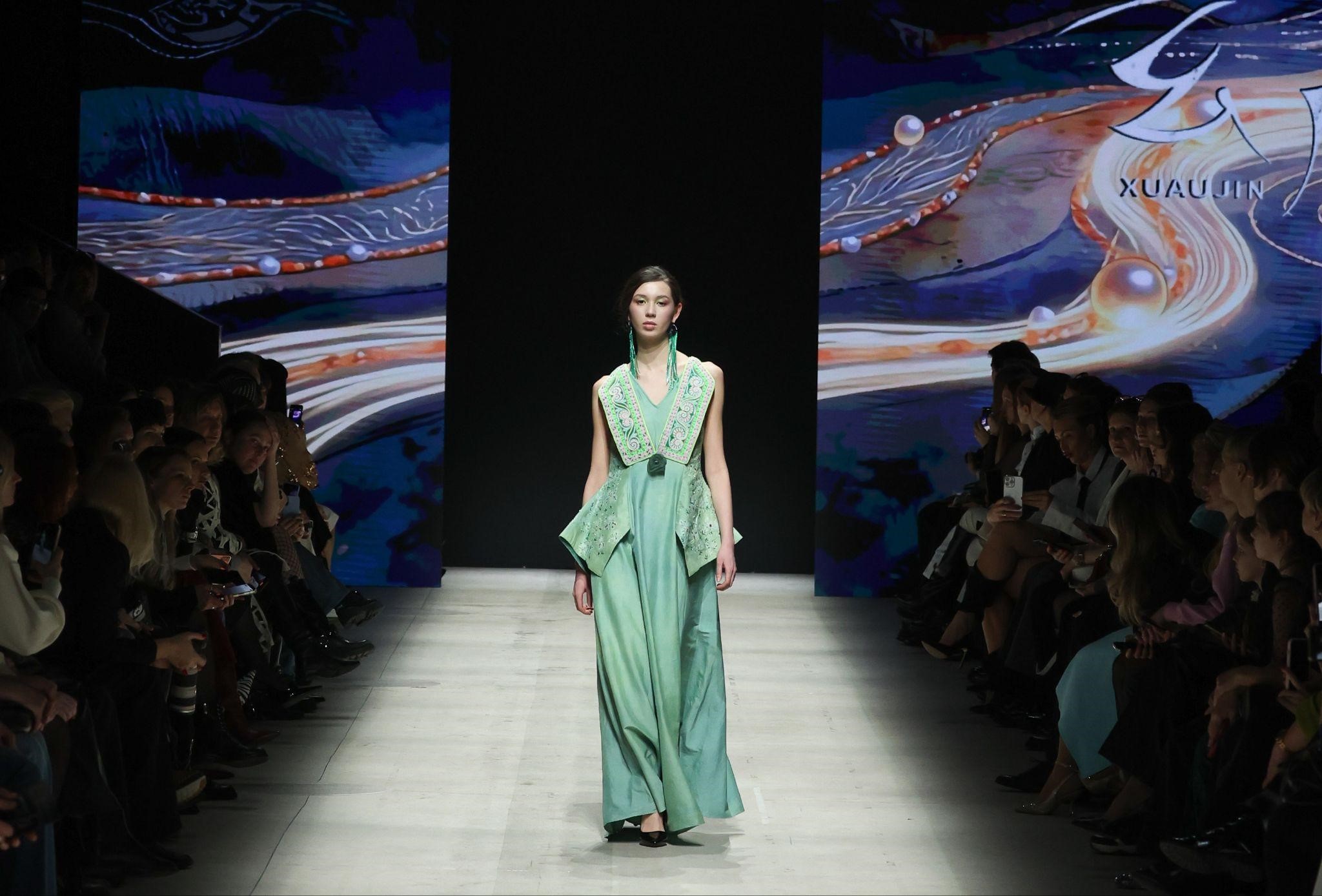
Xuaujin at Moscow Fashion Week
The general partner of Moscow Fashion Week was Wildberries, a massive, high-tech marketplace included in the world’s top 10 most popular platforms.
At Moscow Fashion Week, technology is not just an addition to fashion; it is integrated into the system itself: from innovative fabrics and engineering-driven cuts to AI tools and digital services for attendees. This makes Moscow Fashion Week a platform where new industry-wide operational principles are tested and showcased.