
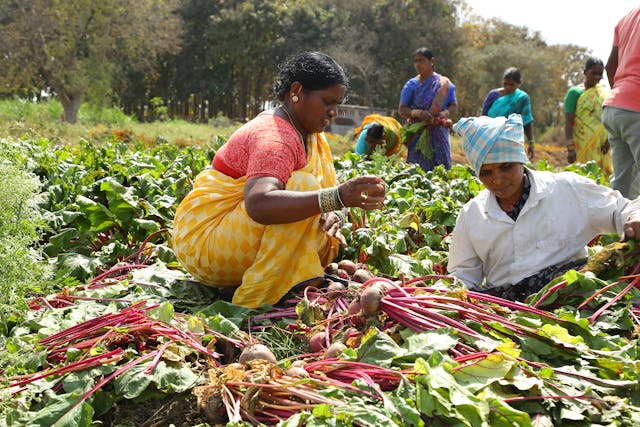

For generations, Indian farmers have produced abundance for the country while absorbing most of the risk themselves. Rising costs, unpredictable weather, shrinking landholdings, and volatile prices have meant that farming, for many, has remained an uncertain livelihood rather than a reliable one.
The Union Budget 2026–27 acknowledges this reality and attempts a subtle but important course correction. Instead of focusing only on output, it places new weight on how farm produce earns, pushing agriculture toward higher-value crops, allied livelihoods, and stronger rural value chains—particularly in coastal regions and fisheries.
Why the old model is under strain
India’s farm economy is constrained by scale. The vast majority of farmers cultivate small plots, leaving little room to increase income simply by growing more. At the same time, dependence on staple crops such as rice and wheat has exposed farmers to thin margins, rising input prices, and growing climate stress.
In this context, higher incomes can come only from greater value per acre, not greater acreage.
That is where high-value agriculture becomes relevant—crops and activities that generate better returns, support processing, and connect farmers to wider markets.
The turn toward high-value crops
The budget sets aside ₹350 crore for promoting high-value agriculture, signalling an intent to encourage diversification away from low-margin cereals.
High-value crops—such as fruits, plantation crops, nuts, spices, and horticultural produce—typically deliver higher income per unit of land. Over the past decade, India’s horticulture sector has expanded steadily, driven by changing consumption patterns and export demand.
The budget’s message is clear: farm income growth will increasingly depend on what farmers grow and how it is marketed, rather than on sheer volume.
Coastal agriculture gets tailored attention
One of the more targeted interventions in the budget is its focus on coastal farming systems.
Regions shaped by humidity, saline soils, and plantation ecosystems are being encouraged to strengthen cultivation of coconut, cashew, and cocoa—crops naturally suited to these environments and backed by strong domestic and global demand.
For farmers in coastal belts, this could mean a gradual shift toward plantation-based livelihoods that support processing, branding, and export opportunities. Such crops also tend to offer longer-term income stability compared to seasonal staples.
Nuts and orchards as a premium play
The budget also looks toward nut cultivation, including walnuts, almonds, and pine nuts, through orchard rejuvenation and modern planting techniques.
While limited to specific agro-climatic zones, these crops represent a growing market within India’s expanding health and nutrition segment. For farmers in suitable regions, nuts offer a chance to enter higher-value supply chains—provided they are supported by quality planting material, storage infrastructure, and reliable buyers.
Knowledge as an input: technology on the farm
Alongside diversification, the budget highlights the role of information and technology in reducing risk and improving outcomes.
Funding for Bharat-VISTAAR aims to link agricultural research with digital advisory platforms and AI-based tools. The objective is to help farmers make better decisions—from crop selection to pest control and market timing.
The promise lies not in the technology itself, but in whether it reaches farmers in usable, accessible forms, especially in remote and underserved areas.
Fisheries moves to the centre of rural livelihoods
A significant livelihood opportunity highlighted in Budget 2026 is fisheries.
India’s fisheries sector already supports millions of households and continues to grow faster than many traditional farm activities. The budget proposes integrating hundreds of reservoirs and water bodies into fisheries development, expanding opportunities for inland aquaculture.
With increased funding for the PM Matsya Sampada Yojana and the Department of Fisheries, the emphasis is on building complete value chains—covering storage, processing, transport, and market access—rather than focusing only on production.
Empowering producers, not just production
A recurring weakness in agricultural and fisheries markets is that primary producers often capture the smallest share of value.
The budget’s focus on producer collectives, women-led groups, and local enterprises aims to correct this imbalance. Stronger organisations can help farmers and fishers negotiate better prices, reduce dependence on intermediaries, and retain more value within rural communities.
Trade facilitation measures in the fisheries sector are also intended to strengthen market access and improve returns.
A quiet reorientation, not a quick fix
Budget 2026 does not promise immediate relief. What it offers instead is a gradual reorientation of India’s farm economy:
From yield to value
From uniform cropping to diversification
From fragmented selling to organised value chains
From vulnerability to resilience
The success of this approach will depend on execution—whether investments translate into cold storage, processing units, extension services, and market assurance that reach small and marginal farmers first.
If implemented well, this shift could help transform agriculture from a livelihood of compulsion into one of choice—offering farming and fishing communities not just higher incomes, but greater security and dignity.