
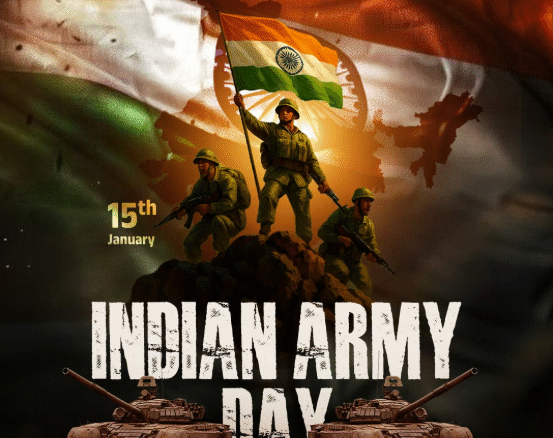

On this historic day, India commemorates the 78th Army Day, a celebration of the valor, dedication, and unwavering service of the Indian Army. From the solemn laying of wreaths to the spectacular display of military strength, Army Day serves as both a tribute to the nation’s heroes and a showcase of India’s evolving defense capabilities.
This year, the celebrations took on special significance as the Army Day parade was hosted in Jaipur for the first time outside a traditional cantonment. The event drew thousands of spectators to Mahal Road, where cutting-edge military technology and brave soldiers came together in a grand display of national pride.
Saluting Courage and Commitment
Prime Minister Narendra Modi took to social media to honor the Indian Army, calling its soldiers “a symbol of selfless service” who safeguard the nation even under the most challenging conditions. He added, “Their sense of duty inspires confidence and gratitude across the country.”
President Droupadi Murmu also extended greetings to soldiers, veterans, and their families, praising the Army’s enduring ‘nation first’ spirit. These tributes underscore the public’s deep respect for those who have defended India in times of conflict and continue to do so today.
A Parade Like No Other: Tradition Meets Modernisation
The 78th Army Day parade was a spectacular blend of heritage and technology. Spectators witnessed an impressive display of BrahMos missiles, Pinaka rocket launchers, Bhishma and Arjun tanks, and advanced combat systems navigating the city streets.
Adding a unique twist, the Army’s K9 unit stole hearts as indigenous dog breeds—Mudhol Hound, Rampur Hound, Chippiparai, Kombai, and Rajapalayam—marched in uniform with sunglasses, trained for detection, surveillance, and counterinsurgency operations. Even a robotic dog, capable of navigating steep terrains and high altitudes, demonstrated the Army’s embrace of cutting-edge technology.
“This parade was not just a demonstration of strength; it was a celebration of innovation, tradition, and the bond between soldiers and citizens,” said Army Chief General Upendra Dwivedi.
Modernisation and Self-Reliance: The Future of India’s Army
Addressing a press conference, Gen. Dwivedi emphasized that self-reliance and modernisation are central to the Indian Army’s strategy. Highlighting lessons from recent global conflicts, he stressed that technology enhances efficiency but cannot replace the soldier, and that smaller, agile units are increasingly vital for modern warfare.
The creation of the Bhairav Battalion, bridging the operational gap between Ghatak units and Special Forces, reflects the Army’s adaptive approach. Gen. Dwivedi also highlighted collaborations with DRDO and academic institutions to ensure indigenous development of critical equipment and sustained readiness for long-term operations.
“Research and development is the cornerstone of true indigenisation. Until India develops technology in-house, full self-reliance cannot be achieved,” he noted, underlining the Army’s commitment to a future-ready force.
A Day of Remembrance and Pride
Army Day also commemorates history. It dates back to January 15, 1949, when Field Marshal Kodandera Madappa Cariappa became the first Indian Commander-in-Chief, replacing the British General Sir Francis Roy Bucher. This transition marked India’s complete claim of military autonomy post-independence and the tumult of the 1947–48 India-Pakistan conflict.
Since then, the Indian Army has participated in critical wars and peacekeeping missions, from 1962, 1965, and 1971, to the Kargil conflict of 1999, and UN operations worldwide. Army Day serves as a reminder of the sacrifices made by countless soldiers and the enduring principles of discipline, secularism, and nation-building that define the force.
Bringing the Army Closer to the People
Hosting the parade in Jaipur was symbolic. The city, steeped in military tradition, is home to brave warriors such as Shaitan Singh Bhati and Abdul Hamid, whose heroism is etched in national memory. Gen. Dwivedi expressed pride in the city’s connection to the Army and explained that the move aimed to bring the military closer to citizens, reinforcing trust and shared pride.
Evening events like the Shaurya Sandhya celebration showcased the courage and valour of soldiers, leaving spectators inspired and grateful.
The Spirit of Army Day
Army Day is more than ceremonial pomp—it embodies sacrifice, courage, and commitment. It reminds the nation of the Army’s critical role in safeguarding sovereignty while highlighting India’s drive toward modernization, self-reliance, and innovation.
As Gen. Dwivedi aptly put it: “Operation Sindoor has set a new normal—it reflects a mature, self-confident, and responsible India.” Today, as India celebrates its soldiers, it honors a legacy of bravery while looking ahead to a future-ready, technologically advanced, and resilient Indian Army.