
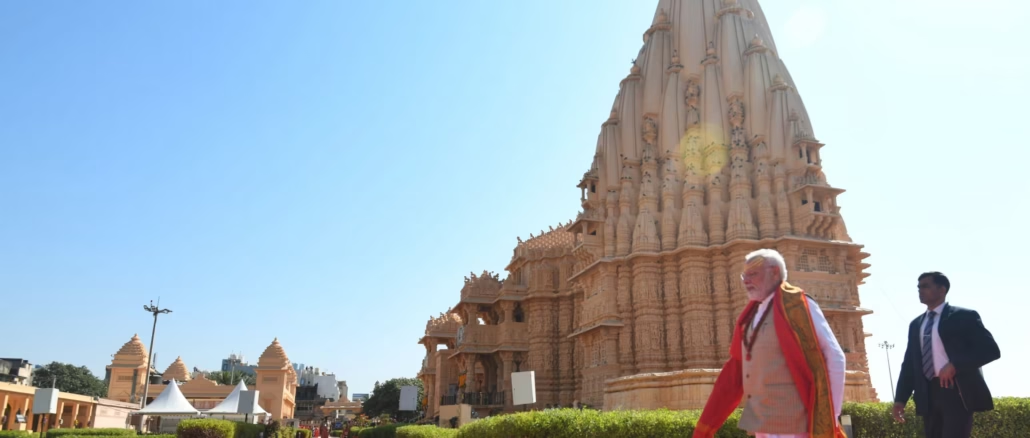

As India approaches 2026, one of its most sacred and enduring spiritual landmarks is preparing to mark a historic milestone. The Somnath Temple Swabhiman Parv, set against the timeless shores of Gujarat’s Prabhas Patan, will commemorate 1,000 years since the first recorded attack on the Somnath Temple and 75 years since its post-Independence reconstruction. More than an anniversary, the occasion represents a powerful reflection on faith, resilience, and India’s civilisational continuity.
Somnath: Where Faith Meets History
Located on the western coast of Gujarat, the Somnath Temple is revered as the first of the twelve Jyotirlingas, the most sacred abodes of Lord Shiva, who is worshipped here as Somnath Mahadev—“the Lord of the Moon.” Ancient scriptures place Somnath at the very beginning of India’s sacred geography, underscoring its unparalleled spiritual importance.
For centuries, devotees have believed that a single darshan at Somnath purifies the soul and awakens spiritual consciousness. The rhythmic sound of the Arabian Sea meeting the temple’s shores only deepens its aura, making it a place where faith, nature, and history converge.
जय सोमनाथ!
वर्ष 2026 में आस्था की हमारी तीर्थस्थली सोमनाथ ज्योतिर्लिंग पर हुए पहले आक्रमण के 1000 वर्ष पूरे हो रहे हैं। बार-बार हुए हमलों के बावजूद हमारा सोमनाथ मंदिर आज भी अडिग खड़ा है! सोमनाथ दरअसल भारत माता की उन करोड़ों वीर संतानों के स्वाभिमान और अदम्य साहस की गाथा है,…
— Narendra Modi (@narendramodi) January 5, 2026
A Temple That Refused to Disappear
Somnath’s legacy is inseparable from its trials. In 1026 CE, the temple faced destruction during an invasion led by Mahmud of Ghazni. What followed was not a single episode of loss, but centuries of repeated damage and reconstruction. Yet, every attempt to erase Somnath only strengthened its symbolic power.
Each rebuilding of the temple became an act of civilisational assertion—proof that faith could not be extinguished by force. Over time, Somnath came to represent not only devotion to Lord Shiva but also the unbroken will of a people to preserve their cultural identity.
Rebuilding After Independence: A Nation Reclaims Its Past
The modern revival of Somnath is deeply tied to India’s journey as an independent nation. In 1947, shortly after Independence, Sardar Vallabhbhai Patel visited the site and resolved that Somnath would be rebuilt as a matter of national self-respect. That vision materialised on May 11, 1951, when the restored temple was inaugurated in the presence of Dr Rajendra Prasad, India’s first President.
The reconstruction was not without debate at the time, but history has since recognised it as a defining moment—one that symbolised India’s confidence in reclaiming its heritage. The efforts of leaders, scholars, and cultural figures, including K.M. Munshi, ensured that Somnath stood once again as a proud marker of India’s spiritual legacy.
A Living Symbol of India’s Spirit
Somnath has inspired thinkers across generations. Swami Vivekananda, after visiting the temple in the 19th century, described it as a reflection of India’s national soul—destroyed and reborn repeatedly, yet never defeated. His words continue to resonate today, as Somnath stands as a reminder that India’s strength lies in its ability to regenerate.
Importantly, Somnath has also been a space of inclusivity. Historical accounts speak of scholars from different traditions visiting the temple, highlighting its role as a shared cultural and spiritual centre.
Somnath in Contemporary India
In today’s rapidly changing India, Somnath holds renewed relevance. As the country asserts itself on the global stage—economically, culturally, and diplomatically—the temple serves as a grounding force, reminding citizens that progress is strongest when rooted in values and memory.
Ongoing conservation efforts, improved pilgrim facilities, and educational initiatives aim to connect younger generations with Somnath’s legacy. At the same time, the temple continues to play a vital role in cultural tourism, contributing to local livelihoods while showcasing India’s heritage to the world.
Swabhiman Parv: A Celebration of Continuity
The Somnath Swabhiman Parv will bring together spiritual leaders, historians, artists, and devotees to reflect on the temple’s extraordinary journey. Through cultural performances, spiritual discourses, exhibitions, and community events, the celebrations will highlight Somnath’s message of resilience and renewal.
The Parv is not just about looking back—it is about drawing inspiration for the future. It reinforces the idea that while structures may fall, faith and conviction endure.
An Eternal Message for the Future
A thousand years after its first destruction, Somnath stands luminous against the horizon, its spire rising above the sea like a promise kept. Worshipped as Lord Shiva in his eternal form, Somnath Mahadev embodies regeneration, balance, and timelessness.
As India moves forward, the story of Somnath offers a quiet but powerful lesson: that hate may destroy temporarily, but faith has the power to create for eternity. The waves that crash upon Somnath’s shores continue their endless rhythm—just as the spirit of the temple continues to rise, again and again.
Jai Somnath.