
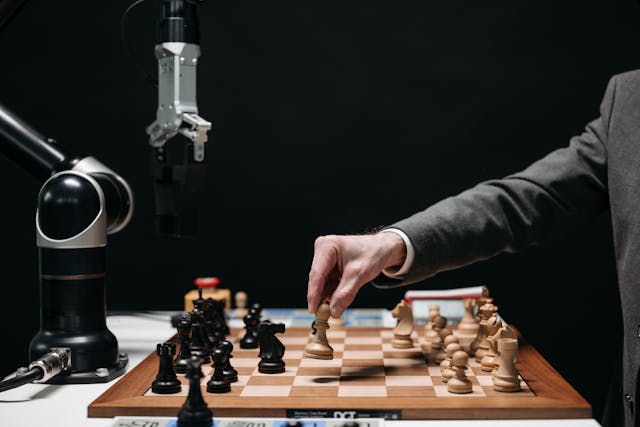

The workplace is on the cusp of a profound transformation. Artificial intelligence is no longer a futuristic concept—it’s an active partner in many industries, reshaping how work gets done. But contrary to fears of widespread job loss, the future of work is less about AI replacing humans and more about humans collaborating with AI to amplify productivity, creativity, and strategic thinking.
Augmentation Over Replacement
One of the most important shifts in the modern workplace is the move from replacement to augmentation. AI excels at tasks that are repetitive, routine, or data-intensive. For example:
-
Processing large datasets in finance or healthcare
-
Automating administrative work, such as scheduling or reporting
-
Handling customer queries with chatbots or automated support systems
By taking over these repetitive and often monotonous tasks, AI frees humans to focus on work that machines cannot replicate—empathy, judgment, creativity, and strategy. Instead of viewing AI as a threat, organizations are increasingly positioning it as a tool that enhances human potential.
Hybrid Roles and Human-in-the-Loop Models
The rise of AI is giving birth to hybrid roles, often referred to as “human-in-the-loop” positions. In these models, AI handles the heavy lifting of analysis and processing, while humans make the final, high-level decisions. Examples include:
-
Healthcare professionals using AI to analyze medical imaging, then applying clinical judgment to diagnose patients
-
Marketers leveraging AI-driven analytics to craft personalized campaigns, while humans fine-tune messaging and storytelling
-
Financial analysts using predictive AI models, but interpreting results to guide investment decisions
This combination of machine efficiency and human discernment creates more accurate, effective, and ethical outcomes than either could achieve alone.
Shifting Skill Demands
As AI transforms roles, the skills in demand are evolving. Routine, easily automated tasks are declining, while human-centric and analytical skills are becoming essential:
-
AI fluency: Understanding AI tools, workflows, and applications
-
Critical thinking: Evaluating AI outputs and making informed decisions
-
Complex problem-solving: Designing creative solutions that machines cannot generate alone
-
Emotional intelligence: Managing teams, clients, and stakeholders in ways AI cannot replicate
-
Adaptability: Learning new tools and workflows as AI evolves rapidly
Upskilling and continuous learning are no longer optional—they are critical for staying relevant in the modern workplace.
Roles Most Affected
Certain job categories are more susceptible to disruption:
-
Administrative support: Scheduling, data entry, and routine reporting
-
Customer service: Automated chatbots and AI assistants
-
Data analysis: Basic statistical processing and reporting
While these roles may change, the core principle is task transformation, not total elimination. Many employees will shift toward higher-value activities within the same role, leveraging AI to increase their impact.
New Opportunities
AI doesn’t just automate—it creates new roles and career paths that didn’t exist a decade ago:
-
AI maintenance and development: Engineers, trainers, and quality controllers
-
AI-driven business strategy: Professionals who can integrate AI insights into decision-making
-
Data storytelling and visualization: Translating AI outputs into actionable narratives for teams or clients
The rise of these new roles highlights a broader trend: AI is a tool that expands opportunity for those who know how to wield it effectively.
The Core Shift: From Tasks to Roles
The future of work isn’t about losing jobs; it’s about redefining roles. Employees who thrive will be those who can partner with AI, using its speed, accuracy, and scale to boost their own creativity and decision-making. Organizations that embrace this human-AI collaboration are likely to see higher productivity, innovation, and employee satisfaction, while those that resist change risk falling behind.
In essence, the AI revolution is less about replacement and more about evolution. The most valuable skill in the modern workplace may not be coding or data analysis—it may be the ability to work alongside AI, combining human intuition with machine intelligence.