

Reliable, high-speed internet is now non-negotiable for small businesses in the Southeast. It keeps point-of-sale systems humming, cloud apps synced, and video calls crisp. Yet connection quality still swings wildly—from Atlanta’s tech corridors to a rural storefront in Mississippi.
That gap is closing fast. Seven Southeastern states are sharing $8.6 billion in new BEAD funding to extend fiber into underserved neighborhoods (Southeastern Regional Commission announcement). Combined with record private investment, gig-class service is finally reaching main streets once limited to major metros.
More choice is great—until you’re the one combing promo pages and hidden fees. So we did the heavy lifting. Our team compared speeds, prices, uptime promises, and real-world support across every provider that serves Alabama, Georgia, Florida, the Carolinas, Tennessee, Mississippi, and Louisiana.
Yes, you’ll see the national telcos. But we also spotlight regional standouts like WOW! Business, whose fiber internet services for businesses pair enterprise-grade speeds with local, human support.
In the next few minutes you’ll find:
- Exactly how we scored each ISP
- A one-page comparison table for quick vetting
- Eight concise reviews that reveal which company is truly “best” for your location, budget, and growth plans
Find the connection that lets you work faster and worry less.
Methodolgy

Choosing an internet provider for your business is high-stakes. Slow speeds drain productivity. Flaky uptime kills sales. Hidden fees torch the budget you fought to protect.
We built a scorecard that zeroes in on what matters day to day. First, we weighed speed: not just download numbers, but the symmetrical uploads that keep cloud backups and video calls smooth. Next came reliability. We looked for written uptime promises and automatic fail-over options that keep you selling even when a backhoe cuts fiber nearby.
Price mattered just as much. A bargain isn’t a bargain if service drops on payday, so we measured value as dollars per guaranteed performance. Coverage counted too: a “great” provider that skips half the Southeast didn’t qualify. We then checked real-world support ratings; a 99.99 percent SLA is worthless if no one answers the phone. Finally, we rewarded helpful extras such as static IPs, built-in security, and contract-free plans that remove friction as you scale.
Each company on our list shines across these six angles. Where one category lags, another must overdeliver to stay on the page. You’ll see those trade-offs called out plainly in every review that follows.
At a glance: how the top providers stack up
We promised you a cheat sheet, and here it is.
Scan the table, circle the names that fit your state and budget, then read the individual reviews that follow.
Everything here answers the questions owners ask first: “Can I get it, how fast, and what strings are attached?”
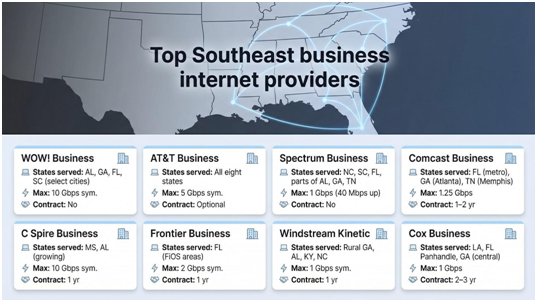
| Provider | States served* | Max business speed | Entry price† | Contract? | Uptime / backup | Stand-out perk |
| WOW! Business | AL, GA, FL, SC (select cities) | 10 Gbps sym. | ~$45 / 300 Mbps | No | 99.9 % network; DIY backup | Local support that answers |
| AT&T Business | All eight states | 5 Gbps sym. | $70 / 300 Mbps | Optional | 99.9 % SLA + free 5 G fail-over | Bundle saves $30 on wireless |
| Spectrum Business | NC, SC, FL, parts of AL, GA, TN | 1 Gbps (40 Mbps up) | $65 / 500 Mbps | No | Best-effort; free LTE backup with mobile | Zero early-termination fees |
| Comcast Business | FL (metro), GA (Atlanta), TN (Memphis) | 1.25 Gbps | $60 / 200 Mbps | 1–2 yr | LTE “Connection Pro” add-on | Built-in SecurityEdge firewall |
| C Spire Business | MS, AL (growing) | 10 Gbps sym. | Quote | 1 yr | 99.99 % SLA | White-glove account manager |
| Frontier Business | FL (FiOS areas) | 2 Gbps sym. | $55 / 500 Mbps | 1 yr | LTE backup add-on | Cheapest true fiber in FL |
| Windstream Kinetic | Rural GA, AL, KY, NC | 1 Gbps sym. | $100 / 1 Gbps | 1 yr | Optional LTE fail-over | Brings fiber to small towns |
| Cox Business | LA, FL Panhandle, GA (central) | 1 Gbps | $65 / 100 Mbps | 2–3 yr | LTE “Continuity” add-on | Strong local Gulf-coast ties |
- Availability varies block by block; always confirm your exact address.
† Advertised promo price before taxes and fees; subject to change.
1. WOW! Business: best for speed and local support
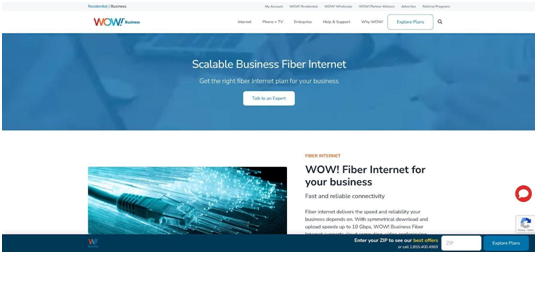
If your office sits inside WOW!’s patchwork footprint, you just scored the fiber jackpot.
WOW! Business fiber internet for small business website screenshot
Through its fiber internet services for businesses, this regional provider has quietly strung multi-gig lines across pockets of Alabama, Georgia, Florida, and South Carolina. Businesses in Montgomery or Columbus rave about downloads and uploads that both hit the throttle, not the brakes. One independent roundup even crowned WOW! the fastest, best-value option for Alabama firms, citing symmetrical plans up to 5 Gbps, a $44.99 starter tier, and in-state support teams who know your street as well as you do.
Speeds climb to a brisk 10 Gbps for teams that push video, CAD files, or large backups. Yet WOW! keeps contracts off the table. You pay month to month, skip early-termination penalties, and still dodge data caps or surprise “internet fees.” Add a 60-day money-back promise and the risk all but disappears.
Reliability backs the marketing. WOW! engineers design their fiber loops with enough redundancy to claim 99.9 percent availability. If something wobbles, you can call a local rep (often the same person who handled your install). That hometown urgency can save the day when a payment terminal blinks red during the lunch rush.
Ideal fit: Any small business lucky enough to fall under WOW!’s fiber build, especially creative studios, medical practices, and multi-location retailers that crave big-city bandwidth without the corporate-telecom runaround.
2. AT&T Business Fiber: best for region-wide reach and automatic 5 G fail-over
When you want the sure thing, you call the incumbent.
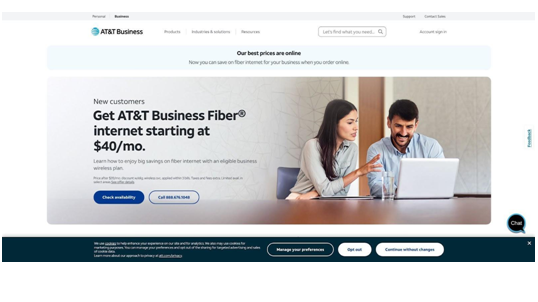
AT&T Business Fiber internet service page screenshot
AT&T’s fiber network sprawls across every Southeastern state, blanketing big metros, and creeping steadily into small-town main streets. That reach lets you open an office in Mobile today and a storefront in Raleigh tomorrow without juggling providers.
Performance is anything but old-telco slow. Plans start at 300 Mbps and climb to a solid 5 Gbps with matching uploads. Even better, AT&T bundles a 5 G wireless router with its gigabit tiers. If a construction crew severs your line, traffic flips to the cellular network in seconds (no frantic hotspot scramble).
Contracts stay optional. Sign month to month if flexibility tops your list, or lock a term to trim a few dollars off the bill. Either way, you pay for what matters: a 99.9 percent uptime guarantee, static-IP options for secure remote access, and customer support that answers 24 / 7.
Ideal fit: Multi-site retailers, professional firms, or any company that prizes stability over rock-bottom pricing. When the lights must stay on and future expansion looms, AT&T is the low-risk path to fiber confidence.
3. Spectrum Business: best for contract-free flexibility
Need solid bandwidth but hate long-term commitments? Spectrum keeps the door wide open.
Every standard plan is month to month. No early-termination penalty, no legal gymnastics. That freedom alone wins over startups and seasonal shops that can’t predict next quarter, let alone three years out.
Spectrum relies on a hybrid fiber-coax network, so downloads reach 300 Mbps, 600 Mbps, or a full gigabit. Uploads trail at roughly 40 Mbps on the top tier, which is fine for daily cloud work, though creative teams moving large files may feel the pinch.
The company balances that limitation with smart reliability perks. Bundle four Spectrum Mobile lines, and they include a 100 Mbps LTE backup connection. If the cable goes down, transactions keep flowing and video calls stay live without you lifting a finger.
Pricing lands in the sweet spot: about $65 for 500 Mbps and $115 for 1 Gbps, equipment included. Speeds rarely dip at peak hours, thanks to aggressive node splits across Florida and the Carolinas. And because there is no contract, you can upgrade, downgrade, or walk away whenever your needs change.
Ideal fit: Entrepreneurs who prize agility, such as pop-up retailers, co-working hubs, or agencies testing a new market. Spectrum lets you scale bandwidth like you add team members: on your timeline, not the fine print.
4. Comcast Business: best for one-stop connectivity and built-in security
Comcast takes the “we’ll handle everything” approach and makes it work at scale.
In South Florida, metro Atlanta, and pockets of Tennessee, the company blankets business districts with coax that delivers 200 to 1,250 Mbps downloads and about 35 Mbps uploads, all wrapped with SecurityEdge, a cloud firewall that blocks malware and phishing sites before they reach your network. Add the Connection Pro LTE gateway for a small fee and you gain automatic cellular fail-over plus eight hours of battery backup.
Service bundles are where Comcast shines. Need a phone system, managed Wi-Fi, and HDTV feeds for a waiting room? You can roll them into one bill and rely on a single support line (a relief for overstretched office managers). Pricing starts around $60 for 200 Mbps on a two-year contract; gigabit sits near $200. The trade-off for those perks is commitment: cancel early and you will pay a hefty termination charge.
Still, the scale shows when you need it most. Comcast crews swarm outage zones, and the national backbone lets multi-state firms keep every branch under one account.
Ideal fit: Growing companies that want internet, voice, security, and fail-over from a single vendor, especially franchises and professional practices spread across several Southeastern metros.
5. C Spire Business: best for ultra-fast fiber and concierge-level care
Mississippi’s home-grown telecom shows that regional does not equal second tier.
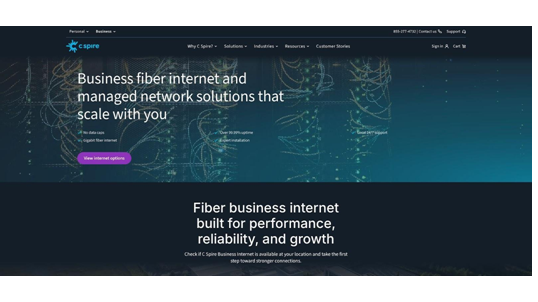
C Spire Business fiber internet solutions page screenshot
C Spire built a dense fiber web across its home state and extended it into neighboring Alabama. The result is impressive capacity: symmetrical tiers from 1 to 10 Gbps that rival big-city enterprise lines. Even better, the company backs that speed with a 99.99 percent uptime SLA and real bill credits, a level of reliability that small businesses rarely see outside Fortune 500 contracts.
Service feels personal from day one. A dedicated account manager learns your stack, oversees installation, and stays on speed-dial when questions pop up. Need a private VLAN or a direct AWS on-ramp? Their engineers handle it without selling you add-ons you do not need. For many clinics, manufacturers, and software teams in Jackson or Mobile, that concierge touch justifies the slightly higher sticker.
Pricing is quote-based yet competitive once you factor in the SLA and hands-on support. Contracts usually last a year, giving you stability without locking you into a marathon term. Because C Spire also runs a full IT services division, you can bundle cloud security or managed Wi-Fi instead of juggling vendors.
Ideal fit: Healthcare groups that move medical images, SaaS firms chasing millisecond latency, and owners who want a name-and-face relationship instead of a ticket number.
6. Frontier Business: best budget fiber for Florida teams
Tampa, Orlando, and St. Pete entrepreneurs know the drill: cable prices rise, uploads crawl, and promotions disappear. Frontier reverses that pattern with some of the cheapest true-fiber plans in the state.
Its network traces Verizon’s old FiOS footprint, so the infrastructure is already in place. The price tag reads roughly $55 for a 500-megabit symmetrical line. Jump to 1 Gbps or even 2 Gbps and you still spend less than many competitors charge for coax. Every tier is uncapped, so nightly cloud backups run full throttle instead of dodging data limits.
Reliability leans on passive fiber that shrugs off Florida heat and afternoon thunderstorms. Frontier does not publish a formal SLA for small-business plans, and support reviews vary. Still, outages are rare, and the company sells an optional LTE backup box if you want extra peace of mind.
Contracts last a single year, short enough that you are not welded to the brand forever. Watch for a five-dollar “network fee” that appears on invoices, but even with that line item the math often wins.
Ideal fit: Cost-conscious shops in Frontier territory that crave fiber speeds without a fiber surcharge, such as design studios, dentist offices, or e-commerce startups counting every operating dollar.
7. Windstream Kinetic: best for bringing gigabit to small-town main street
Drive thirty minutes outside Atlanta or Montgomery and cable fades fast. Until recently that meant DSL speeds stuck in 2008. Windstream’s fiber upgrade program is changing that picture.
Fueled by state grants and its own capital, the company has laced rural Georgia and pockets of Alabama with new fiber. Businesses that limped along at 25 Mbps can now sign up for 300 Mbps or 1 Gbps symmetrical service, often for about $100 a month. The productivity jump is immediate: cloud backups finish in minutes, not overnight.
Windstream’s roots as the local phone company help when storms roll in. Field technicians already live in the counties they serve, so downed lines get quick truck rolls. Formal SLAs show up only on enterprise plans, but real-world uptime trends solid once fiber replaces copper.
Expect a one-year promo contract and a modest price bump in year two. An optional LTE appliance adds automatic fail-over if your operation cannot spare a minute of downtime. For multi-location outfits, Windstream Enterprise layers on SD-WAN and managed security, bringing big-city networking to Main Street without a CIO on payroll.
Ideal fit: Manufacturers, clinics, and retailers in smaller towns where “choice” once meant slow DSL or pricey satellite. If Windstream lights up your county, grab the gig and get to work.
8. Cox Business: best for Gulf-Coast reliability and community support
Along Louisiana’s I-10 corridor and the Florida Panhandle, Cox is practically part of the infrastructure. Its hybrid fiber-coax grid delivers up to 1 Gbps downstream to offices from New Orleans to Pensacola, with upload lanes capped near 35 Mbps. The asymmetry is typical for cable, yet performance stays steady thanks to extensive network hardening after recent hurricane seasons.
Cox puts local presence front and center. Account managers sponsor chamber breakfasts, technicians live in the parishes they serve, and recovery trucks roll out within hours when storms knock power lines sideways. Add the optional Continuity LTE gateway and your modem switches to cellular the instant coax drops, keeping credit-card terminals and cloud apps online until crews splice the fiber.
Plans start around $65 for 100 Mbps on a two-year term; gigabit sits near $140. Bundles sweeten the deal: pair internet with managed Wi-Fi or hospitality TV and you consolidate billing and support under one roof. Contracts run longer than Spectrum’s, but most Gulf-Coast owners accept the term in exchange for local touch and strong disaster-recovery muscle.
Ideal fit: Restaurants, hotels, and professional offices along the Gulf that want hometown support, quick storm response, and a clear upgrade path to full-fiber service when budgets allow.
Frequently asked questions

Is cable good enough, or does my business need fiber?
If your team mostly downloads content such as training videos or large design assets, modern cable works. The limitation is upload speed. Fiber’s symmetrical lanes keep cloud backups, VoIP calls, and real-time collaboration smooth. When you send as much as you receive, fiber removes the bottleneck and future-proofs your workflow.
How much bandwidth should I aim for?
A five-person office that lives in email and Google Workspace runs comfortably on 300 Mbps. Add heavy design files, security-camera feeds, or a showroom full of guest Wi-Fi users, and 500 Mbps to 1 Gbps starts to pay off. Multi-gig tiers make sense only when you routinely push gigabytes per user or host data-hungry services onsite.
What does a 99.99 percent SLA translate to in real life?
About four minutes of unplanned downtime a month. Drop to 99.9 percent and the outage window expands to roughly 44 minutes. If every lost minute hurts revenue, choose the tighter guarantee or add a backup line.
I can’t get fiber at my address. What’s the next best option?
First check for cable: Spectrum, Comcast, or Cox deliver gigabit-plus downloads across most of their footprints. Still no luck? Consider fixed-wireless services like Verizon or T-Mobile 5 G business internet. They install in a day, cost around $70, and cover basic cloud tasks until a fiber build reaches your street.
Any tips for negotiating the best deal?
Gather at least two quotes, then ask each rep to “meet or beat.” Request free installation, a promo price lock, or a static-IP waiver. Competition in 2026 is fierce, and providers have room to sharpen offers when they know you are comparison shopping.
Conclusion
Find the connection that lets you work faster and worry less.
Disclaimer:
The information provided in this article is for general informational purposes only. The rankings, comparisons, and opinions expressed are based on publicly available data, industry reports, and editorial analysis at the time of publication. Service availability, pricing, and features may vary by location and may change without notice. Readers are advised to verify details directly with the respective internet service providers before making any business decisions.