
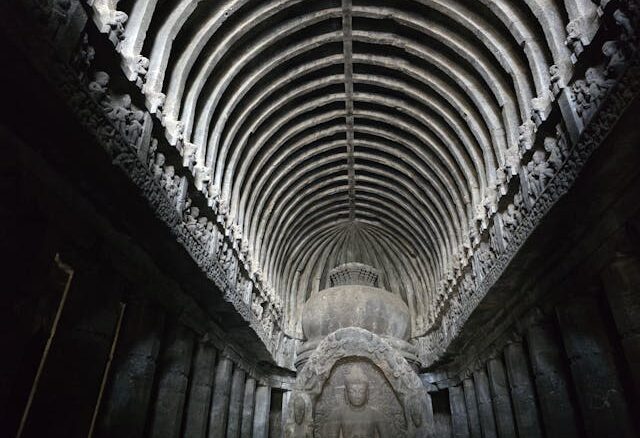

Some journeys take you across landscapes. Others take you deeper—into history, faith, and the enduring spirit of human creativity. The Ellora Caves in Maharashtra belong firmly to the second kind. Carved directly into a basalt cliff, Ellora is not simply a heritage site; it is an experience that unfolds slowly, revealing how devotion, imagination, and perseverance once transformed a mountain into one of the world’s greatest architectural wonders.
For travelers drawn to destinations shaped by both nature and human genius, Ellora offers something rare: a place where stone itself becomes sacred.
Where Rock Becomes Revelation
Located about 30 kilometers from Aurangabad, the Ellora Caves stretch across a rugged cliff of the Deccan Plateau, formed by ancient volcanic activity. At first glance, the rocky landscape appears quiet, even austere. But as you climb toward the site, the mountain reveals its secret—temples, monasteries, and prayer halls carved directly into its face.
This is “solid rock travel” at its most profound. Nothing here was built upward. Everything was shaped inward, extracted patiently from living stone over centuries.
The Ellora complex comprises 34 monumental caves, carved between the 6th and 10th centuries, representing Buddhism, Hinduism, and Jainism. Nowhere else in the world do three major faiths share a single sacred landscape with such harmony and scale.
The Rhythm of Ancient Craftsmanship
Walking through Ellora, it becomes clear that this was not a hurried endeavor. Each cave bears the mark of extraordinary patience—pillars aligned with perfect symmetry, ceilings chiseled with floral patterns, walls alive with stories of gods, demons, and cosmic events.
The artisans who worked here used only basic tools—iron chisels and hammers—yet achieved astonishing precision. There was no room for error. Every strike removed stone forever, meaning each decision had to be final.
What makes Ellora remarkable is not just its size, but its refinement. The caves reflect the evolution of Indian rock-cut architecture, blending regional styles and artistic traditions passed down through generations. Stone carving here was not merely a craft; it was a sacred act.
The Kailasanatha Temple: A Mountain Turned Temple
At the heart of Ellora stands its most breathtaking creation—the Kailasanatha Temple (Cave 16). Dedicated to Lord Shiva, this temple is the largest monolithic structure ever carved from a single rock.
Instead of assembling stone blocks, the builders took on a far more audacious task: they carved the temple from the top down, removing thousands of tons of rock to reveal a fully formed structure below. It is estimated that hundreds of thousands of tons of basalt were removed to bring the temple into existence.
Towering over the complex, the temple rises more than 100 feet, with massive sculpted elephants appearing to support its weight. Every surface tells a story—from epic battles of the Ramayana and Mahabharata to graceful depictions of Shiva as the cosmic dancer.
Standing within the temple courtyard, travelers often fall silent. The scale humbles, the detail mesmerizes, and the sheer ambition of the project defies logic—even by modern standards.
A Shared Sacred Landscape
Beyond the grandeur of Kailasanatha, Ellora’s true magic lies in its diversity.
Buddhist caves, among the oldest, reflect a life of meditation and learning. Their quiet halls and simple forms invite introspection.
Hindu caves burst with energy, drama, and movement, celebrating divine stories through richly carved reliefs.
Jain caves, built later, display remarkable restraint and elegance, emphasizing purity, discipline, and inner awakening.
Together, these caves form a spiritual timeline—one that mirrors India’s evolving religious and philosophical traditions.
Ellora and the Golden Age of India
Ellora was created during a period when India was a global center of knowledge, trade, and culture. Ancient trade routes passed nearby, bringing merchants, monks, and travelers from distant lands. This exchange of ideas left subtle traces in the art—foreign motifs, architectural influences, and symbolic forms woven into Indian tradition.
Despite centuries of political change and occasional damage, Ellora endured. Its relative isolation protected it from large-scale destruction, allowing much of its original grandeur to survive. In 1983, UNESCO recognized its universal value by granting it World Heritage status.
Experiencing Ellora Today
Visiting Ellora today is both a visual and emotional journey. Families wander through the caves, guides explain ancient symbolism, and travelers pause often—not to take photos, but to absorb the atmosphere.
There is a rare stillness here. Despite the size of the site, Ellora invites slow exploration. Sitting in a shaded alcove, one can imagine monks chanting, artisans carving, and pilgrims resting after long journeys. The past feels close—almost within reach.
The best time to visit is between October and February, when the weather is pleasant, though quieter months offer a more intimate experience for those willing to brave the heat.
Why Ellora Stays With You
Ellora is not just about history or architecture—it is about human possibility. It stands as proof that vision, faith, and patience can shape even the hardest stone into something timeless.
For travelers seeking more than sightseeing, Ellora offers reflection. It asks us to slow down, to marvel, and to reconnect—with history, with creativity, and perhaps with something deeper within ourselves.
Long after leaving, the memory remains: a mountain carved into meaning, a journey etched not just in stone, but in the heart.