
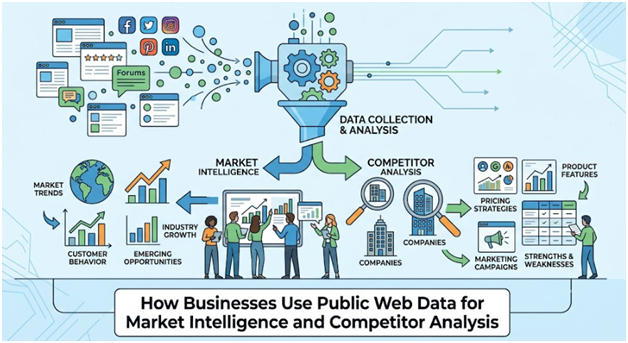

Markets rarely announce their changes in one neat report. A competitor adjusts pricing overnight. A distributor adds a new product line. Customer reviews begin to reveal a recurring complaint. A local marketplace starts showing different availability by region. Individually, these signals may look small. Together, they can explain where demand is moving and where a business is losing ground.
That is why public web data has become a serious input for commercial decision-making. Used responsibly, it helps teams monitor what is already visible online and turn it into a structured picture of the market. The infrastructure behind that work matters, especially when research needs to reflect local search results, regional storefronts, or market-specific availability. Providers such as Rola IP can support this type of research by helping teams access public-facing web experiences from relevant geographic contexts, rather than relying on a single office connection or incomplete view of the market.
The key distinction is simple: effective market intelligence is not about collecting the most data. It is about asking useful questions, gathering information that can answer them, and validating the conclusions before acting. Businesses that treat public web data as evidence—not as a shortcut—tend to make better commercial decisions.
What Counts as Public Web Data?
Public web data is information made available on publicly accessible websites and digital platforms. It can include product listings, published prices, customer reviews, search-result pages, company announcements, job postings, marketplace rankings, news coverage, and social discussions.
For a consumer brand, useful public signals may include changes in competitor assortment, shipping promises, review sentiment, and promotional language. For a B2B company, the stronger signals may come from new hiring patterns, partner announcements, pricing pages, case studies, or changes to a competitor’s ideal customer profile.
Public availability does not remove the need for care. Teams should respect website terms, applicable privacy laws, rate limits, and restrictions on collecting or using personal data. The best programs focus on business-relevant, non-sensitive information and establish clear rules before any monitoring begins.
Start With a Decision, Not a Dataset
Many intelligence projects fail because they start with a vague instruction: “Track our competitors.” That produces a large, noisy collection of pages and screenshots, but very little insight.
A stronger approach starts with a business decision. For example:
- Should we change prices in a specific market?
- Which product category should we enter next?
- Are competitors winning on delivery, assortment, or trust?
- Is a new regional player becoming a credible threat?
- Which customer complaints should influence our product roadmap?
Once the decision is defined, the data requirements become clearer. A pricing question may require product-level comparisons across marketplaces, including shipping and stock status. A market-entry question may require local search visibility, category demand signals, review themes, and distributor activity.
This decision-first discipline also improves data quality. It prevents teams from measuring what is easy to collect instead of what is important to the business.
A Practical Framework for Competitor Intelligence
The table below shows how public web data can be translated into concrete business questions and actions.
| Intelligence area | Public data to monitor | Question it answers | Possible business action |
| Pricing | Product prices, discounts, bundles, shipping fees | Are competitors changing their price position? | Adjust promotions, packaging, or margin strategy |
| Product assortment | Listings, launch pages, stock status, category filters | What are competitors introducing or discontinuing? | Identify gaps, validate launch timing |
| Customer sentiment | Reviews, forums, public comments, ratings | What do customers value or dislike? | Improve product features and messaging |
| Search visibility | Local search results, category pages, paid placements | Who owns high-intent discovery? | Refine SEO, content, and paid-search priorities |
| Brand protection | Marketplace listings, domains, ads, social profiles | Is the brand being misrepresented or copied? | Escalate takedowns and customer-protection measures |
| Market expansion | Local retailers, delivery terms, localized content | Is the market ready and competitive? | Prioritize countries, partners, and entry plans |
This framework works because it connects observation to action. A dashboard should not merely report that a competitor has 20 percent more reviews. It should help answer whether those reviews indicate stronger product quality, better post-purchase support, a more aggressive acquisition strategy, or a temporary promotion.
Why Geographic Context Changes the Answer
The internet is not a single, identical marketplace. Search results, product availability, prices, delivery estimates, advertising, and even website content can vary by country, city, language, device, or user location.
A retailer reviewing its own site from London may not see the same experience a customer receives in Singapore or São Paulo. That matters when evaluating local competitors. A product that appears out of stock in one region may be heavily promoted in another. A search result that seems dominant in the United States may barely appear in Germany.
For teams researching multiple markets, a geographically appropriate, reliable connection can make the data more representative. This is where Rola IP fits naturally into a research workflow: it can help organizations conduct public-web checks with location-aware access, supporting market comparisons without treating one region’s results as universal. The value is not simply access; it is the ability to build a more accurate picture of what real markets display publicly.
That said, location-aware research should be documented. Record the date, target geography, query or URL, device assumptions, and methodology. This makes findings easier to reproduce and prevents overconfident conclusions based on one observation.
Turn Raw Signals Into Evidence
A high-quality intelligence process has three stages: collection, validation, and interpretation.
Collection means gathering relevant signals consistently. Use a defined list of competitors, products, regions, and pages. Avoid changing the criteria every week, or trend comparisons become unreliable.
Validation means checking whether the signal is real and meaningful. A price drop may be a short-term sale, a regional test, or a listing error. Compare multiple dates, channels, and sources where possible. If one marketplace suggests a competitor is expanding, look for supporting evidence in its hiring, press releases, partner pages, or product catalog.
Interpretation means explaining what the evidence could mean for the business. This is where human judgment remains essential. Data can show that reviews mentioning “delivery delay” have increased; it cannot independently determine whether the cause is logistics capacity, a new carrier, or unrealistic customer expectations.
A useful internal habit is to label confidence levels. For instance, “confirmed” may require multiple sources, while “emerging signal” may be based on limited but credible evidence. This simple practice makes executive reporting more honest and more useful.
Common Mistakes to Avoid
The first mistake is confusing volume with insight. Thousands of listings do not automatically create a strategy. Narrow the work to the metrics that connect to a decision.
The second is failing to normalize comparisons. A competitor’s advertised price may exclude tax, shipping, or mandatory fees. Review scores can be misleading without considering review volume, date range, and country.
The third is ignoring compliance and reputation risk. Public data programs need boundaries around sensitive information, account-gated content, automated request volumes, and data retention. Legal and technical teams should be involved early, particularly when research spans jurisdictions.
Finally, do not treat a competitor’s visible activity as proof of commercial success. A loud launch, frequent discounting, or a large ad presence may signal growth—but it may also indicate weak unit economics or a defensive response. Intelligence should inform decisions, not replace commercial due diligence.
Build an Intelligence Program People Trust
The strongest programs are transparent about how findings were obtained and what they do not prove. They combine structured public data with firsthand knowledge from sales, customer support, distribution partners, and product teams.
For leaders, the objective is not a perfect view of the market. That is impossible. The objective is a faster, more defensible view than the organization had last quarter—one that spots changes early, tests assumptions, and gives teams a clear reason to act.
When public web data is collected ethically, interpreted carefully, and grounded in regional context, it becomes more than competitor tracking. It becomes an operational advantage: a way to hear the market before it becomes obvious to everyone else.
Frequently Asked Questions
Is public web data legal to use for competitor analysis?
It can be, but the answer depends on the data, jurisdiction, website terms, and collection method. Businesses should focus on genuinely public, non-sensitive information, respect applicable rules and technical restrictions, and seek legal guidance for higher-risk use cases.
What is the best public data for pricing intelligence?
Track the final customer-facing price, not only the listed product price. Include promotions, bundles, taxes where visible, shipping costs, stock availability, and delivery timing. Comparing these factors produces a more realistic view of competitive position.
How often should businesses monitor competitors?
The right frequency depends on market volatility. Fast-moving retail categories may require daily or weekly checks, while B2B positioning and hiring signals may be reviewed monthly. Monitor more frequently when a major launch, promotion, or market entry is underway.
Can public web data replace customer research?
No. It complements customer research. Public data shows visible market behavior and conversation, while interviews, surveys, and customer success feedback explain motivations that may not be visible online.
How can a company make its findings credible?
Document the source, date, location, collection method, and confidence level for each major finding. Validate important claims across more than one source and distinguish confirmed facts from hypotheses.