

New Delhi, Aug 28: India’s progress in financial inclusion has continued, with the country’s Financial Inclusion Index rising from 53.9 in 2018 to 67 in 2026, reflecting wider access to formal banking and financial services.
Pic Credit: https://x.com/FinMinIndia
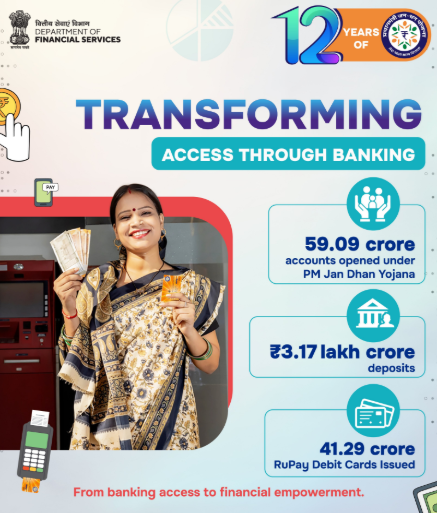
The rise points to the growing participation of people across urban and rural India in the formal financial system. Initiatives such as the Pradhan Mantri Jan Dhan Yojana (PMJDY) have played an important role in expanding access to bank accounts, savings facilities, payments and other essential financial services.
Over the past 12 years, the Jan Dhan programme has helped bring banking services closer to people who were previously outside the formal financial system. The expansion of basic banking access has made it easier for households to save money, receive financial assistance and carry out transactions securely.
The impact has been particularly significant for women. Having a bank account in their own name gives women greater control over their finances and provides direct access to government transfers and digital payment services. This can strengthen household financial security while encouraging greater participation of women in the formal economy.
The wider use of RuPay debit cards has also helped extend the benefits of financial inclusion beyond simply opening a bank account. With easier access to card-based transactions and digital banking, more customers can use formal financial services for everyday payments.
The expansion of financial inclusion can have a wider impact on the Indian economy. When more people use formal banking channels, household savings can enter the financial system and become available for lending to businesses, farmers, entrepreneurs and individuals.
Better access to formal credit can help small businesses invest, expand their operations and create employment. For households, access to savings, payments and credit can improve their ability to manage financial emergencies and plan for the future.
Financial inclusion can also make government welfare delivery more efficient by enabling benefits to be transferred directly into beneficiaries’ bank accounts. This can improve transparency and reduce dependence on intermediaries.
The growing adoption of digital payments is further strengthening the formal economy. As more consumers and businesses shift towards secure digital transactions, financial activity becomes easier to access and manage, supporting the broader growth of India’s digital economy.
The increase in the Financial Inclusion Index therefore reflects a broader transformation in how Indians access and use financial services. Continued expansion of banking, digital payments and financial access could help bring more households and businesses into the formal economy and support more inclusive economic growth.