
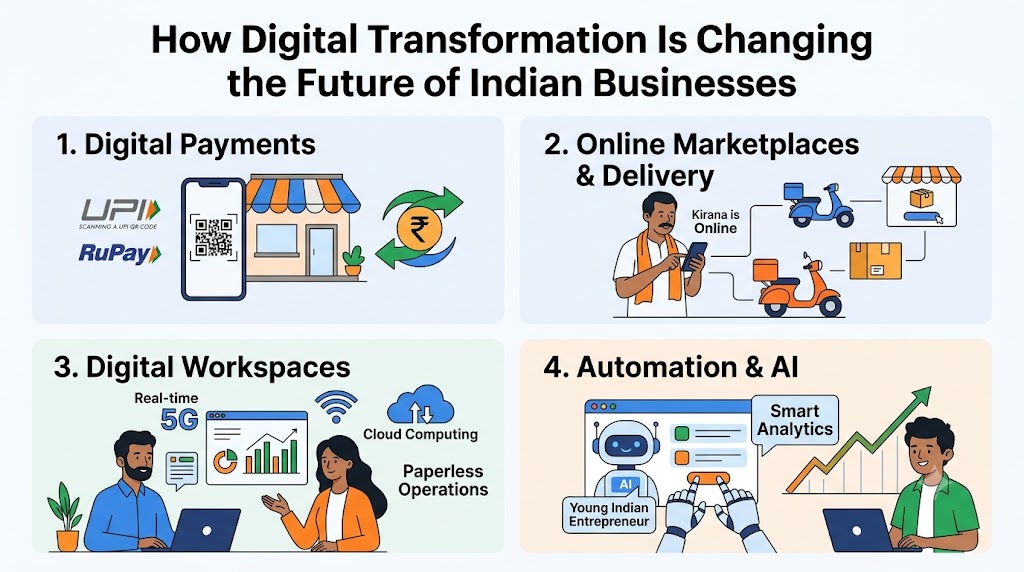
India’s business environment is entering a new phase in which technology is influencing how companies produce goods, deliver services and connect with customers. Businesses that once relied on conventional processes are embracing digital platforms, automation and data-driven decision-making to improve productivity, control costs and respond to changing market demands.
This transformation extends beyond large corporations and technology firms. Small retailers are accepting digital payments, manufacturers are modernising production systems, and regional businesses are using online platforms to reach customers beyond their traditional markets. For many enterprises, digital transformation is becoming a strategic investment in competitiveness and long-term resilience.
According to a report, India’s digital transformation market was valued at $46.42 billion in 2025 and is projected to grow at a compound annual growth rate of 13.5% through 2030. This growth outlook highlights the increasing importance of digital technologies in modernising business operations and supporting economic development.
Digital Infrastructure Is Redefining Business Operations
One of the strongest foundations of India’s digital transformation is the expansion of digital public infrastructure, mobile connectivity and online payment systems.
The Unified Payments Interface (UPI) has made digital transactions an integral part of everyday commerce, enabling businesses to collect payments quickly and offer customers convenient payment options. Digital identity infrastructure, including Aadhaar, has also supported service delivery and enabled new digital business models.
For businesses, these developments go beyond convenience. Digital transactions can improve payment records, support accounting processes and provide greater visibility into cash flows. When combined with suitable business software, digital systems can help companies make faster operational decisions.
Affordable mobile internet and widespread smartphone use have further expanded opportunities for customer engagement. Businesses can use mobile applications, websites, messaging platforms and e-commerce channels to connect with consumers across different regions.
As a result, digital access is becoming an increasingly important factor in how businesses attract customers, manage transactions and compete in India’s diverse markets.
Artificial Intelligence Is Transforming Business Decisions
Artificial intelligence (AI) and data analytics are emerging as important tools for improving business productivity. Rather than relying entirely on past experience, companies can analyse sales trends, customer behaviour and operational data to make better-informed decisions.
Retailers can use predictive analytics to estimate demand and reduce inventory imbalances. Manufacturers can monitor equipment performance to identify potential failures before they disrupt production. Financial institutions can deploy AI-supported systems to flag suspicious transactions and strengthen fraud detection.
Generative AI is creating additional possibilities in customer service, content development, document processing and internal knowledge management. Businesses can use these tools to handle routine tasks more efficiently, allowing employees to focus on problem-solving, customer relationships and strategic work.
India’s multilingual environment also creates opportunities for regional-language digital services. Initiatives such as Bhashini are working to make language technologies more accessible, potentially helping businesses communicate with customers who prefer Indian languages over English.
However, AI adoption requires reliable data, appropriate human oversight and safeguards against inaccurate outputs and misuse of sensitive information. Businesses that combine automation with human expertise are better positioned to translate technological capabilities into practical results.
Cloud Computing and Automation Improve Business Flexibility
Cloud computing is changing how businesses access and manage technology. Rather than investing entirely in expensive on-site infrastructure, organisations can use cloud-based software, storage and computing resources according to their needs.
This approach can help businesses expand operations, collaborate across locations and introduce new services without making large upfront infrastructure investments. Cloud-based accounting, customer relationship management and enterprise resource planning systems can also bring different business functions onto a more connected platform.
Automation complements this shift by reducing repetitive manual work. Tasks such as invoice processing, inventory updates, payroll administration and routine reporting can be streamlined through appropriate digital systems.
For smaller enterprises, these tools can improve visibility into costs and operations while reducing administrative pressure. However, actual savings depend on implementation quality, subscription costs, integration requirements and employee adoption. Digital transformation delivers the strongest results when businesses redesign inefficient processes rather than simply transferring them to new software.
MSMEs Are Finding New Pathways to Growth
Micro, small and medium enterprises (MSMEs) are central to India’s economic activity, making their digital readiness particularly important. According to widely cited government estimates, the MSME sector contributes around 30% of India’s GDP and supports employment across manufacturing, trade and services.
Digital platforms can help these businesses overcome some of the limitations associated with traditional, location-dependent operations. Online marketplaces enable local manufacturers, artisans and retailers to access customers in other cities, while digital payment systems can simplify collections and transaction records.
Cloud-based accounting and inventory tools can help business owners monitor expenses, track stock and manage orders more systematically. Manufacturers can also use digital systems to coordinate suppliers, monitor production and reduce avoidable material wastage.
Digital commerce initiatives such as the Open Network for Digital Commerce (ONDC) seek to broaden participation in online commerce by connecting buyers and sellers through an open network approach.
Nevertheless, adoption remains uneven. Many smaller businesses face financial constraints, limited digital skills, cybersecurity concerns and uncertainty about which technologies offer genuine value. Affordable solutions, practical training and reliable technical support will be important in helping these enterprises participate more fully in the digital economy.
Digital Transformation Is Reshaping Major Industries
The effects of digital transformation are becoming visible across several sectors of the Indian economy.
Banking and financial services: Digital onboarding, mobile banking and automated workflows are improving service delivery and operational efficiency. AI-supported analytics can help institutions monitor transactions and assess risks, while digital platforms can simplify parts of the customer lending process. Responsible lending and data protection remain essential.
Retail and e-commerce: Retailers are integrating physical stores with digital channels to create more convenient shopping experiences. Customer analytics, digital inventory management and demand forecasting can improve product availability, reduce wastage and support more effective marketing.
Manufacturing: Connected equipment, industrial automation and predictive maintenance are helping factories improve production planning, monitor quality and reduce unplanned downtime. These capabilities can strengthen productivity and supply-chain resilience.
Healthcare: Digital records, telemedicine and AI-assisted tools can support patient management and expand access to services. Their success depends on clinical oversight, reliable infrastructure and responsible handling of sensitive information.
Agriculture: Digital advisory services, weather information, precision farming tools and online market platforms can help farmers make more informed decisions about inputs, cultivation and sales. Wider adoption will depend on affordability, connectivity and ease of use.
Across these industries, technology is becoming a means of improving how work is organised, decisions are made and services reach customers.
Cybersecurity and Digital Skills Will Shape the Next Phase
As businesses become more dependent on digital systems, cybersecurity is becoming a fundamental part of business continuity. Data breaches, phishing attacks, online fraud and service disruptions can lead to financial losses and damage customer confidence.
Businesses need appropriate access controls, secure backups, regular software updates, employee awareness programmes and clear incident-response procedures. They must also understand their obligations under India’s applicable data protection framework, including the Digital Personal Data Protection Act, 2023, and relevant rules and notifications.
The availability of skilled workers presents another challenge. Many organisations need employees with expertise in data analytics, cloud computing, AI implementation and cybersecurity. At the same time, existing employees require training to adapt to changing responsibilities and digital workflows.
Successful transformation therefore depends on people as much as technology. Clear communication, practical training and employee participation can help organisations manage change and improve the adoption of new systems.
How Businesses Can Prepare for a Digital Future
Digital transformation does not require every business to adopt every emerging technology. A more effective approach begins with identifying operational problems and selecting tools that address them.
Businesses should assess their existing systems, identify high-impact opportunities and set measurable objectives. These might include reducing processing time, improving customer satisfaction, lowering inventory losses or accelerating order fulfilment.
The next step is to select secure, scalable technologies that can integrate with existing operations. Employees should receive appropriate training, while management should regularly review results using indicators such as operating costs, error rates, customer retention and productivity.
For smaller enterprises, introducing digital tools in stages can help control costs and demonstrate value before further investment. Technology partners can provide specialised expertise, but businesses should assess their experience, security practices, integration capabilities and long-term support.
A clear digital strategy also needs to account for data governance, regulatory requirements and the total cost of ownership. Technology should support a defined business objective rather than become an expense driven by market trends alone.
The Future of Indian Businesses in a Digital-First Economy
India’s digital transformation is expected to advance through wider AI adoption, greater automation, connected supply chains and more accessible cloud-based services. These developments could help businesses improve productivity, develop new revenue streams and compete in increasingly connected markets.
For MSMEs, digital tools can open doors to new customers and improve operational discipline. For larger enterprises, they can support innovation, efficiency and stronger risk management. For consumers, they can deliver more convenient services and more responsive experiences.
Yet, the benefits will not be distributed automatically. Access to technology, workforce readiness, data security and effective implementation will determine how successfully individual businesses navigate this transition.
The future of Indian business will not be shaped by technology alone, but by how intelligently companies use it to solve real problems, empower employees and create lasting value. Digital transformation is ultimately a business strategy—one that can help organisations become more agile, competitive and prepared for the opportunities and challenges ahead.
