

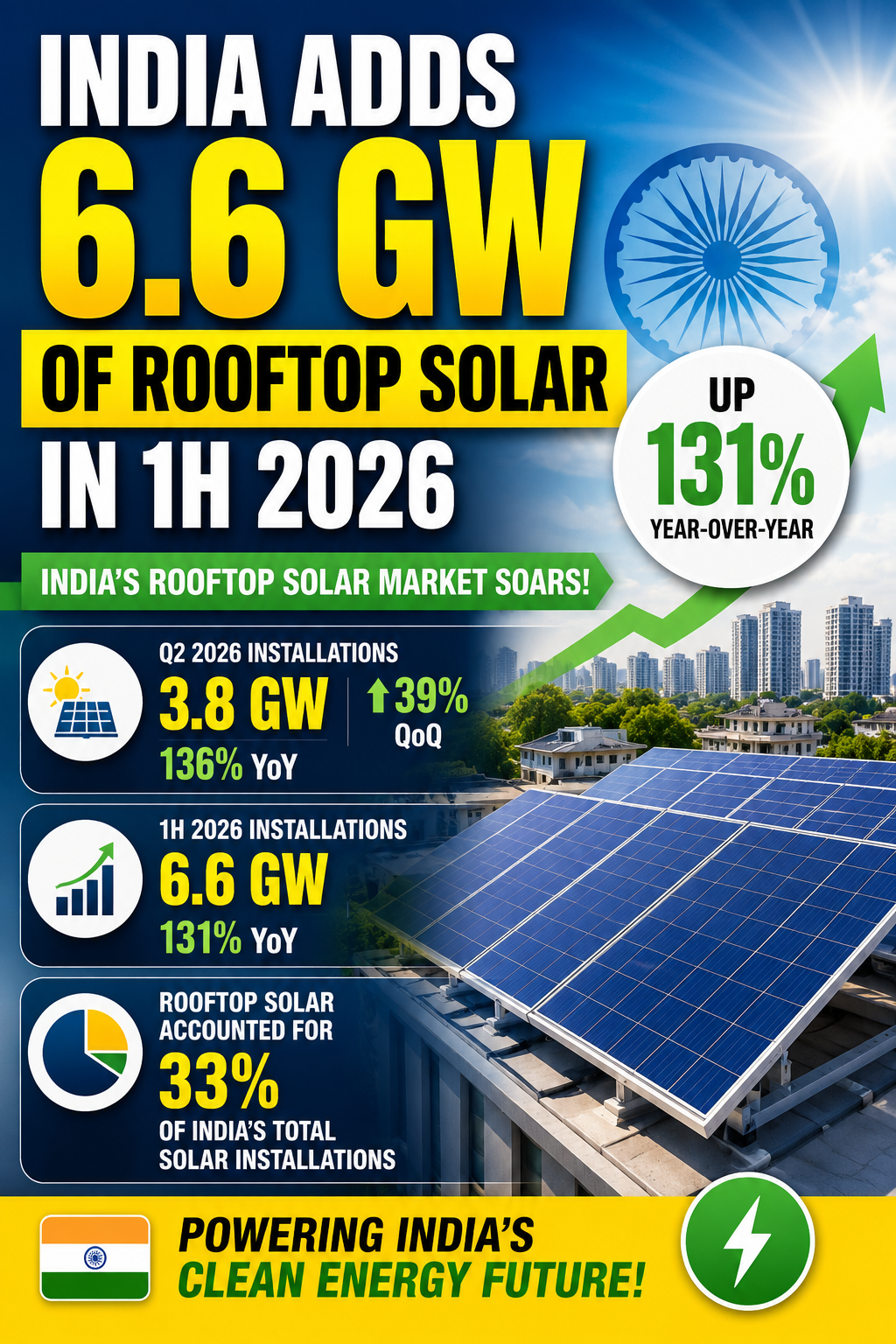
Bengaluru, India – August 31, 2026 – India added 6.6 gigawatts (GW) of rooftop solar capacity in the first half (1H) of calendar year (CY) 2026, up 131% compared to the 2.8 GW installed in 1H 2025, according to Mercom India’s newly released Q2 and 1H 2026 India Rooftop Solar Market Report.
In the second quarter (Q2) of 2026, India added 3.8 GW of rooftop solar capacity, a 39% increase compared to the 2.7 GW installed in Q1 2026. Installations were also up 136% compared to 1.6 GW in Q2 2025.
Rooftop solar accounted for 33% of India’s total solar installations during the quarter.
The government’s continued push under the Pradhan Mantri Surya Ghar Muft Bijli Yojana (PM Surya Ghar program) remained the primary driver of market growth. Rooftop systems had been installed in nearly 4.5 million households by June 2026, reaching approximately 45% of the program’s target of 10 million households.
Residential installations continued to dominate the market in Q2 2026, contributing 84% of total additions. Industrial installations accounted for 10%, followed by commercial installations at 5%, and government installations at 1%.
Installations under the capital expenditure (CAPEX) model accounted for a majority of quarterly additions in Q2 2026.
The implementation of ALMM List-II requirements from June 1, 2026, increased pressure on domestic cell availability and domestic content requirement (DCR) module prices. Subsequent transition measures eased near-term pressure, with eligible net-metering and open access projects receiving a transition window until December 31, 2026. Residential consumers under PM Surya Ghar opting for the “Give It Up” category can forgo the subsidy and use non-DCR modules until the program ends in March 2027.
“India has a strong residential rooftop solar pipeline, but converting it into installations will depend on faster approvals, financing, and project delivery. Higher grid tariffs should strengthen commercial demand, but rising system costs and regulatory constraints could limit industrial growth. The ALMM transition window will help projects move forward in the second half, but it could also trigger a rush to meet deadlines and increase price volatility. Beyond 2026, market growth will depend on domestic cell capacity ramping up quickly and states removing approval, metering, and grid connectivity bottlenecks,” said Raj Prabhu, CEO of Mercom Capital Group.
Average rooftop solar system costs remained broadly flat during Q2 2026, although significant differences persisted across module technologies and sourcing categories. Chinese mono PERC-based systems were the least expensive, while Indian TOPCon DCR-based systems were the most expensive. This cost differential is particularly relevant as domestic content requirements increase demand for compliant cells and modules.
Uttar Pradesh, Maharashtra, and Gujarat led quarterly installations, accounting for 18%, 15%, and 13%, respectively.
The top 10 states accounted for 80% of cumulative rooftop solar installations as of June 2026, with Gujarat, Maharashtra, Uttar Pradesh, Rajasthan, and Kerala leading installed capacity.
Assam recorded the highest compounded quarterly growth rate of 36% between Q2 2025 and Q2 2026. Uttar Pradesh and Andhra Pradesh followed, with growth rates of 23% and 20%, respectively.
Mercom forecasts strong growth in India’s rooftop solar market in 2026, with residential installations expected to remain the primary growth driver, supported by the PM Surya Ghar program and state-level incentives. Commercial installations are also forecast to grow significantly, driven by higher grid tariffs that improve the savings potential from rooftop solar. Industrial installations, however, could face near-term pressure from comparatively lower grid tariffs, higher system and storage costs, and more stringent connectivity, net-metering, banking, and other network requirements in some states.
A comprehensive analysis of net metering policies across all Indian states and Union Territories is also included in the report.
-
India added 6.6 GW of rooftop solar capacity in 1H 2026, up 131% YoY
-
Q2 2026 installations totaled 3.8 GW, increasing 39% QoQ and 136% YoY
-
Residential installations accounted for 84% of Q2 additions
-
Uttar Pradesh, Maharashtra, and Gujarat led quarterly capacity additions
-
Assam recorded the highest compounded quarterly growth rate between Q2 2025 and Q2 2026
The Q2 2026 Mercom India Rooftop Solar Report covers installations, market trends, state-level developments, system costs, investments, tenders, policies, and forecasts across India’s rooftop solar market. For the complete report, visit: https://www.mercomindia.com/product/rooftop-solar-market-report-q2-2026