
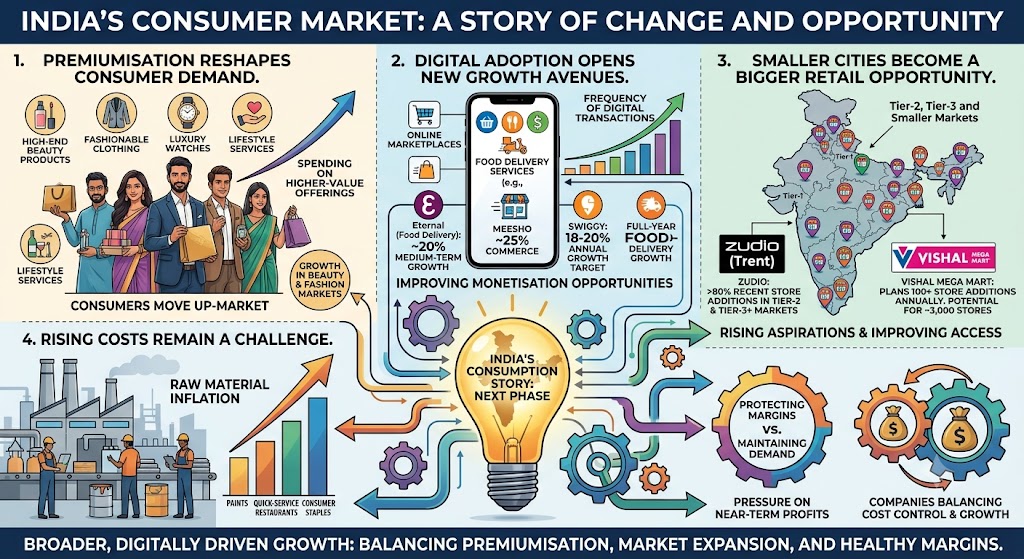
India’s consumer market is changing rapidly as shoppers increasingly move towards premium products, digital platforms and organised retail. But while these trends are creating fresh growth opportunities for companies, rising raw material costs are putting pressure on margins in the near term, according to Jefferies.
The observations were made following discussions with 24 companies at Jefferies’ India Consumer & Internet Forum, where premiumisation, digital adoption and the expansion of organised retail emerged as key themes for India’s consumption story.
Premiumisation reshapes consumer demand
One of the biggest shifts in India’s consumer market is the growing preference for premium products and services. Consumers are increasingly willing to spend on higher-value offerings in categories such as beauty, fashion, watches and other lifestyle products.
For companies, this trend creates an opportunity to increase revenues not only by selling more products but also by encouraging consumers to move towards higher-priced and value-added offerings.
The premiumisation trend is also visible in India’s growing beauty and fashion markets, where digital platforms are making it easier for consumers to discover and purchase premium brands.
Digital adoption opens new growth avenues
Digital platforms are becoming an increasingly important part of everyday consumption in India. Online marketplaces, food-delivery services and quick-commerce platforms are benefiting from a large consumer base and rising frequency of digital transactions.
Jefferies said internet and new-age businesses continue to benefit from increasing usage and improving monetisation opportunities. Eternal expects around 20 per cent medium-term growth in food delivery, while Meesho is targeting around 25 per cent annual growth in net merchandise value over the next five years. Swiggy expects 18-20 per cent full-year food-delivery growth, while continuing to invest in its quick-commerce operations.
These developments underline how digital adoption is changing the way Indian consumers shop, order food and access products and services.
Smaller cities become a bigger retail opportunity
India’s consumption story is also moving beyond the largest metropolitan centres. Organised retailers are increasingly expanding into Tier-2, Tier-3 and smaller markets, bringing branded products closer to consumers in emerging cities and towns.
Jefferies noted that more than 80 per cent of recent Zudio store additions by Trent have been in Tier-2 and Tier-3-plus markets. Vishal Mega Mart, meanwhile, plans to add more than 100 stores annually and sees potential for around 3,000 stores across its formats.
The expansion highlights the growing importance of smaller markets in India’s retail landscape, where rising aspirations and improving access to organised retail are creating new opportunities.
Rising costs remain a challenge for companies
Despite the positive demand outlook, profitability remains an important concern. Raw material inflation is emerging as a key pressure point for sectors including paints, quick-service restaurants and consumer staples.
Higher input costs can make it difficult for companies to protect margins, particularly when consumers remain sensitive to price increases. This leaves businesses balancing two priorities—maintaining demand while controlling costs and protecting profitability.
The challenge is particularly relevant for companies operating in competitive consumer categories, where passing the full increase in costs on to customers may affect demand.
Companies look towards new categories
Consumer companies are responding to changing preferences by expanding premium offerings and entering newer categories.
Tata Consumer Products expects double-digit revenue growth in FY27 along with 50-70 basis points of margin expansion, while Marico expects its premium, food and digital-first portfolios to contribute 33 per cent of revenue by FY30, according to Jefferies.
This reflects a broader strategy among consumer companies to build growth through premium products, new categories and changing consumption habits rather than depending only on traditional volume growth.
India’s consumption story enters a new phase
India’s consumer market is increasingly being shaped by a combination of rising aspirations, premiumisation, digital adoption and wider retail penetration.
For businesses, the opportunity extends beyond major cities and traditional consumer segments. Smaller towns, digital-first shoppers and consumers upgrading to higher-value products are becoming increasingly important parts of the market.
At the same time, companies will need to manage input costs carefully as they expand. The near-term focus is therefore likely to remain on finding the right balance between revenue growth, premiumisation, market expansion and healthy margins.
The changing consumer landscape suggests that India’s next phase of consumption growth could be broader and more digitally driven, with companies competing not only for more customers but also for a larger share of their evolving spending.
