

A Ramsar Site is a wetland area designated as being of international importance under the Ramsar Convention. These wetlands are recognized for their ecological, hydrological, and biological significance, including their role in supporting biodiversity, migratory birds, groundwater recharge, flood control, and climate regulation. Ramsar Sites include lakes, rivers, marshes, mangroves, estuaries, and coastal wetlands.
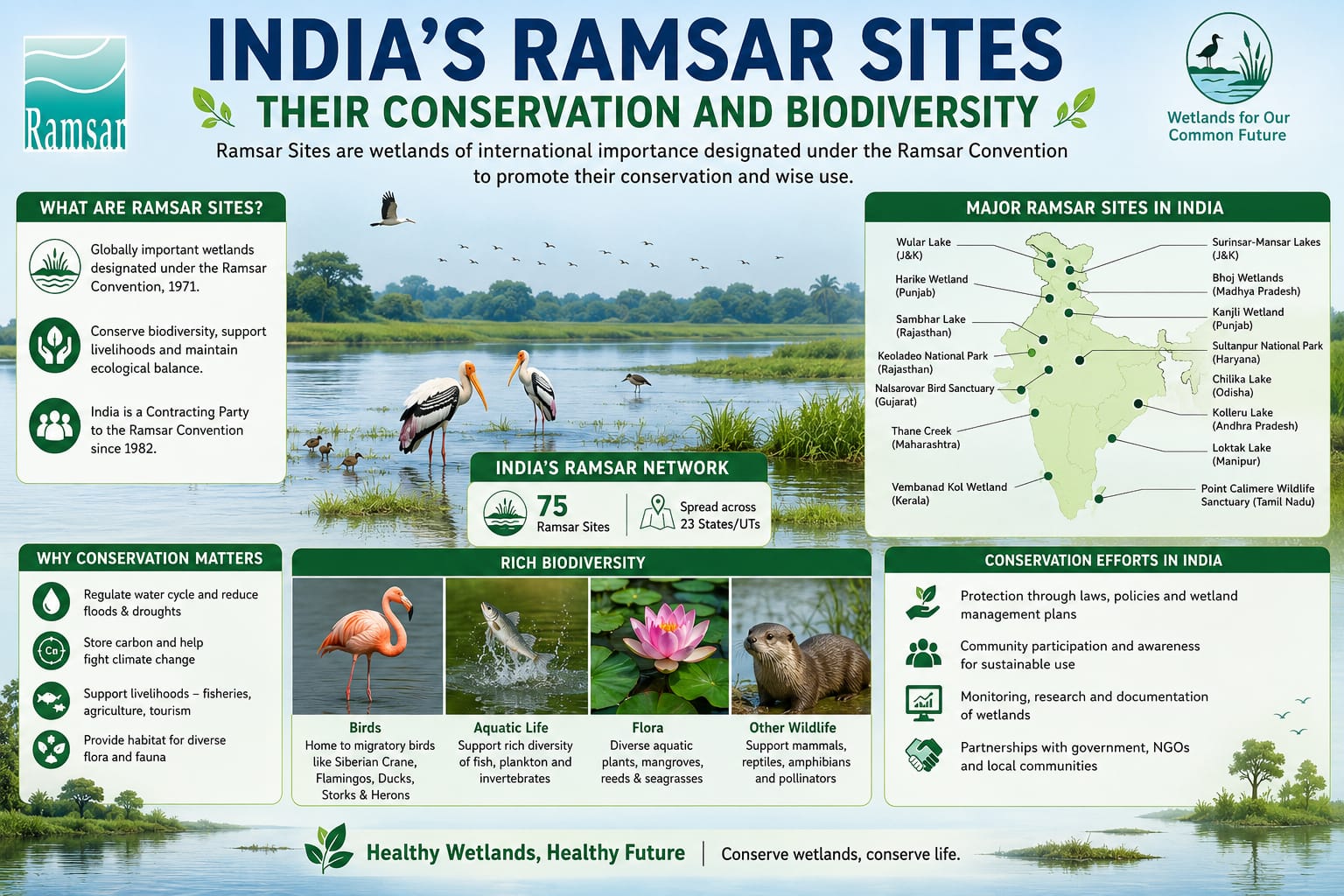
Ramsar Convention and India’s Entry
- The Ramsar Convention on Wetlands was signed in 1971 in Ramsar, Iran, with the goal of conserving wetlands and ensuring their sustainable use worldwide.
- India became a party to the convention on 1 February 1982, committing itself to identify, protect, and sustainably manage wetlands of international importance.
Highlighted Milestones in India’s Ramsar Journey
- 1st Ramsar Sites in India: Chilika Lake (Odisha) and Keoladeo National Park (Rajasthan)
- 100th Ramsar Site: Surha Tal (Jai Prakash Narayan Bird Sanctuary), Ballia, Uttar Pradesh
Ramsar Sites in India(100 Sites)
Andhra Pradesh
- Kolleru Lake
Assam
- Deepor Beel
Bihar
- Kanwar Taal
- Nagi Bird Sanctuary
- Nakti Bird Sanctuary
- Gokul Jalashaya
- Gogabeel Lake
- Udaipur Jheel
Chhattisgarh
- Kopra Reservoir
Goa
- Nanda Lake
Gujarat
- Khijadia WLS
- Nalsarovar Bird Sanctuary
- Thol Lake
- Wadhvana Wetland
- Chhari-Dhand
Haryana
- Bhindawas WL
- Sultanpur NP
Himachal Pradesh
- Chandra Taal
- Pong Dam Lake
- Renuka Lake ( Smallest )
Jammu & Kashmir
- Hokera Wetland
- Hygam Wetland
- Shallbugh Wetland
- Surinsar-Mansar Lakes
- Wular Lake
Jharkhand
- Udhwa Lake
Karnataka
- Ranganathittu Bird Sanctuary
- Magadi Kere Conservation Reserve
- Ankasamudra Bird Conservation Reserve
- Aghanashini Estuary
- KeralaAshtamudi Wetland
- Sasthamkotta Lake
- Vembanad-Kol Wetland
Ladakh
- Tso Kar
- Tsomoriri
Madhya Pradesh
- Bhoj Wetland
- Sakhya Sagar
- Sirpur Wetland
- Yashwant Sagar
- Tawa Reservoir
Maharashtra
- Lonar Lake
- Nandur Madhameshwar
- Thane Creek
Manipur
- Loktak Lake
Mizoram
- Pala Wetland
Odisha
- Ansupa Lake
- Bhitarkanika Mangroves
- Chilika Lake
- Hirakud Reservoir
- Satkosia Gorge
- Tampara Lake
Punjab
- Beas Conservation Reserve
- Harike Wetland
- Kanjli Wetland
- Keshopur-Miani Community Reserve
- Nangal Wildlife Sanctuary
- Ropar Wetland
Rajasthan
- Keoladeo National Park
- Sambhar Lake
- Khichan
- Menar
- Siliserh Lake
Sikkim
- Khecheopalri Wetland
Tamil Nadu
- Chitrangudi Bird Sanctuary
- Gulf of Mannar Marine Biosphere Reserve
- Kanjirankulam Bird Sanctuary
- Karikili Bird Sanctuary
- Koonthankulam Bird Sanctuary
- Pallikaranai Marsh
- Pichavaram Mangrove
- Point Calimere
- Suchindram Theroor Wetland Complex
- Udhayamarthandapuram BS
- Vaduvur BS
- Vedanthangal BS
- Vellode BS
- Vembannur Wetland Complex
- Karaivetti Bird Sanctuary
- Longwood Shola
- Kazhuveli Bird Sanctuary
- Nanjarayan Bird Sanctuary
- Therthangal Bird Sanctuary
- Sakkarakottai Bird Sanctuary
Tripura
- Rudrasagar Lake
Uttar Pradesh
- Bakhira WLS
- Haiderpur Wetland
- Nawabganj BS
- Parvati Arga BS
- Saman BS
- Samaspur BS
- Sandi BS
- Sarsai Nawar Jheel
- Sur Sarovar
- Upper Ganga River
- Patna Bird Sanctuary
- Shekha Jheel Bird Sanctuary
- Jai Prakash Narayan Bird Sanctuary (Surha Tal)
Uttarakhand
- Asan Barrage
West Bengal
- East Kolkata Wetlands
- Sundarban Wetland
Biodiversity Protection through Ramsar Sites
Ramsar Sites play a crucial role in:
- Protecting endangered species like Gangetic dolphin, Siberian crane, fishing cat
- Conserving migratory bird routes like the Central Asian Flyway
- Maintaining aquatic ecosystems such as mangroves and coral-linked wetlands
- Supporting fisheries, agriculture, and rural livelihoods
- Acting as natural carbon sinks and climate buffers
Government Schemes for Wetland Protection
India has introduced several initiatives:
1. Wetlands (Conservation and Management) Rules, 2017
Legal protection against encroachment, pollution, and unsustainable use.
2. National Wetland Conservation Programme (NWCP)
Provides financial assistance for wetland restoration.
3. NPCA (National Plan for Conservation of Aquatic Ecosystems)
Integrated conservation of lakes and wetlands.
4. Amrit Dharohar Scheme
Promotes eco-tourism, biodiversity conservation, and livelihood generation.
5. State Wetland Authorities
Decentralized monitoring and management of wetlands.
Conclusion
India’s Ramsar Sites represent a remarkable success story in environmental conservation, showcasing the country’s commitment to protecting vital wetland ecosystems. From the first designated sites like Chilika Lake and Keoladeo National Park to the historic 100th site at Surha Tal in Uttar Pradesh, India has significantly expanded its global leadership in wetland protection. These wetlands are not only biodiversity hotspots but also essential for climate regulation, water security, and sustainable livelihoods. With strong government policies, community participation, and international cooperation, India continues to strengthen its mission of preserving these ecological treasures for future generations.