
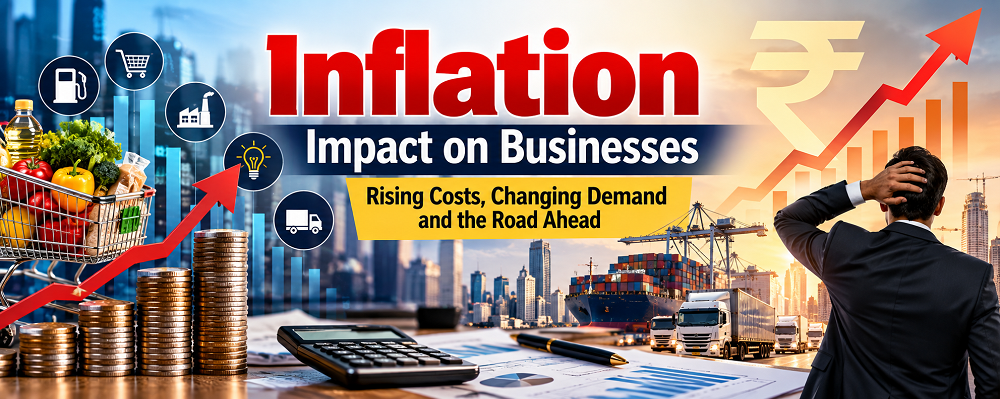
Inflation is often described through familiar numbers—the Consumer Price Index, food prices, fuel costs or interest rates. For businesses, however, inflation is far more than an economic statistic. It directly influences the cost of producing goods, paying employees, transporting products, financing operations and serving customers.
When prices rise persistently, businesses are forced to make difficult choices. Should they increase prices and risk losing customers? Should they absorb higher costs and accept lower margins? Should they reduce expenses, postpone investments or find new suppliers?
For large corporations, inflation can be managed through scale, technology, financial planning and purchasing power. For small businesses and MSMEs, the challenge can be considerably more immediate.
The impact of inflation therefore extends across the entire business ecosystem—from manufacturers and retailers to technology companies, service providers and consumers.
What Inflation Means for Businesses
Inflation refers to a sustained increase in the general price level of goods and services. When inflation rises, the purchasing power of money declines.
For businesses, this can translate into higher prices for:
-
Raw materials
-
Energy and fuel
-
Transportation and logistics
-
Rent and real estate
-
Salaries and employee benefits
-
Packaging
-
Technology and software
-
Borrowing and working capital
-
Professional and outsourced services
The challenge becomes particularly serious when business costs rise faster than selling prices.
A company may report higher revenues in nominal terms while actually experiencing weaker profitability after adjusting for increased operating costs.
Rising Input Costs Put Pressure on Margins
One of the most direct consequences of inflation is an increase in the cost of inputs.
Manufacturers may face higher prices for metals, chemicals, components, packaging materials and energy. Food businesses may experience rising costs for agricultural commodities. Construction companies may have to pay more for cement, steel, labour and transportation.
Businesses ultimately have three broad choices:
Absorb the cost.
This protects customers from immediate price increases but reduces margins.
Pass the cost to customers.
This protects profitability but may reduce demand.
Improve efficiency.
Technology, procurement, automation and process improvements can help reduce the impact.
In practice, companies often use a combination of all three.
Pricing Becomes a Strategic Decision
Inflation changes the way companies think about pricing.
A business cannot simply increase prices every time its costs increase. Customers may switch to cheaper competitors, reduce their purchases or postpone buying decisions.
This makes pricing strategy increasingly important.
Companies are experimenting with:
-
Smaller product sizes
-
Premium and economy product categories
-
Subscription models
-
Dynamic pricing
-
Bundled offerings
-
Value-based pricing
-
Loyalty programmes
-
Long-term contracts
The objective is not simply to charge more. It is to protect profitability while preserving customer value.
Consumers Become More Price Conscious
Inflation changes consumer behaviour.
When household expenses increase, consumers often reassess discretionary spending. They may move from premium products to lower-priced alternatives, compare prices more aggressively or postpone non-essential purchases.
This creates both challenges and opportunities.
A premium brand may lose some price-sensitive customers, while a value-oriented company may gain market share.
Businesses that understand these changes can redesign their product portfolios accordingly.
The result can be a shift from simply selling products to offering different value propositions for different income and customer segments.
Wage Inflation and the Talent Challenge
Inflation does not affect only physical inputs.
Employees also face higher living costs and naturally seek salary increases to protect their purchasing power.
Businesses therefore face pressure from wage inflation.
Higher salaries can increase operating costs, but failing to provide competitive compensation can result in employee attrition.
Replacing skilled employees is expensive. Recruitment, training and lost productivity can significantly increase the real cost of turnover.
Companies are consequently looking beyond salary alone.
Flexible working arrangements, performance incentives, employee benefits, professional development and productivity-linked compensation can become important tools for retaining talent.
Interest Rates Add Another Layer of Pressure
Inflation and interest rates are closely connected.
When central banks raise policy rates to control inflationary pressures, borrowing can become more expensive.
For businesses, higher interest rates can increase the cost of:
-
Working capital
-
Business loans
-
Equipment financing
-
Expansion projects
-
Inventory financing
-
Real estate purchases
Highly leveraged companies can therefore experience a double challenge: higher operating costs combined with higher financing costs.
This makes cash-flow management increasingly important.
MSMEs Are Particularly Vulnerable
Small businesses often operate with limited financial buffers.
An established corporation may negotiate better supplier contracts, hedge commodity prices or access multiple sources of finance. An MSME may have much less bargaining power.
A sudden increase in raw-material prices can therefore have an immediate impact on its cash flow.
Delayed payments from customers can make the situation worse.
For MSMEs, inflation management increasingly requires:
better inventory planning + stronger cash-flow discipline + diversified suppliers + efficient pricing.
Working capital can become as important as revenue growth.
Supply Chains Under Pressure
Inflation can expose weaknesses in supply chains.
Businesses dependent on a single supplier or geographical region may find themselves vulnerable when transportation costs increase or supplies become constrained.
Companies are therefore increasingly considering:
-
Multiple suppliers
-
Local sourcing
-
Regional manufacturing
-
Strategic inventories
-
Digital supply-chain monitoring
-
Long-term procurement agreements
The objective is not simply to find the cheapest supplier.
It is to build a supply chain that balances cost, reliability, flexibility and resilience.
Technology Can Become an Inflation-Management Tool
One of the most important responses to inflation is improving productivity.
Technology can help businesses achieve this by reducing manual processes, improving inventory management and increasing operational visibility.
Automation can reduce repetitive labour requirements.
Artificial intelligence can help businesses forecast demand, analyse customer behaviour and optimise pricing.
Cloud-based systems can reduce infrastructure costs and improve collaboration.
Digital payments and automated accounting can improve cash-flow visibility.
In this environment, technology is no longer simply a growth investment. It can also become a cost-management strategy.
Inflation Can Accelerate Business Transformation
Although inflation creates significant challenges, it can also force businesses to become more efficient.
Companies may discover unnecessary expenses that were previously overlooked.
They may renegotiate contracts, eliminate inefficient processes, automate routine operations or redesign products.
In other words, inflation can accelerate a transformation that might otherwise have taken years.
Businesses that respond strategically can emerge leaner and more competitive.
Sector-Wise Impact
The effect of inflation varies significantly by industry.
Manufacturing
Manufacturers are exposed to raw-material, energy, logistics and labour costs. Companies with strong procurement systems and pricing power are generally better positioned.
Retail
Retailers face a difficult balance between supplier costs and consumer affordability. Inventory management and product mix become critical.
Construction
Higher prices for steel, cement, fuel, equipment and labour can significantly affect project costs and timelines.
Hospitality
Hotels and restaurants face rising food, energy, labour and maintenance expenses while customers remain sensitive to prices.
Healthcare
Hospitals, clinics and pharmaceutical businesses can face rising equipment, labour and operational costs, although pricing structures and regulations can limit their ability to pass costs directly to customers.
Technology
Technology companies may have lower exposure to physical commodities but can face higher salary costs, infrastructure expenses and financing pressures.
Logistics
Fuel, vehicle maintenance, wages and financing costs can all increase, making route optimisation and fleet efficiency particularly important.
Inflation and Business Investment
One of the more important long-term consequences of inflation is its impact on investment decisions.
When costs and interest rates are uncertain, companies may delay expansion plans.
A factory expansion that looked financially attractive two years ago may appear less compelling if construction costs and borrowing rates have risen substantially.
However, postponing every investment can also be dangerous.
Companies that continue investing selectively in productivity-enhancing technologies, automation and resilient supply chains may gain an advantage over competitors that simply cut spending.
The key is distinguishing between cost-cutting investments and growth-oriented investments.
How Businesses Can Respond
There is no single solution to inflation. Companies need a coordinated strategy.
1. Strengthen Cost Monitoring
Businesses should track costs more frequently instead of relying solely on annual budgets.
2. Improve Cash-Flow Management
Profitability does not guarantee liquidity. Companies should closely monitor receivables, payables, inventory and working capital.
3. Diversify Suppliers
Multiple suppliers can reduce dependency and improve negotiating power.
4. Review Pricing Regularly
Pricing should reflect changing costs, customer demand and competitive conditions.
5. Invest in Productivity
Automation and digital tools can help businesses produce more with fewer resources.
6. Protect Employee Productivity
Retaining skilled employees can be more cost-effective than repeatedly recruiting and training replacements.
7. Reduce Energy Consumption
Energy efficiency can deliver both financial and environmental benefits.
8. Build Scenario Plans
Businesses should prepare for multiple possibilities—higher inflation, falling inflation, slower demand and changing interest rates.
The Importance of Pricing Power
One of the most valuable assets a company can have during an inflationary period is pricing power.
Businesses with strong brands, differentiated products or limited competition can often increase prices without losing a significant portion of their customer base.
Companies operating in highly competitive markets have less flexibility.
This makes differentiation increasingly important.
A business that competes solely on price can become particularly vulnerable when its own costs rise.
A business that offers unique quality, technology, service, reliability or brand value may have greater flexibility.
Inflation Can Separate Strong Businesses from Weak Ones
Economic pressure often reveals the underlying strength of a business.
Companies with:
-
Strong balance sheets
-
Loyal customers
-
Efficient operations
-
Diversified suppliers
-
Healthy cash flows
-
Pricing power
-
Low dependence on expensive debt
are generally better positioned to withstand inflationary periods.
Businesses with weak cash flows, excessive leverage and low margins can face much greater pressure.
Inflation therefore becomes not only a macroeconomic challenge but also a test of corporate resilience.
Looking Ahead
Inflation is unlikely to disappear as a business concern even when headline inflation moderates.
Companies must increasingly operate in an environment where commodity prices, wages, energy costs, interest rates, exchange rates and geopolitical developments can change rapidly.