
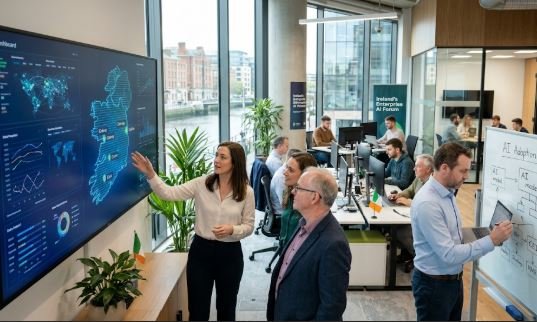
Artificial intelligence (AI) is becoming an increasingly important part of Ireland’s business landscape, changing how companies manage operations, engage customers and compete in an increasingly digital economy. From financial services and manufacturing to retail, technology and professional services, businesses are exploring intelligent technologies to improve productivity, reduce operational costs and identify new opportunities for growth. As Ireland strengthens its position as a European technology and innovation hub, AI adoption is emerging as an important factor shaping the future of its enterprise market.
The shift is becoming visible across businesses of different sizes. According to Ireland’s Central Statistics Office (CSO), 20.2% of enterprises used AI technologies in 2025, compared with 8.1% in 2023. While large corporations have moved faster in integrating these solutions, smaller businesses are also beginning to recognise their commercial value. The growing adoption reflects a change in business priorities, with companies increasingly looking beyond basic digital tools towards technologies that can support decision-making, automate routine activities and improve customer experiences.
However, the real opportunity for Ireland’s enterprise sector lies in turning AI adoption into measurable business results. Introducing intelligent software is only the first step. Companies must understand where these technologies can make a meaningful difference to productivity, revenue and operational efficiency.
Ireland’s Enterprise Market Enters a New Phase of AI Adoption
Ireland’s AI adoption rate has reached a significant milestone, but the pace of implementation varies considerably across enterprise sizes.
Large enterprises lead the transition, with 57.7% using AI technologies in 2025. Adoption among medium-sized businesses stands at 28.6%, while small enterprises recorded 17.2%.
This difference reflects the resources available to businesses. Larger organisations generally have greater investment capacity, established IT infrastructure and dedicated technology teams. Smaller companies, on the other hand, often need to balance technology investment against everyday operating expenses.
Nevertheless, the growing interest among SMEs represents an important opportunity for Ireland’s technology industry. Affordable AI platforms, cloud-based applications and specialised automation services can help smaller businesses access capabilities that were previously more difficult and expensive to implement.
Ireland’s overall adoption rate is broadly in line with the EU average of 20%, although it remains behind leading countries such as Denmark and Finland. This leaves considerable scope for Irish enterprises to strengthen their digital capabilities and improve their competitiveness.
Key Business Opportunities Driving AI Adoption in Ireland
1. Business Automation: Improving Productivity and Controlling Costs
Administrative processes are among the most practical starting points for AI implementation. Businesses are increasingly exploring intelligent systems to handle document processing, invoice management, scheduling, internal communication and routine customer enquiries.
For SMEs operating with limited staff, automation can make a considerable difference. Instead of spending valuable working hours on repetitive activities, employees can concentrate on customer relationships, business development and more complex responsibilities.
This is creating opportunities for software developers, automation consultants and technology providers offering business-specific AI solutions. Companies that can deliver affordable systems with straightforward integration are particularly well positioned to serve smaller enterprises.
2. Data Analytics: Turning Business Information into Better Decisions
Businesses generate large amounts of information through sales transactions, customer interactions, digital platforms and daily operations. AI-powered analytics can help enterprises identify patterns in this information and use the findings to make better commercial decisions.
Retailers can understand purchasing behaviour and improve inventory planning, while manufacturers can monitor production performance and identify inefficiencies. Financial services companies can use intelligent analytics to strengthen risk assessment and identify unusual transactions.
Ireland’s growing use of data analytics provides a strong foundation for this development. Businesses are increasingly recognising that data is valuable only when it can be converted into practical insights.
For technology companies, this creates opportunities in predictive analytics, business intelligence platforms and customised data management services.
3. Customer Service: Building Stronger Customer Relationships
Customer expectations are changing, with businesses under increasing pressure to provide faster responses and more convenient support.
AI-powered chatbots and virtual assistants can handle common enquiries, provide product information and assist customers outside conventional working hours. Businesses can also use intelligent systems to analyse customer feedback and identify recurring service issues.
For retailers, banks, hospitality companies and professional service providers, these tools can improve response times while reducing pressure on customer support teams.
The commercial benefit, however, goes beyond cost savings. Businesses that use AI effectively can offer more consistent and personalised customer experiences, helping strengthen customer satisfaction and retention.
4. Marketing and Sales: Creating More Targeted Business Opportunities
AI is also changing how companies approach marketing and sales. Intelligent tools can help businesses analyse customer preferences, identify potential buyers, optimise advertising campaigns and develop more relevant marketing content.
For smaller companies, these capabilities can reduce the resources required to manage digital marketing activities. AI-assisted customer segmentation and sales forecasting can also help businesses focus their efforts on audiences with stronger purchasing potential.
Digital marketing agencies, technology consultants and software providers can benefit from this growing demand by offering AI-supported marketing services.
As competition for online visibility increases, businesses that combine customer insights with effective marketing strategies may gain an advantage in attracting and retaining customers.
5. Manufacturing and Supply Chain Management: Supporting Smarter Operations
Ireland’s manufacturing sector, particularly pharmaceuticals, medical technology, food processing and industrial production, offers significant opportunities for AI integration.
Manufacturers can use intelligent systems to monitor equipment, identify production defects and predict maintenance requirements. These applications can reduce unexpected downtime and improve the use of machinery and materials.
In supply chain management, AI can support demand forecasting, inventory monitoring and logistics planning. Better visibility into business operations can help companies respond more effectively to changing market conditions and avoid unnecessary costs.
For manufacturers competing in international markets, these improvements can strengthen operational efficiency and support long-term business growth.
6. Financial Services: Strengthening Risk Management and Security
Ireland’s established financial services sector is another important market for AI-powered solutions.
Banks, insurance companies and financial technology businesses can use intelligent systems to analyse transactions, identify suspicious activity and support customer verification processes.
AI can also assist with insurance claims, document reviews and routine customer services, allowing employees to focus on more complex cases.
However, financial institutions must ensure that these applications operate with appropriate security, transparency and human oversight. Responsible implementation will be essential for maintaining customer confidence and meeting regulatory requirements.
Why Ireland Is Becoming an Important Market for AI Businesses
Ireland’s established technology ecosystem gives it an important advantage in the development and adoption of enterprise AI.
The country hosts a strong presence of multinational technology and financial services companies, alongside a growing community of startups, software developers and specialist technology providers. Dublin remains a major centre for digital business activity, while other regional locations are also contributing to Ireland’s innovation landscape.
Homegrown technology companies are developing solutions in enterprise automation, cybersecurity and intelligent workflow management. This is helping strengthen the local technology sector while creating opportunities for partnerships between startups, established businesses and international companies.
Ireland’s position within the European Union also makes it an attractive location for businesses seeking to develop technology solutions for the wider European market.
For international technology providers, the enterprise market offers opportunities in software integration, AI consulting, cloud infrastructure, cybersecurity and specialised business applications.
SMEs: The Next Major Growth Opportunity for AI Providers
Although large companies currently account for the highest level of AI adoption, small and medium-sized enterprises could become an important source of future demand.
Many smaller businesses understand the potential benefits of AI but are unsure where to begin. High implementation costs, limited technical expertise, concerns about data security and outdated business systems can prevent them from adopting more advanced solutions.
This creates a commercial opportunity for service providers that can simplify the transition.
Affordable AI subscriptions, customised automation packages, employee training and cloud-based business applications can help SMEs adopt intelligent technologies without making substantial upfront investments.
There is also growing scope for industry-specific solutions. Retailers may require customer analytics, while accounting firms could benefit from document automation and manufacturers may need predictive maintenance systems.
Technology companies that understand these individual business requirements can build stronger customer relationships and develop recurring revenue opportunities.
Challenges Affecting AI Implementation in Irish Enterprises
Despite growing adoption, several barriers continue to influence how quickly Irish businesses can integrate AI into their operations.
- Technology investment: Software, infrastructure, integration and maintenance expenses can be difficult for smaller companies to manage.
- Digital readiness: Businesses using outdated systems may need to improve their cloud infrastructure and data management processes before implementing advanced AI solutions.
- Skills shortages: The demand for professionals with expertise in AI, data analytics, software development and cybersecurity is increasing.
- Data protection: Enterprises must protect customer and employee information while ensuring their systems comply with European data protection requirements.
- Trust and accountability: Businesses need to understand how AI-generated decisions are made and maintain appropriate human oversight.
Regulatory compliance is particularly important for companies operating in Ireland. The EU AI Act introduces obligations based on the level of risk associated with different AI applications. Businesses must therefore consider transparency, accountability and risk management when introducing these technologies.
Addressing these challenges will be important for ensuring that AI adoption delivers long-term commercial benefits rather than becoming another costly technology experiment.
The Road Ahead for Ireland’s AI-Powered Enterprise Market
Ireland’s AI adoption journey is gradually moving from experimentation towards wider business integration. As technology becomes more accessible, enterprises are likely to explore applications that connect different departments, improve operational visibility and support more informed decision-making.
SMEs could play an increasingly important role in this next phase, particularly as affordable software and specialised AI services become more widely available. Demand for automation, cybersecurity, predictive analytics and employee training is also expected to create opportunities for technology providers and business consultants.
For enterprises, the priority will be to identify applications that solve genuine business problems. Companies that combine suitable technology with skilled employees, reliable data and responsible management will be better positioned to achieve meaningful results.
Ultimately, artificial intelligence is becoming more than a technology trend in Ireland. It is developing into an important business tool that can influence productivity, competitiveness and innovation across the enterprise sector. As adoption expands beyond large corporations and reaches smaller businesses, Ireland’s AI-powered enterprise market could become an increasingly important contributor to the country’s future economic and digital growth.
