

Learning a foreign language has changed dramatically over the past decade. What was once limited to physical classrooms, printed textbooks and fixed schedules has evolved into a flexible digital learning experience that allows students to study from virtually anywhere. Today, online language education has become a preferred choice for university students, working professionals, job seekers and even school students looking to prepare for international careers.
This transformation did not happen overnight. It is the result of advancements in technology, changing lifestyles and the growing demand for global communication skills. As industries become increasingly international, learning languages such as German, French, Spanish and Japanese is no longer viewed as simply a hobby. Instead, it has become a valuable career skill that opens doors to higher education, global employment and cross-cultural collaboration.
Among the institutions that have witnessed and contributed to this transformation is the Indian Institute of Foreign Languages (IIFLS). Over the years, the institute has experienced first-hand how learner expectations have shifted from traditional classroom instruction to highly interactive online learning environments. Rather than replacing classroom education, online learning has expanded access to quality language education for students across India and beyond.
The Early Days of Traditional Language Learning
For many years, learning a foreign language meant attending scheduled classes at a physical institute. Students travelled long distances after school, college or work to participate in lessons conducted inside classrooms. Face-to-face interaction created a structured learning environment where teachers could immediately correct pronunciation, conduct group activities and encourage classroom discussions.
Traditional classrooms offered several advantages. Students developed friendships with classmates, participated in role-play exercises and experienced a disciplined study routine. Many learners appreciated the motivation that came from attending regular classes and interacting with instructors in person.
However, classroom learning also presented practical challenges.
Working professionals often struggled to reach institutes on time because of office commitments and traffic. University students sometimes had to choose between academic schedules and language classes. Learners living in smaller towns frequently had limited access to experienced foreign language trainers.
These limitations highlighted the need for a more flexible approach to language education.
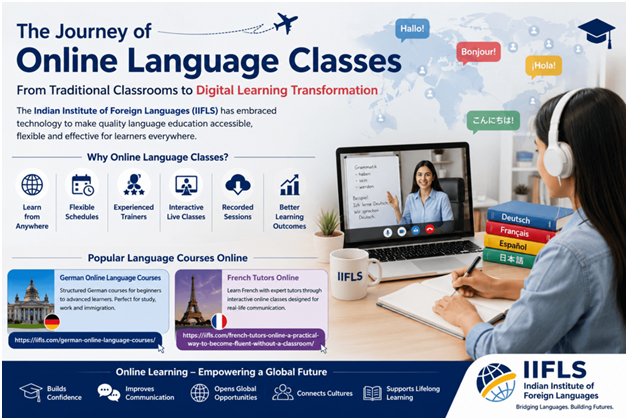
The Beginning of Digital Learning
As internet connectivity improved and virtual communication platforms became more reliable, educational institutions started experimenting with online teaching methods. Initially, many learners were uncertain whether language learning could be equally effective without sharing the same physical classroom.
Foreign language education relies heavily on speaking, listening and interactive practice. Many believed these skills required face-to-face instruction.
Over time, however, technology evolved significantly. High-quality video conferencing, screen sharing, digital whiteboards, interactive assignments, online assessments and collaborative learning tools transformed the virtual classroom into an engaging educational environment.
The transition accelerated even further as students became more comfortable with digital platforms for learning, communication and professional development.
Educational institutions, including the Indian Institute of Foreign Languages, adapted by redesigning their teaching methods to ensure that online students received structured learning experiences comparable to classroom programmes.
How Online Language Classes Changed the Learning Experience
One of the biggest advantages of online education is accessibility.
Students no longer need to relocate or travel long distances to receive quality language instruction. Whether someone lives in Bengaluru, Delhi, Kochi, Hyderabad, a small town or even outside India, they can now learn directly from experienced trainers using an internet connection.
This flexibility has made language education available to a much wider audience.
Working professionals can attend evening classes after office hours.
College students can balance university schedules with language learning.
Parents can study from home without disrupting family responsibilities.
International students can continue learning regardless of their location.
These changes have fundamentally altered how learners approach skill development.
For institutions such as the Indian Institute of Foreign Languages, online education has made it possible to reach students from multiple cities while maintaining consistent teaching standards.
German Online Language Courses Continue to Grow in Popularity
Among the many foreign languages taught today, German continues to attract strong interest from Indian students and professionals.
Germany’s reputation in engineering, manufacturing, research, healthcare and higher education has encouraged thousands of learners to improve their German language proficiency before pursuing international opportunities.
As a result, German Online Language Courses have become an increasingly popular option for learners seeking flexibility without compromising quality.
Modern virtual classrooms provide opportunities for speaking practice, grammar sessions, vocabulary building, pronunciation correction and interactive activities that closely resemble traditional classroom experiences.
Learners interested in structured German Online Language Courses can explore programmes such as those offered by the Indian Institute of Foreign Languages, which combines live instructor-led sessions with practical communication exercises to support language development.
Learn more about these programmes here to learn German online .
French Tutors Online Are Making Language Learning More Accessible
The growth of online education has also benefited learners interested in French.
Rather than depending solely on local institutes, students now have access to experienced French Tutors Online who can conduct personalised sessions through interactive virtual classrooms.
Online French learning offers flexibility for professionals preparing for international careers, students planning overseas education and individuals who simply wish to develop multilingual communication skills.
Virtual learning also enables instructors to incorporate multimedia resources, pronunciation exercises, interactive conversations and digital assignments that keep learners actively engaged throughout the course.
Institutions like the Indian Institute of Foreign Languages have embraced these methods to ensure that online learners receive the same level of guidance and academic support traditionally associated with classroom education.
Readers interested in learning more about this approach can explore French Tutors Online:
Benefits of Online Language Classes
The rapid adoption of online learning has demonstrated that language education can be both effective and convenient when supported by experienced instructors and the right technology. While every learner has unique preferences, several benefits have made online language classes increasingly popular.
1. Learn from Anywhere
Perhaps the greatest advantage is location independence. Students no longer need to relocate or spend hours commuting to attend classes. Whether living in a metropolitan city, a small town or even abroad, learners can access quality instruction with a stable internet connection.
2. Flexible Scheduling
Online classes offer greater flexibility for working professionals, university students and parents. Many institutes provide weekday and weekend batches, allowing learners to choose schedules that fit around their personal and professional commitments.
3. Access to Experienced Trainers
In a traditional classroom, students are limited to instructors available in their local area. Online learning removes geographical barriers, enabling institutions such as the Indian Institute of Foreign Languages (IIFLS) to connect learners with experienced trainers regardless of where they live.
4. Interactive Learning Technology
Today’s virtual classrooms are far more advanced than simple video calls. Live discussions, digital whiteboards, breakout rooms, quizzes, screen sharing, recordings and collaborative exercises help create an engaging learning environment that encourages active participation.
5. Recorded Sessions for Revision
Many online programmes allow students to revisit lessons through recorded sessions or digital learning materials. This makes revision easier and enables learners to review complex grammar topics or pronunciation exercises at their own pace.
6. Better Work-Life-Study Balance
Instead of spending additional hours travelling, learners can invest that time in revision, assignments or conversation practice. This balance has made language learning more sustainable for busy professionals.
Challenges of Online Language Learning
Although online learning offers many advantages, it is not without its challenges. Understanding these limitations helps learners choose the format that best suits their needs.
Maintaining Self-Discipline
Learning from home requires consistency and personal motivation. Without regular classroom attendance, some students may procrastinate or miss practice sessions. Establishing a dedicated study routine becomes essential for success.
Internet Connectivity
Online classes depend on stable internet access. Poor connectivity can occasionally interrupt lessons or reduce the quality of communication, particularly during speaking exercises.
Fewer Informal Classroom Interactions
Traditional classrooms naturally encourage conversations before and after class, helping students practise language skills informally. While virtual classrooms include interactive activities, spontaneous social interactions may be less frequent.
Managing Screen Time
Students who already spend long hours working on computers may experience screen fatigue. Taking regular breaks and balancing digital learning with offline reading and speaking practice can help maintain focus.
Despite these challenges, improvements in digital platforms and teaching methodologies continue to enhance the online learning experience year after year.
Classroom Learning vs Online Learning
Rather than viewing online and classroom learning as competitors, many educators now see them as complementary approaches.
Traditional classrooms offer face-to-face interaction, structured environments and immediate social engagement. They remain an excellent choice for learners who enjoy studying in groups and prefer in-person communication.
Online learning, meanwhile, provides unmatched flexibility, wider access to expert instructors and the ability to learn regardless of location. For professionals with demanding schedules or students living far from quality institutes, online education has created opportunities that previously did not exist.
Many institutions now combine the strengths of both models through blended learning, allowing students to benefit from classroom interaction while also using digital resources for revision and self-paced learning.
The Future of Online Language Education
The evolution of digital education is far from complete. Artificial intelligence, adaptive learning systems, virtual reality and speech recognition technologies are expected to make online language learning even more personalised and interactive in the coming years.
AI-powered pronunciation analysis, automated vocabulary practice and intelligent progress tracking are already helping learners receive more immediate and customised feedback. As these technologies continue to mature, students will gain access to richer learning experiences while still benefiting from the guidance of experienced instructors.
Online education will also play an increasingly important role in lifelong learning. Professionals seeking career advancement, students preparing for international universities and individuals interested in global communication will continue to rely on flexible digital learning options.
A Journey That Continues
The transformation from traditional classrooms to online language education represents more than a technological shift—it reflects changing learner expectations and the growing importance of accessible, high-quality education.
The Indian Institute of Foreign Languages (IIFLS) has been part of this journey by adapting its teaching methods to meet the needs of modern learners. Through live virtual classrooms, experienced instructors and structured learning programmes, the institute has demonstrated that effective language education can extend well beyond the walls of a physical classroom.
Whether someone chooses German Online Language Courses to prepare for higher education or employment in German-speaking countries, or works with French Tutors Online to develop fluency for academic or professional goals, today’s digital learning environment offers opportunities that were difficult to imagine just a decade ago.
More importantly, online learning has made foreign language education accessible to people who may never have had the opportunity to attend a specialised institute in person. It has connected learners from different cities, professions and backgrounds through a shared goal of building global communication skills.
As technology continues to evolve, online language education will undoubtedly become even more engaging, personalised and accessible. While classrooms will always have their place, the future of foreign language learning is increasingly defined by flexibility, innovation and the ability to learn from anywhere in the world.