
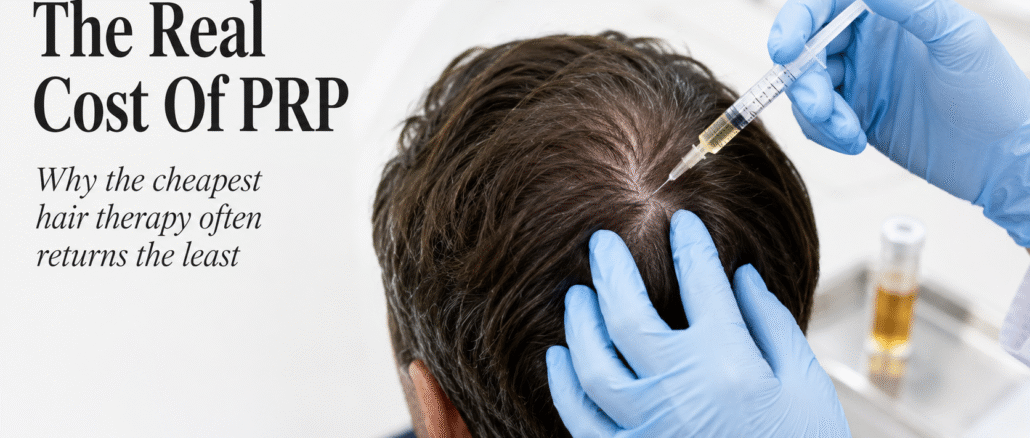

Platelet-rich plasma therapy for hair has moved from a niche regenerative offering to one of the most widely available non-surgical treatments for hair loss in Indian cities. With wider availability has come a more confused conversation. Prices vary by a factor of three across the same city. Outcomes are described in language that ranges from carefully realistic to enthusiastically overstated. Patients trying to evaluate whether PRP is right for them often struggle to find an honest baseline.
The economic logic of the treatment, however, is not actually complex. A clearer picture starts by separating what PRP actually does, what it actually costs, and what realistic outcomes look like over a treatment course.
What PRP Therapy Actually Is
Platelet-rich plasma is a concentrated preparation derived from the patient’s own blood. A sample is drawn, processed in a centrifuge to separate the platelet-rich fraction from the rest of the blood, and the resulting concentrate is injected into the scalp in areas where follicular support is needed.
The therapeutic premise is that growth factors contained in the platelet concentrate stimulate the follicular environment, support weakening follicles, and improve local conditions for hair retention and modest regrowth. Because the material is autologous, drawn from the patient’s own body, the safety profile is favourable when the procedure is performed in a properly equipped clinical setting.
What PRP Can And Cannot Do
Realistic clinical framing has converged across serious practices. PRP can stabilise early to moderate pattern hair loss in many cases. It can support follicles that are weakening but still present. It can complement other treatments and, used appropriately before and after surgical restoration, can improve the longevity of the overall result.
What it cannot do is restore follicles that are no longer there. Once a follicle has miniaturised past a certain point and disappeared, no regenerative therapy will recover it. Patients arriving with expectations that PRP will reverse advanced pattern hair loss are usually disappointed, and responsible clinics tell them so before accepting them for treatment.
The Cost Picture
Pricing varies meaningfully across Indian cities and within the same city across different clinics. Patients researching prp hair treatment cost mumbai will find a spread that reflects differences in preparation protocols, equipment quality, the number of injections per session, the experience of the treating clinician, and what is included in the per-session fee.
A typical treatment course involves three to four initial sessions spaced roughly a month apart, followed by maintenance sessions at intervals the treating clinician determines. The total annual cost is the per-session price multiplied across the course, which makes the per-session figure less useful in isolation than the total expected commitment.
Why The Cheapest Option Often Costs More
PRP preparation is not a uniform process. Different centrifuge protocols produce different platelet concentrations, and different injection techniques distribute the material with very different precision. The lowest-priced offerings sometimes use simpler protocols that produce lower platelet concentrations, fewer injection points, or shorter session durations.
Patients optimising on price alone can end up paying for multiple sessions of a sub-therapeutic version of the treatment, which produces minimal benefit and ultimately costs more than a properly performed shorter course at a better clinic. The economic logic of choosing on quality applies here as much as it does to any other evidence-based medical procedure.
How To Read A Serious PRP Practice
Mumbai practices that approach PRP as evidence-based medicine, such as Kibo Clinics, share several markers with serious centres elsewhere. They use standardised, validated centrifuge protocols. They quantify the platelet concentration their preparations achieve rather than treating it as a black box. The treating clinician performs the injections personally rather than delegating to junior staff. They photograph and track progress at defined intervals, and they tell patients honestly whether the treatment is producing the expected response or whether the plan should be revised.
Casual practices skip most of this. The treatment is performed quickly, the protocol is not discussed in detail, and progress assessment is informal. The cost may be lower, but the value is harder to identify.
Expert Tip
Before starting PRP, ask the clinic two specific questions. What platelet concentration their preparation typically achieves, and how they will measure your response over the course of the year. Clinics that answer specifically are clinics taking the therapy seriously. Clinics that hesitate are usually offering a generic version.
The Honest Takeaway
PRP therapy is a useful, evidence-supported regenerative treatment for the right patient at the right stage of hair loss. It is not a cure, not a substitute for surgical restoration when surgery is genuinely indicated, and not a treatment whose price can be evaluated in isolation from its protocol. The patients who get the most from PRP are the ones who understand its scope, choose a clinic that performs it carefully, and treat it as one component of a longer plan.