
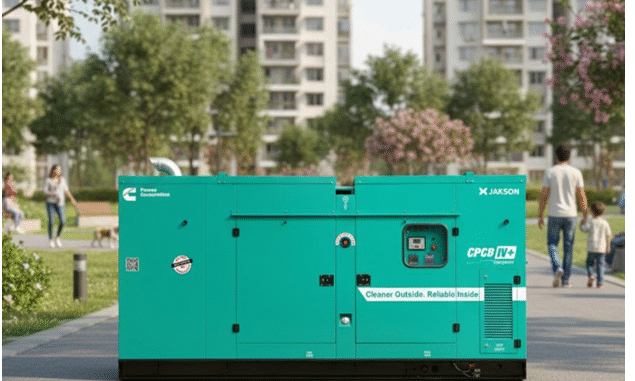

For decades, diesel generators occupied a narrowly defined role in industrial and commercial environments: emergency backup. They were installed, tested occasionally, and expected to perform only when the grid failed. That assumption no longer holds. Across India, diesel generators are increasingly deployed as primary power solutions, not contingency assets. This shift is not cosmetic or marketing-driven; it is rooted in operational reality, grid behaviour, load economics, and risk management.
Industrial facilities, infrastructure projects, and mission-critical operations now demand power that is predictable, controllable, and independent of external volatility. Grid instability, demand surges, geographic constraints, and cost unpredictability have forced decision-makers to rethink traditional power architectures. In this environment, diesel generators, particularly engineered systems offered by manufacturers such as the Jakson group, are no longer “last-resort machines.” They are becoming deliberate, engineered choices for continuous and semi-continuous power delivery.
From Emergency Equipment to Core Power Infrastructure
The evolution of diesel generators into primary power assets has been gradual but decisive. Modern gensets are designed for sustained load handling, thermal stability, and long operational cycles. Engine efficiency, alternator design, control systems, and monitoring capabilities have all advanced to support continuous operation rather than intermittent use.
For many industrial users, especially in regions where grid quality varies or expansion is slow, diesel generators offer a controllable power environment. Voltage stability, frequency control, and load responsiveness are managed internally rather than delegated to an external utility. This level of control is fundamental when power interruptions translate directly into production loss, safety risk, or reputational damage.
Why Industries Are Choosing Diesel as Primary Power
1. Grid reliability is no longer a given
In several industrial corridors and remote locations, grid supply remains inconsistent. Voltage fluctuations, planned outages, and infrastructure bottlenecks disrupt operations that cannot afford downtime. Diesel generators eliminate this dependency and allow organisations to plan production schedules with confidence.
2. High-load equipment requires stable power
Manufacturing lines, heavy machinery, healthcare equipment, and data infrastructure demand stable, uninterrupted power. Diesel gensets are engineered to handle sustained high loads without degradation when properly maintained.
3. Predictability matters more than nominal cost
While grid power may appear cheaper on paper, unplanned downtime carries hidden costs: equipment damage, lost output, labour inefficiency, and contractual penalties. Diesel generators offer cost predictability when evaluated across the full operational lifecycle.
4. Hybrid energy systems rely on diesel stability
Even in renewable-integrated environments, diesel generators play a stabilising role. Solar and storage systems handle variable loads, but diesel gensets provide firm capacity when renewable output fluctuates. In these configurations, the generator is not a backup; it is the backbone.
Maintenance Becomes Strategic, Not Optional
Once a diesel generator is promoted from backup to primary power, maintenance discipline must change accordingly. Casual or reactive servicing is no longer acceptable.
Diesel generator maintenance tips for primary use
Primary-use generators require condition-based maintenance. Oil analysis, coolant chemistry checks, and load performance monitoring must be routine. Engines should not simply be “run periodically”; they should be evaluated continuously against performance benchmarks.
Genset service guide India: operational reality
Indian operating conditions, dust, heat, humidity, and fuel variability demand region-specific servicing strategies. Scheduled inspections must account for environmental stress, not just operating hours. Service intervals should align with duty cycles, not calendar assumptions.
Diesel generator repair in India: speed and competence matter
When generators are primary power sources, repair response time directly affects business continuity. Access to trained technicians, genuine parts, and diagnostic capability is essential. Delayed or improvised repairs introduce cascading risk.
Industrial diesel generator servicing: a different discipline
Industrial servicing focuses on prevention, not reaction. Bearings, belts, turbochargers, and alternator insulation are assessed proactively. Data logs and service histories become decision tools, not paperwork.
Diesel Genset Maintenance Checklist
A structured diesel genset maintenance checklist should include:
- Engine oil condition testing and scheduled replacement
- Coolant level and concentration verification
- Air and fuel filter inspection and replacement
- Battery load testing and electrical connection checks
- Exhaust system inspection and back-pressure evaluation
- Alternator insulation resistance and output stability checks
This checklist is not administrative; it is foundational to uptime.
Why This Shift Will Continue
The transition of diesel generators into primary power roles is not temporary. As energy demand grows faster than grid infrastructure can keep pace and operational risk tolerance declines, industry players like Jakson Group will continue to favour controllable, self-reliant power systems. When engineered correctly and maintained rigorously, diesel generators meet this requirement with proven reliability.
They are no longer just reliable backup power solutions in India. They are deliberate power strategies.
FAQs
- Why are diesel generators used as primary power solutions today?
Because they provide stable, controllable power independent of grid reliability, especially for high-load and mission-critical operations. - How often should a primary-use diesel generator be serviced?
Servicing should be based on operating hours and load conditions, typically every 250–500 hours, with deeper inspections scheduled proactively. - What are the most important diesel generator maintenance tips for continuous use?
Consistent lubrication management, cooling system integrity, fuel quality control, and electrical system monitoring. - Is diesel generator repair in India reliable for industrial users?
Yes, when handled by certified service providers with access to trained technicians and genuine parts. - How does industrial diesel generator servicing differ from backup servicing?
Industrial servicing is preventive and data-driven, whereas backup servicing is largely reactive.