
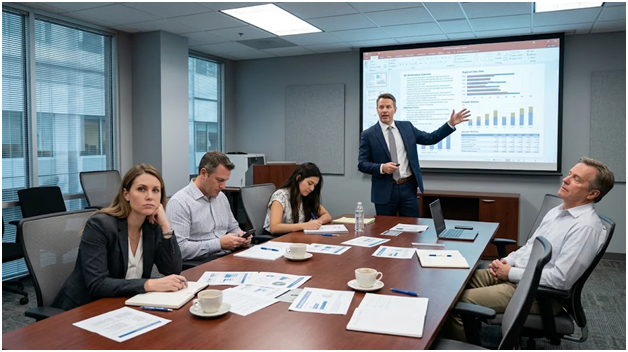

Every week, millions of employees sit through presentations that do nothing but test their patience. A speaker talks, slides flip, and the audience nods or quietly checks their phone. By the time the meeting ends, most of what was said is already forgotten. The problem is not the presenter. It is the format.
Static presentations, the kind where information flows in only one direction are fundamentally misaligned with how people actually engage, learn, and make decisions. And for businesses, the cost of this misalignment is real: wasted meeting time, shallow alignment, poor decisions made without the full picture, and teams that walk away feeling like they were talked at rather than listened to.
The good news is that the problem is not the meeting itself. It is one specific assumption baked into how most meetings are run: that communication is something one person does to a room, rather than something a room does together.
The One-Way Problem
Traditional presentations put one person in control and everyone else in passive mode. There is no mechanism for the audience to signal confusion, share opinions, or push back in real time. Leaders walk away thinking alignment was achieved. Teams walk away feeling like their perspective never entered the room.
People retain far more information when they are actively involved in a discussion rather than passively receiving it. Yet most business meetings are still built around the slide deck as a one-way broadcast tool, a format designed for a pre-digital era that has not kept up with how modern teams actually work.
The deeper issue is that passive presentations do not just fail to communicate they actively create a false sense that communication happened. A leader presents a strategy, the room nods, and everyone leaves with a different interpretation of what was decided. That gap between what was said and what was understood is where execution breaks down.
The Cost of Getting It Wrong
The numbers behind meeting inefficiency are staggering. Organizations waste an estimated $37 billion annually on unproductive meetings, a figure that reflects not just lost time but lost decisions, lost momentum, and lost trust between teams and leadership. According to Harvard Business Review, 71% of senior managers view their meetings as unproductive and just 37% of meetings result in an actual decision.
These are not outlier companies with poor management. These are the average numbers across industries and team sizes. The meeting format itself is systematically producing bad outcomes and the static presentation is at the heart of it. When the structure of a meeting gives all the power to one person and asks nothing of everyone else, disengagement is not a people problem. It is a design problem.
Remote and Hybrid Work Made It Worse
The shift to remote and hybrid work did not solve the engagement problem, it amplified it. When your audience is spread across Zoom windows, the physical cues that once helped presenters gauge the room disappear entirely. Nodding heads, furrowed brows, side conversations all gone. Presenters are left speaking into a void, with no reliable way to know if anyone is actually following along.
The data confirms what most people already feel. According to Calendly’s 2024 State of Meetings report, 52% of employees admit to multitasking often or always during virtual meetings. Flowtrace puts the overall figure even higher 73% of professionals multitask during meetings regardless of format. Someone in a different time zone, joining from a noisy home office, is already fighting distractions before the first slide appears. Without a reason to actively participate, disengagement is not laziness. It is the entirely predictable outcome of a format that asks nothing of them.
And with no real-time feedback mechanism built into most slide tools, most presenters do not even know the gap exists.
What Interactive Presentations Actually Change
The fix is not a better slide template or a more charismatic speaker. It is building participation directly into the presentation itself. When audiences can respond to live polls, submit questions, vote on priorities, or contribute to a word cloud in real time, two things happen: they pay attention, and the presenter gets honest, immediate feedback on what the room actually thinks.
When people feel involved, the dynamic shifts from a lecture to a conversation. Decisions get made with actual input from the room rather than assumptions about what the room thinks. Employees feel their perspective matters because it visibly does. And the data collected during the session, how people voted, what they flagged, what questions they asked becomes a record that outlasts the meeting itself and can inform what happens next.
Where It Makes the Biggest Difference
All-Hands Meetings: A leadership team presents a quarterly update, employees listen, a few pre-screened questions get answered, and everyone logs off. What actually happened? Leadership felt heard. Employees felt managed. Interactive formats change this entirely. A simple “Pulse Check” poll at the start asking employees how confident they feel about the quarter ahead, or what their biggest concern is right now surfaces what the room is actually thinking before a single slide is shown. That changes everything about how the presentation is received.
Sales Presentations: A pitch that talks at a prospect for forty minutes is forty minutes spent not understanding what actually matters to them. Embedding a quick poll early in the presentation asking what their biggest challenge is, or which outcome they care most about gives the presenter live intelligence to adapt in real time. The prospect feels heard from the first slide. That changes the tone of the entire conversation.
Employee Training: Passive training does not work. People sit through it, click through it, and forget it. Quizzes, knowledge checks, and open-ended questions built into the training session itself force active recall, which is one of the most effective learning techniques known. The same content, delivered interactively, produces measurably better retention and far higher completion rates.
The Data Your Meetings Are Already Generating and Wasting
One of the most underappreciated advantages of interactive presentations is what they leave behind. Every poll response, every submitted question, every word cloud contribution is a data point, a real signal from a real person about what they think, what they need, and what they are worried about.
Static presentations generate nothing. The meeting ends, the slides are emailed out, and the organisation has no idea whether the message landed, whether people agreed, or whether the decisions made in the room actually reflected what the team thought. Interactive sessions flip this entirely. Leaders can review post-session data to understand sentiment across departments, track how opinions shift over time, and identify the questions that keep coming up the ones that signal where clarity is missing or trust is low.
In a business environment where decisions need to be faster and more data-informed than ever, the meeting itself becomes a source of organisational intelligence but only if the format allows for it.
Getting Started Without Overhauling Everything
One concern teams often raise is that switching to interactive presentations means learning a whole new tool and starting over from scratch. In practice, the best solutions integrate directly with what you already use. Slidea works alongside PowerPoint, Google Slides, Zoom, and Microsoft Teams so you can add live polls, Q&A, word clouds, and quizzes to your existing presentations without rebuilding anything. With AI-powered slide creation also built in, teams that previously spent hours building decks from scratch are now generating structured, presentation-ready slides in minutes.
For teams that have been stuck in the one-way presentation loop for years, the barrier to change is lower than most expect.
The era of the one-way presentation is not ending because people are getting lazier. It is ending because better options now exist and the organisations still relying on static slides are not just running less engaging meetings. They are making slower decisions, missing what their teams actually think, and leaving the most valuable part of every room, the people in it completely out of the conversation.