

India’s startup ecosystem is the third largest in the world. With over 1.4 lakh registered startups and a growing base of active angel investors and venture capital firms, the opportunity to raise funding has never been more accessible. Yet one obstacle consistently holds promising founders back long before they reach the term sheet stage: a poorly structured business plan presentation.
Having worked with thousands of presentation projects across industries, the pattern is consistent. The business idea is solid. The numbers add up. But the presentation fails to communicate either clearly enough for an investor to act.
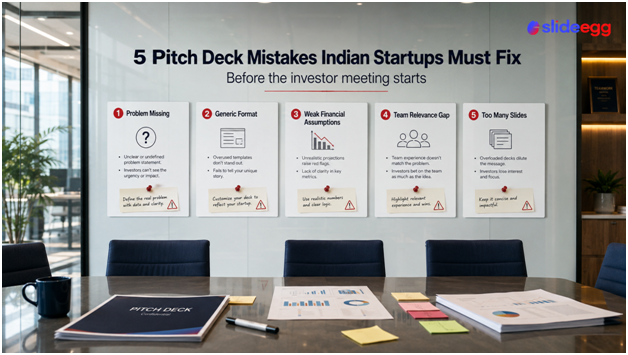
Here are the five mistakes that come up most often — and what to do instead.
- Leading with the solution before establishing the problem
Indian founders frequently open with what their product does. Investors, however, make funding decisions based on the size and urgency of the problem being solved — not the elegance of the solution.
If your first three slides describe your app’s features without first establishing that a painful, widespread problem exists, you’ve already lost the room. Investors are pattern-matching against hundreds of pitches. The mental model they use is: big problem + credible solution + large market = worth my time.
Fix it: Slide 2 should be entirely dedicated to the problem. Quantify it. Show who experiences it, how often, and what it costs them. The solution slide earns its impact only after the problem slide has done its job.
- Using a generic template that doesn’t match the presentation’s purpose
Not all business plan presentations serve the same function. A pitch to an angel investor requires a completely different structure than a presentation for a bank loan, an accelerator application, or an internal strategy review.
Many founders use the same generic slide deck for every audience — leading with vision and market size when pitching for a bank loan (which evaluates repayment capacity, not growth potential) or burying the funding ask in slide 18 of a VC pitch where it should appear on slide 10.
Before building a single slide, define who the presentation is for and what decision you want them to make. Platforms like SlideEgg offer audience-specific business plan templates — startup investor pitch, SBA-style loan plan, corporate strategy deck, nonprofit grant presentation — so founders can start with the right structure for their specific context rather than retrofitting a generic format.
- Financial projections with no visible assumptions
India’s investor community has matured significantly. Angel networks, family offices, and VC firms now review dozens of decks monthly. Sophisticated investors don’t just read your revenue projections — they immediately ask: what assumptions produced these numbers?
A slide showing ₹10 crore ARR by Year 3 with no supporting assumptions reads as guesswork. The same projection with visible assumptions — average revenue per customer, customer acquisition cost, expected churn rate, growth rate basis — reads as a plan.
Fix it: Put your key assumptions on the same slide as your projections, either as a footnote or a supporting column. It signals financial literacy and makes your numbers defensible in a Q&A.
- A team slide that lists titles instead of relevance
Indian founders frequently present team slides that list names, photos, and titles. What’s missing is the answer to the only question investors actually have: why is this team uniquely qualified to solve this specific problem?
A founder with 8 years in supply chain logistics launching a B2B logistics SaaS is a compelling story. A founder with a general MBA and “passion for entrepreneurship” launching the same company is not. The team slide must connect each person’s background directly to an unfair advantage in the specific domain.
Fix it: Replace generic title descriptions with one line of relevant evidence per team member. Not “Co-Founder & CEO” but “Co-Founder & CEO — previously led operations at Delhivery, scaled 3 warehouse networks from 0 to ₹50Cr GMV.”
- Slide count that signals poor editing
Indian startup presentations frequently run 25–35 slides. This is almost always too long for an investor pitch context. Experienced investors make initial judgments in 10–15 minutes. A 30-slide deck signals that the founder hasn’t done the hard work of prioritization.
For investor pitches, 10–12 slides is the target. Every slide beyond that needs to justify its existence. If information can be moved to an appendix that investors can request, move it. The core deck should communicate the entire investment thesis in the time it takes to drink a cup of chai.
The format is the first impression
In India’s increasingly competitive funding environment, presentation quality directly signals operational quality. An investor who sees a cluttered, poorly structured deck makes an immediate judgment about how that founder will communicate with their team, their customers, and their board.
Furthermore, leveraging interactive presentation tools like Slidea for live polls and Q&As instantly signals that a presentation is dynamic and prepared for engagement, not just a static read-through.
Getting the structure right before walking into any investor meeting isn’t a cosmetic detail — it’s table stakes.
Frequently Asked Questions
How many slides should a business plan presentation have for Indian investors?
For angel investors and early-stage VCs in India, aim for 10 to 12 slides. This covers the core thesis — problem, solution, market size, business model, traction, team, financials, and funding ask — without overloading the reviewer. Anything beyond 15 slides should be moved to an appendix that investors can request separately. Indian accelerator programs like Y Combinator India, Sequoia Surge, and Elevation Capital consistently see the strongest pitches in the 10–12 slide range.
What is the difference between a business plan presentation and a pitch deck?
A pitch deck is a short (10–12 slide) document designed to generate investor interest and secure a follow-up meeting. A business plan presentation is more comprehensive (15–25 slides) and is used when a stakeholder needs the full picture — bank loan applications, government grant committees, accelerator deep dives, or internal board reviews. The pitch deck is the hook; the business plan presentation is the detail behind it.
What should a business plan presentation include for Indian angel investors?
Indian angel investors typically evaluate: the size of the problem (is this a real pain point in the Indian or global market?), the founding team’s domain credibility, early traction or validation (even pre-revenue signals), a realistic revenue model with unit economics, and a clear funding ask with a use-of-funds breakdown. Market size slides should reference Indian market data where relevant — TAM stated in USD for a global opportunity, or in INR for a domestic play.
How do I present financial projections in a business plan presentation?
Show a 3-year projection with Year 1, Year 2, and Year 3 revenue figures. Use a bar chart for growth trajectory — it communicates faster than a table. Critically, show your assumptions on the same slide: average revenue per customer, expected customer count, churn rate, and growth rate basis. Investors will immediately ask where the numbers come from. Having assumptions visible on the slide answers the question before it’s asked and signals financial discipline.
Should I send a business plan presentation as a PowerPoint file or PDF?
For email submissions to investors before a meeting, send as PDF — it preserves formatting across devices and prevents accidental editing. For the live meeting itself, present from PowerPoint or Google Slides so you can navigate fluidly. Keep both versions ready. If an investor asks for the deck after the meeting, send the PDF version with a clear file name: CompanyName_InvestorPitch_2026.pdf.
How long should a startup pitch presentation take in India?
Most Indian investor meetings are structured as 20–30 minute sessions. Plan your presentation to run 12–15 minutes, leaving 10–15 minutes for questions. Founders who fill the entire 30 minutes with slides leave no room for the conversation — and the conversation is where investment decisions actually happen. Practice your deck until you can deliver the core pitch in under 15 minutes without rushing.