
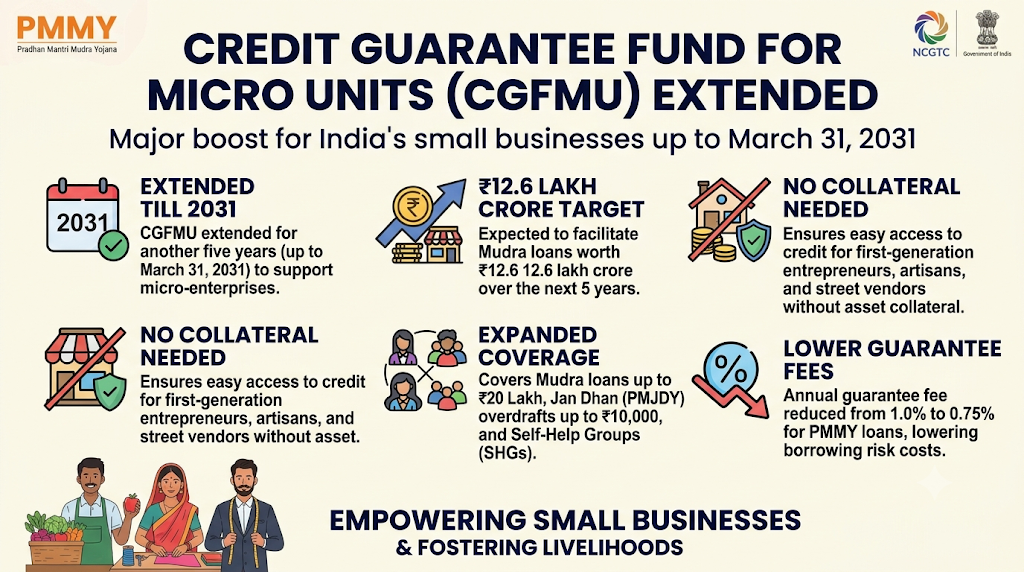
New Delhi, Nov 12: In a major boost to India’s small business sector, the Union Cabinet, chaired by Prime Minister Narendra Modi, has approved the continuation of the Credit Guarantee Fund for Micro Units (CGFMU) for another five years, up to March 31, 2031. The decision is expected to facilitate Pradhan Mantri Mudra Yojana (PMMY) loans worth ₹12.6 lakh crore during the extended period, strengthening access to formal credit for small entrepreneurs across the country.
The approval carries particular significance for millions of aspiring business owners who often struggle to secure bank loans because they lack property, assets or other collateral. From a small grocery shop owner and a street vendor to a tailor, artisan or first-generation entrepreneur, access to institutional finance can make the difference between abandoning a business idea and turning it into a sustainable source of income.
Launched in January 2016, the CGFMU has played an important role in supporting the growth of the Mudra lending ecosystem by providing credit guarantee coverage to lending institutions through the National Credit Guarantee Trustee Company Limited (NCGTC). The guarantee mechanism helps banks and other eligible lending institutions manage the risk of lending to micro enterprises without conventional collateral.
According to the government’s figures, as of September 2026, more than 60.36 crore loans amounting to ₹43.34 lakh crore have been sanctioned by lending institutions since the launch of PMMY. The latest Cabinet decision seeks to build on this lending network and extend its reach to more small businesses during the 2026-27 to 2030-31 financial years.
Under the continued scheme, credit guarantee support will cover eligible loans of up to ₹20 lakh extended to micro enterprises under PMMY. It will also cover overdrafts of up to ₹10,000 provided through Pradhan Mantri Jan Dhan Yojana (PMJDY) accounts and eligible loans to Self-Help Groups (SHGs) with portfolio exposure ranging from ₹10 lakh to ₹20 lakh.
In another important measure, the annual guarantee fee for eligible PMMY lending will be reduced from 1 per cent to 0.75 per cent. This reduction is expected to lower the cost of guarantee protection for lending institutions and support the continued flow of credit to micro enterprises. For SHG loans, the existing fee structure will remain unchanged, at 0.25 per cent during the first year and 0.50 per cent in subsequent years.
The guarantee coverage will also be linked more closely to the actual credit exposure of lending institutions. For working capital facilities, it will be linked to the disbursed amount, while for term loans it will be based on the outstanding amount. This approach is intended to make the guarantee mechanism more responsive to the actual risk faced by lenders.
Beyond loans, a push for livelihoods
The significance of the decision goes beyond banking figures. For a person looking to establish a small manufacturing unit, expand a neighbourhood shop, purchase equipment for a service business or develop a home-based enterprise, timely access to finance can open the door to economic independence.
Micro enterprises are an important part of India’s employment and local economic ecosystem. Their growth can create jobs within communities, support local suppliers and strengthen economic activity in smaller towns, semi-urban centres and rural areas.
The extension of CGFMU is expected to encourage banks and financial institutions to continue extending credit to borrowers who may otherwise find it difficult to access formal finance. It also reinforces the role of PMMY in promoting self-employment, entrepreneurship and financial inclusion.
With a proposed lending facilitation target of ₹12.6 lakh crore over the next five years, the government aims to strengthen the foundation of India’s micro-enterprise economy. The broader objective is to ensure that a lack of collateral does not become a permanent barrier for people seeking to build their own businesses.
As India moves towards 2031, the continued credit guarantee framework is expected to remain an important instrument in transforming small business aspirations into viable enterprises, livelihoods and employment opportunities.
