
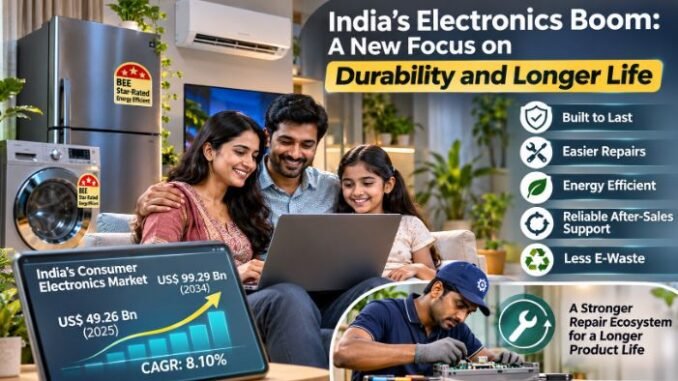
As India’s consumer electronics market expands, buyers are looking beyond attractive features and low prices. Durability, reliability, energy efficiency and affordable repairs are emerging as important factors influencing purchasing decisions, opening new business opportunities for manufacturers and service providers.
India’s consumer electronics market is growing rapidly, transforming the way millions of households live, work and communicate. From smartphones and smart televisions to refrigerators, washing machines and air conditioners, electronic products have become an essential part of everyday life.
But as more Indians invest in consumer electronics, their expectations are also changing. Consumers are no longer interested only in buying the latest devices or upgrading to products with advanced features. Increasingly, they want products that perform reliably, require fewer repairs and remain useful for several years.
This shift is creating a new direction for India’s electronics industry, where product longevity and after-sales support could become just as important as technology and design.
India’s consumer electronics market is projected to grow from approximately US$49.26 billion in 2025 to US$99.29 billion by 2034, registering an annual compound growth rate of 8.10%. Rising incomes, urbanisation, digital adoption, expanding 5G connectivity and growing demand for smart appliances are supporting this expansion.
However, the next phase of growth will not simply be about selling more products. It will also depend on how effectively manufacturers respond to consumers who increasingly value quality, durability and long-term ownership costs.
Consumers are willing to pay more for quality
A noticeable change is taking place in the purchasing habits of Indian households. Many consumers are increasingly prepared to spend more on products that offer better performance, stronger build quality and dependable service.
In the smartphone segment, premium devices are attracting buyers looking for better cameras, improved battery performance, faster processors and longer software support. Similarly, consumers purchasing televisions and household appliances are paying greater attention to product quality, energy efficiency and brand reliability.
For a family buying a refrigerator or an air conditioner, the decision is no longer based entirely on the initial price. Electricity consumption, maintenance expenses, warranty coverage and the availability of spare parts also influence the purchase.
This is encouraging manufacturers to compete on overall product value rather than relying exclusively on discounts and attractive specifications.
Repairability is becoming a consumer priority
One of the biggest frustrations for electronics consumers is discovering that a relatively minor fault can make an otherwise functional product expensive or difficult to repair.
A damaged smartphone battery, a faulty television component or a malfunctioning washing machine circuit board can sometimes lead to substantial repair expenses. In some cases, consumers choose to replace the entire product because spare parts are unavailable or repair costs are too high.
This situation is gradually increasing interest in affordable repair services, accessible spare parts and transparent after-sales policies.
The government has also taken steps to encourage a stronger repair ecosystem. The Department of Consumer Affairs has been promoting the Right to Repair initiative, which seeks to improve consumer access to repair information, services and spare parts.
In May 2025, a committee recommended a Repairability Index framework for smartphones and tablets. Such an approach could help buyers understand how easily a product can be repaired before making a purchase.
For manufacturers, repairability presents an opportunity to build consumer trust. Products designed for easier maintenance and component replacement could enjoy a competitive advantage in an increasingly quality-conscious market.
India’s manufacturing growth needs deeper localisation
India has made considerable progress in establishing itself as a major electronics manufacturing destination. Government initiatives such as Make in India and the Production Linked Incentive scheme have encouraged domestic production and attracted investment in electronics manufacturing.
Domestic electronics production increased from approximately ₹1.9 lakh crore in 2014–15 to around ₹12 lakh crore in 2024–25. Electronics exports have also expanded significantly, reaching approximately ₹3.3 lakh crore in 2024–25.
However, assembling products within the country and manufacturing their critical components domestically are two different things.
India continues to have opportunities to strengthen its domestic capabilities in semiconductors, printed circuit boards, displays, batteries and other electronic components. Greater local sourcing could reduce supply-chain vulnerabilities, improve component availability and support the growth of domestic repair and maintenance services.
This is particularly important for product longevity. Even a well-designed electronic device can become difficult to maintain if essential replacement components are unavailable or expensive.
Energy efficiency matters beyond the purchase price
Electricity consumption is becoming another important consideration for households purchasing electronic appliances.
Air conditioners, refrigerators and washing machines are among the products where operating costs can significantly influence long-term ownership expenses. Consumers are therefore paying closer attention to energy ratings and efficient technologies.
The Bureau of Energy Efficiency’s star-labelling programme helps buyers compare the energy performance of appliances. Periodic improvements in efficiency standards also encourage manufacturers to develop products that consume less electricity.
Smart technology is adding further possibilities. Connected appliances can offer energy monitoring, fault notifications and remote diagnostics, potentially helping users identify problems before they become serious.
However, technology alone cannot guarantee a longer product life. Reliable hardware, timely software updates, affordable repairs and continued manufacturer support remain equally important.
5G and smart homes are opening new opportunities
The expansion of 5G connectivity is supporting India’s transition towards connected homes and digital lifestyles.
Smart televisions, connected security systems, intelligent air conditioners and app-controlled household appliances are becoming increasingly visible in the Indian market.
For manufacturers, these technologies create opportunities to offer remote maintenance, predictive fault detection and personalised customer support.
Imagine an air conditioner alerting its owner that a filter needs cleaning or a connected appliance notifying a service centre about a possible technical fault. Such features could make maintenance easier and reduce unexpected breakdowns.
At the same time, manufacturers must ensure that connected products continue to receive software support. An appliance may remain physically functional for years, but unsupported software or discontinued online services can reduce its usefulness.
E-waste creates another business opportunity
The growing use of electronic devices also brings an environmental challenge. As households replace smartphones, televisions and appliances, the volume of discarded electronics continues to increase.
Repairing, refurbishing and reusing electronic products can help reduce unnecessary waste while creating new commercial opportunities.
India’s electronic waste management framework places greater responsibility on manufacturers and other stakeholders for the collection and environmentally sound processing of discarded electronic products.
This is encouraging the development of organised recycling, refurbished electronics, component recovery and repair businesses.
The refurbished electronics market is particularly promising because it offers consumers access to devices at more affordable prices while extending the useful life of products that might otherwise be discarded.
For entrepreneurs, this creates opportunities in repair centres, spare-parts distribution, certified refurbishment and electronic waste management.
After-sales service could become a major competitive advantage
As consumers spend more on electronics, their expectations from brands are also increasing. A good product experience does not end when the customer leaves the showroom. It continues through installation, maintenance, repairs and warranty support.
Manufacturers with dependable service networks, trained technicians, transparent repair charges and readily available spare parts are likely to earn stronger customer confidence.
This is especially important beyond major metropolitan cities, where access to authorised service centres and skilled technicians can still be limited.
Expanding repair infrastructure in smaller towns and rural markets could therefore become an important business opportunity while creating employment for technically skilled young people.
The next big opportunity is to make electronics last
India’s consumer electronics industry is entering a new phase in which success will depend not only on innovation but also on reliability and customer satisfaction.
Consumers want advanced products, but they also want the confidence that their investment will deliver value over time. Manufacturers that focus on durable design, repair-friendly products, energy efficiency, longer software support and strong after-sales services could stand out in an increasingly competitive market.
The shift towards longer product life also has wider economic implications. It can reduce household replacement expenses, create skilled repair-related employment, support small businesses and encourage more responsible use of resources.
For India’s electronics industry, the opportunity is therefore much bigger than selling the next smartphone or smart appliance.
The real competitive advantage of tomorrow may belong to companies that do not just sell more electronics, but build products that consumers can trust for longer.
