

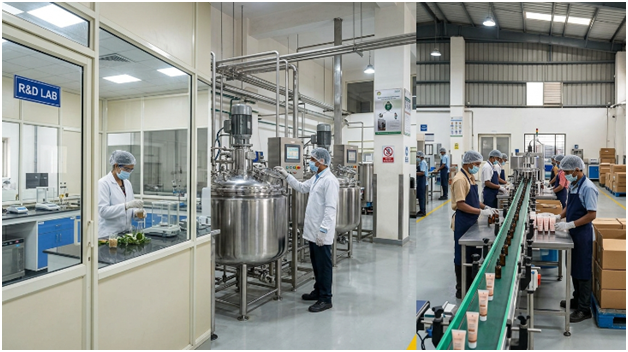
The skincare industry in India has grown significantly, with consumers increasingly looking for products that are effective, safe, and suited to different skin types. Behind every face cream, serum, cleanser, moisturizer, and body-care product is a detailed manufacturing process that involves research, formulation, testing, production, quality control, and packaging.
For brands planning to launch their own skincare range, understanding how products move from an initial concept to a finished product can help them make better manufacturing decisions. This is where experienced skin care products manufacturers in India play an important role by combining formulation expertise, manufacturing capabilities, quality standards, and packaging solutions.
1. Understanding the Product Concept
The manufacturing journey begins with a clear product concept. A skincare brand first determines what it wants to create and who the target customers are.
For example, a brand may want to develop:
- Face cleansers
- Moisturizers
- Sunscreens
- Face serums
- Body lotions
- Face creams
- Hair and scalp care products
- Exfoliating products
- Natural or herbal skincare products
The target skin type, consumer preferences, price range, product benefits, and intended market all influence the formulation and manufacturing process.
A well-defined product concept helps manufacturers understand the required ingredients, texture, fragrance, packaging format, and production requirements.
2. Research and Ingredient Selection
Once the product concept is finalized, the next stage is selecting suitable ingredients. Manufacturers evaluate ingredients based on their intended function, compatibility, stability, safety, and suitability for the product.
Depending on the formulation, ingredients may include botanical extracts, moisturizing agents, vitamins, antioxidants, emollients, preservatives, cleansing agents, and other cosmetic ingredients.
Ingredient sourcing is particularly important because the quality of raw materials can directly affect the performance and consistency of the finished product.
Reliable manufacturers generally work with established suppliers and conduct appropriate checks on incoming raw materials before they enter production.
3. Formulation and Product Development
Formulation is one of the most important stages of skincare manufacturing. Cosmetic formulators combine different ingredients in carefully controlled proportions to create the desired product.
The formulation process considers factors such as:
- Product texture and consistency
- Skin feel
- Absorption
- Stability
- Appearance
- Fragrance
- Ingredient compatibility
- Expected shelf life
- Packaging compatibility
For example, developing a lightweight facial serum requires a different formulation approach from creating a rich body butter.
Manufacturers may create several laboratory samples before arriving at a formulation that meets the brand’s requirements.
4. Testing and Quality Evaluation
Before moving into large-scale production, the formulation needs to undergo appropriate testing and evaluation.
Depending on the product, manufacturers may assess physical characteristics such as appearance, colour, odour, viscosity, and pH. Stability evaluation can also help determine how the formulation performs under different environmental conditions over time.
Microbiological quality is another important consideration for many cosmetic products, particularly those containing water.
Testing helps manufacturers identify potential formulation issues before the product reaches commercial production. It also supports consistency and quality throughout the product’s intended shelf life.
5. Pilot Batch and Manufacturing Scale-Up
After the formulation is finalized, manufacturers may produce a pilot batch. This smaller production run helps determine whether the formulation performs consistently when manufactured using production-scale equipment.
Scaling up a formula from laboratory quantities to commercial production is not always straightforward. Mixing speed, temperature, processing time, equipment design, and order of ingredient addition can influence the final product.
Experienced manufacturers carefully control these parameters to achieve consistency between development batches and commercial batches.
6. Large-Scale Production
Once the formulation and manufacturing process are approved, production can begin.
Depending on the type of skincare product, the manufacturing process may involve:
- Weighing and dispensing raw materials
- Preparing the required phases
- Mixing or homogenizing ingredients
- Heating or cooling where required
- Adding active or sensitive ingredients at appropriate stages
- Adjusting the formulation
- Performing quality checks
- Transferring the finished bulk product for filling
Manufacturing facilities need appropriate equipment and controlled processes to produce consistent batches efficiently.
7. Quality Control During Production
Quality control does not happen only at the end of manufacturing. Checks may be performed at multiple stages throughout production.
Quality teams monitor factors such as raw material quality, batch specifications, processing parameters, and finished product characteristics.
Proper documentation and batch records are also important because they help manufacturers maintain traceability and consistency.
For skincare brands, working with a manufacturer that follows structured quality processes can reduce the risk of inconsistencies between batches.
8. Choosing the Right Packaging
Packaging is more than just an attractive outer layer. It protects the product and can influence its stability, usability, and shelf life.
Skincare products may be packaged in:
- Jars
- Tubes
- Pump bottles
- Dropper bottles
- Airless containers
- Sachets
- Sprays
- Bottles with dispensing caps
The packaging material needs to be compatible with the formulation. Certain ingredients may interact with particular packaging materials, while products that are sensitive to air or light may require more protective packaging.
Brands should therefore consider both aesthetics and functional requirements when selecting packaging.
9. Filling, Labelling and Final Packaging
After the bulk product passes the required quality checks, it is transferred to the filling stage.
Automated or semi-automated equipment can be used to fill products into their respective containers. The containers are then closed, labelled, coded, and prepared for secondary packaging where applicable.
Labels should provide applicable information required under Indian cosmetic regulations, such as the product name, ingredients, quantity, batch details, manufacturing information, usage instructions where applicable, and other mandatory particulars.
Accurate labelling is essential because it helps consumers understand how to use the product and provides important product identification information.
10. Final Quality Checks and Dispatch
Before finished products leave the manufacturing facility, final inspections and quality checks are performed according to the manufacturer’s procedures.
Products may be checked for:
- Correct filling
- Packaging integrity
- Label placement
- Batch coding
- Product appearance
- Quantity
- Overall packaging quality
Once the finished goods are approved, they can be packed into shipping cartons and prepared for distribution.
The Role of a Reliable Skincare Manufacturing Partner
Choosing the right manufacturing partner can have a significant impact on the success of a skincare brand. A capable manufacturer can support multiple stages of product development, from formulation and ingredient sourcing to manufacturing, quality control, filling, and packaging.
Brands such as Kamicka Organics can be considered when exploring skincare manufacturing solutions and developing products aligned with specific brand requirements.
When evaluating skin care products manufacturers in India, businesses should look beyond pricing alone. Manufacturing experience, formulation capabilities, quality processes, customization options, production capacity, packaging support, communication, and compliance should all be considered.
Conclusion
The journey from a skincare product idea to a finished product involves considerably more than simply mixing ingredients and filling containers. It requires careful formulation, ingredient selection, testing, controlled manufacturing, quality checks, appropriate packaging, and accurate labelling.
India’s cosmetic manufacturing ecosystem provides brands with opportunities to develop customized skincare products for different markets and consumer needs. By partnering with an experienced manufacturer and maintaining clear quality expectations throughout the process, brands can create skincare products that are consistent, reliable, and aligned with their customers’ expectations.
Whether you are launching your first skincare product or expanding an existing product range, understanding the manufacturing process can help you choose the right partner and build a stronger foundation for your brand.