

The digital economy is expanding at a pace that is forcing governments around the world to rethink how businesses should be taxed. For India, the issue has become increasingly important as cloud computing, artificial intelligence, digital platforms, fintech, virtual assets and cross-border online services become closely connected with everyday economic activity.
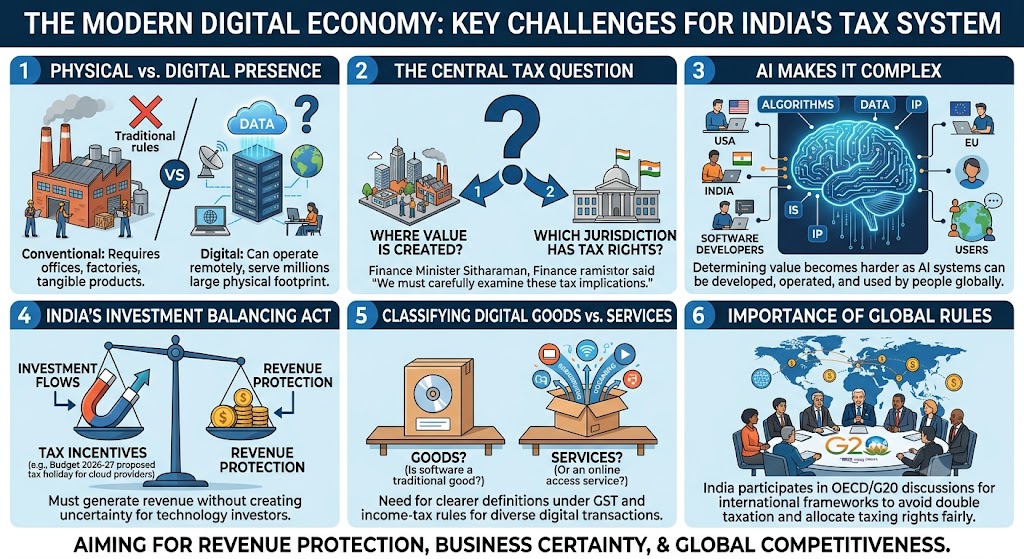
Unlike traditional businesses, digital companies do not always need a large physical presence in the markets they serve. A technology company can develop its intellectual property in one country, operate its digital infrastructure from another and serve millions of customers across several markets.
That business model creates a fundamental tax question: where is the economic value created, and which jurisdiction should have the right to tax it?
Finance Minister Nirmala Sitharaman has called for these questions to be examined carefully, particularly because tax decisions can influence investment flows, business expansion and India’s competitiveness as a technology destination.
Why Digital Taxation Is Different
Conventional tax systems were largely built around physical locations, offices, factories, employees and tangible products. Digital businesses operate differently.
A cloud provider, for example, can supply computing and storage services to customers without establishing a conventional business operation in every market. Similarly, an online platform can earn revenue from Indian consumers while much of its technology, intellectual property and corporate structure may be located outside the country.
This makes it harder to apply traditional concepts such as permanent establishment and place of business.
The challenge becomes even greater when artificial intelligence enters the picture. AI companies can generate value from algorithms, data, computing power and intellectual property, while the people developing and using those technologies may be spread across different countries.
Tax authorities therefore need frameworks that reflect how value is actually created in a modern digital economy.
India’s Investment Balancing Act
For India, digital taxation is not simply about collecting revenue. It is also closely linked to the country’s ambition to attract global investment in technology and digital infrastructure.
India is competing for investments in areas such as data centres, cloud computing, semiconductor manufacturing, artificial intelligence and global technology services. Tax policy can influence the cost of setting up and expanding such operations.
The Union Budget 2026-27, for instance, proposed a tax holiday until 2047 for eligible foreign companies providing global cloud services using data-centre services from India, subject to specified conditions. The measure is aimed at strengthening India’s position as a global cloud infrastructure hub.
Such policy measures illustrate the wider challenge facing policymakers: taxation must generate appropriate revenue without creating uncertainty that could discourage productive investment.
The AI Factor
Artificial intelligence is likely to make digital taxation even more complicated.
An AI-driven business may depend on data collected in several countries, computing infrastructure located elsewhere and software developed by teams spread across different regions. Revenue may then come from customers worldwide.
Determining how much value belongs to each jurisdiction could become increasingly difficult.
The same questions are emerging around robotics, automated services, digital marketplaces and the gig economy. As technology reduces the importance of physical distance, tax rules will need to evolve accordingly.
Digital Goods and Services
Another area requiring greater clarity is the classification of digital transactions.
Traditional products and services are relatively easy to distinguish. Digital businesses, however, frequently combine software, subscriptions, online access, data and services into a single offering.
For businesses, uncertainty over whether a transaction should be treated as a good or a service can create additional compliance requirements and the possibility of disputes.
A clearer framework under GST and income-tax rules could make it easier for companies to understand their obligations and plan investments with greater confidence.
Global Rules Matter
India cannot address digital taxation entirely on its own because technology companies operate across borders.
The country has participated in international discussions on reforming taxation of the digital economy, including the OECD/G20 two-pillar framework. These negotiations seek to address challenges arising from digitalisation and establish clearer rules for allocating taxing rights among countries.
For India, the international dimension is particularly important. The country is simultaneously a major consumer market and one of the world’s leading exporters of information technology and professional services.
A balanced international framework can help reduce the possibility of multiple jurisdictions taxing the same income while giving countries greater clarity over their legitimate taxing rights.
What Businesses Need
For companies, the biggest requirement is often not a lower tax rate but predictability.
Businesses making investments in technology infrastructure need to know how their income will be treated, what documentation will be required and how cross-border transactions will be assessed.
This is particularly important for start-ups. Young technology companies often operate internationally from an early stage, and complicated tax rules can increase compliance costs just as they are trying to expand.
Clear rules, simplified procedures, faster dispute resolution and consistent interpretation can therefore become important components of India’s investment environment.
A Wider Economic Opportunity
The digital taxation debate also needs to be viewed in the context of India’s broader economic transformation.
Digital payments, e-commerce, cloud services, online education, fintech and technology-enabled professional services are creating new forms of economic activity. These businesses generate employment, attract investment and create opportunities for smaller companies to reach customers beyond their traditional markets.
A well-designed tax framework can help formalise this activity while providing businesses with the confidence to grow.
For the government, the objective is to ensure that the expanding digital economy contributes fairly to public revenues. For businesses, the priority is to operate under rules that are clear, stable and practical.
Building a Tax System for the Digital Era
India’s tax system is entering a phase in which technology and taxation can no longer be treated as separate policy areas.
Cloud computing, AI, digital platforms, virtual assets and cross-border services are changing the way economic value is created. Tax policy will have to keep pace with those changes without placing unnecessary barriers in the way of investment and innovation.
The future of digital taxation will therefore depend on finding a workable balance between revenue protection, business certainty, global competitiveness and technological growth.
For India, that balance could be particularly important as the country seeks to strengthen its position as a global hub for technology, services, innovation and digital infrastructure.