

New Delhi, Sep 16: India and New Zealand are moving towards a deeper economic partnership after New Zealand’s Parliament approved the legislation required to implement their free trade agreement (FTA). The development brings the two countries closer to putting in place a trade framework aimed at lowering tariffs, improving market access and creating new opportunities for businesses.
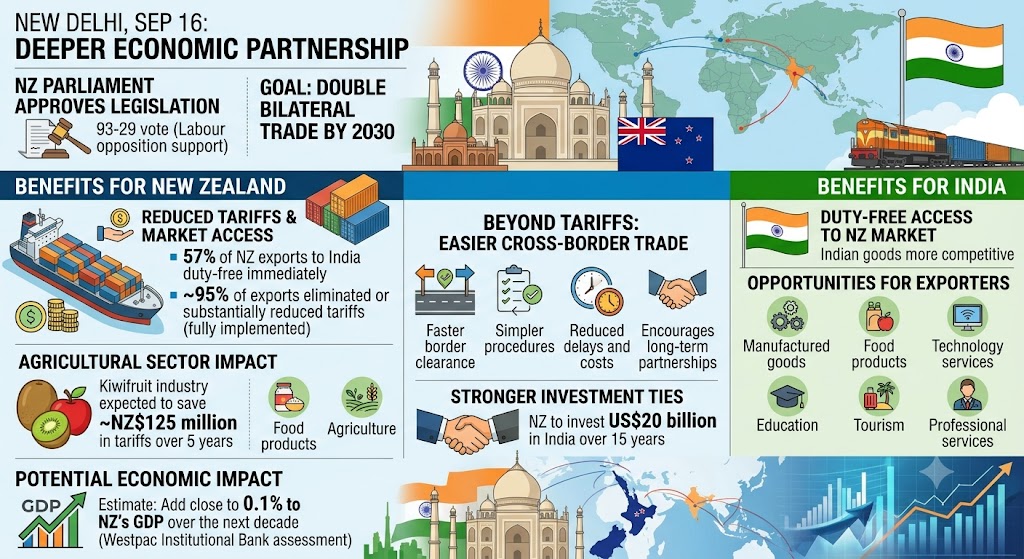
The legislation was approved by the New Zealand Parliament with a 93-29 vote, receiving support from the opposition Labour Party. The agreement will come into effect after both countries complete their respective domestic ratification procedures.
For businesses, the most significant change will be the reduction of trade barriers. About 57 per cent of New Zealand’s exports to India are expected to become duty-free when the agreement takes effect, while tariffs on around 95 per cent of New Zealand exports to India are expected to be eliminated or substantially reduced once the agreement is fully implemented.
The agreement also provides an important opening for Indian exporters. Indian goods will receive duty-free access to the New Zealand market, potentially making products from India more competitive and giving companies greater scope to expand their exports.
Greater opportunities for exporters
The trade agreement is expected to benefit a wide range of industries. Agriculture and food products are likely to be among the prominent areas of trade, while opportunities are also expected to emerge in technology, education, tourism and professional services.
For New Zealand’s agricultural sector, lower tariffs could make a meaningful difference to export costs. The country’s kiwifruit industry, for example, is expected to save around NZ$125 million in tariffs over five years under the agreement.
For Indian companies, improved access to New Zealand could create opportunities to expand the export of manufactured goods, food products, technology-related services and other products covered by the agreement.
Focus on easier cross-border trade
The pact goes beyond tariff reductions. It is also intended to make trade between the two markets more efficient through improved procedures and faster border clearance.
For businesses, simpler procedures can help reduce delays and trade-related costs. This could be particularly useful for smaller companies looking to enter overseas markets but facing higher compliance, logistics and distribution costs.
The agreement could also encourage businesses to develop longer-term partnerships rather than treating the two markets only as destinations for individual exports.
India offers a large growth market
India’s large consumer base and expanding economy make it an important market for New Zealand companies. Growing demand across food, education, tourism, technology and professional services could provide additional avenues for New Zealand businesses.
At the same time, Indian companies can gain from stronger access to the New Zealand market and potentially use the country as a gateway for developing commercial relationships in the wider region.
The two countries have set an objective of doubling bilateral trade by 2030, giving the FTA a broader role in their economic relationship.
Scope for stronger investment ties
The agreement is also expected to support investment and closer private-sector cooperation. New Zealand has committed to investing US$20 billion in India over the next 15 years, according to the terms outlined for the partnership.
Greater investment can complement trade by encouraging companies to establish partnerships, expand supply chains and explore opportunities in sectors where both economies have complementary strengths.
Two-way trade between India and New Zealand stood at around US$2.29 billion in the year ended June 2026. The relatively modest trade base also leaves considerable room for businesses on both sides to expand their presence.
Potential economic impact
The potential benefits of closer economic ties have also drawn attention from financial institutions. A Westpac Institutional Bank assessment estimated that the trade agreement could add close to 0.1 per cent to New Zealand’s GDP over the next decade.
The impact will ultimately depend on how quickly businesses take advantage of the new market-access opportunities and how effectively the agreement is implemented.
With New Zealand’s parliamentary approval now secured, the focus shifts to completing the remaining domestic procedures in both countries. Once the agreement becomes operational, businesses will have a clearer framework for expanding exports, developing partnerships and exploring new investment opportunities.
For India and New Zealand, the agreement represents more than a reduction in tariffs. It provides a platform for building a broader commercial relationship, with the potential to connect businesses, strengthen supply chains and increase economic engagement over the coming years.